
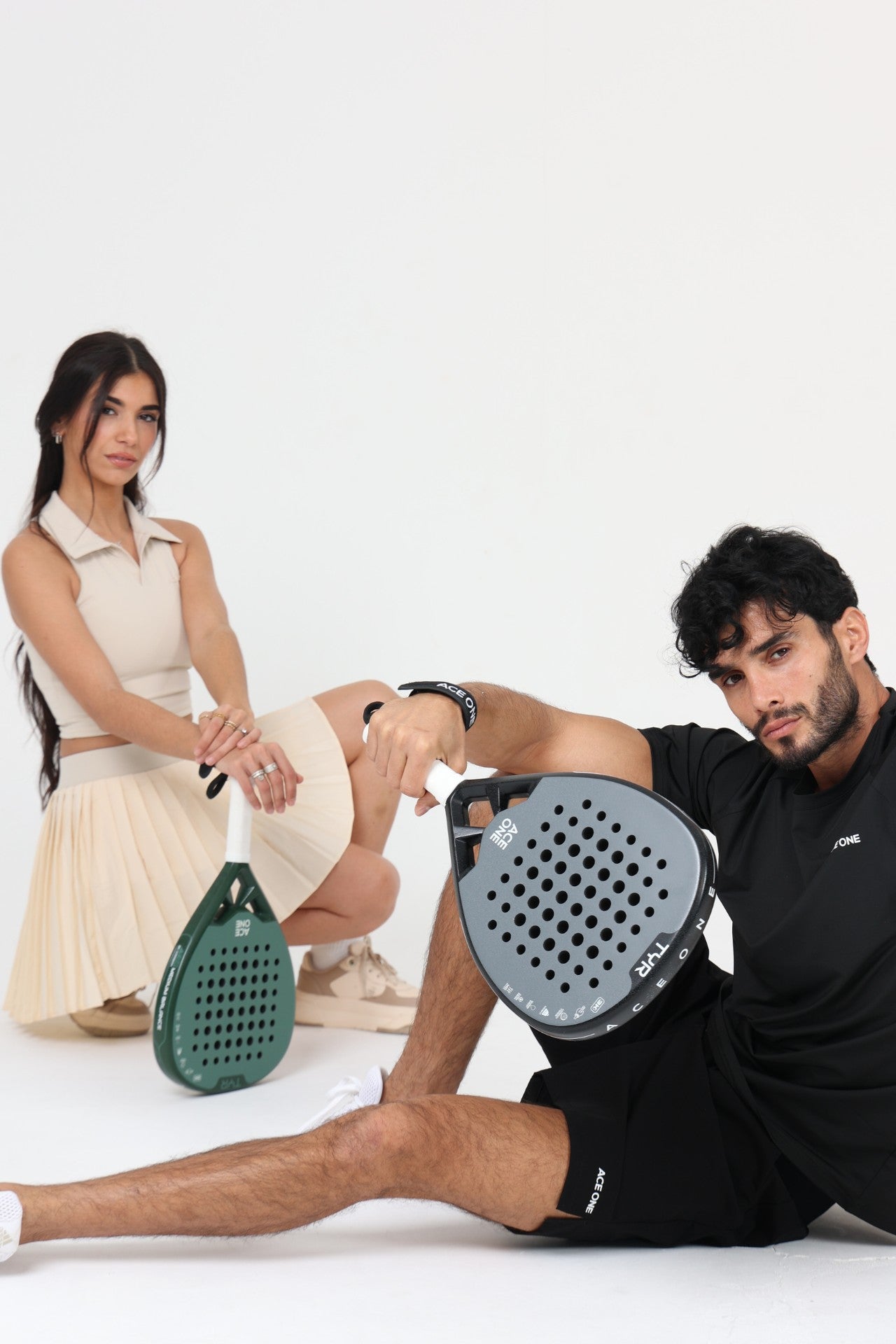
It is 7:42 a.m. Saturday morning. Your match is on Court 3 at 8:30. You are still on the highway, your partner has not texted back, your overgrip is the one you taped on three weeks ago, and your only padel bag is the one you take to club night. You are not late. You are just not ready. The first tournament is not lost on the first serve. It is lost in the hour before it.
This guide is the checklist almost no amateur uses on their first competition day. It orders your preparation in time, not in things. Most beginner gear lists tell you what to bring. This one tells you when to do what.
TL;DR
- Time, not things: prepare on a timeline (T-7 days through T-0), not on a packing list.
- Arrive ninety minutes early: thirty for admin, thirty for warm-up, thirty for nerves. Not one of them is optional.
- Two rackets, four overgrips, one note card: the tournament-day inventory that survives a cracked frame, a sweated grip, and a missed score call.
- The 15-minute warm-up: five minutes of mobility, ten minutes on-court, finishing with three serves. Skip it and you give away the first three points.
- The 30-second team script: agreed before warm-up, in front of the bench. Sides, serve order, the one shot you trust. That is the entire pre-match plan you need.
What a club padel tournament actually looks like
Most amateur events use one of three formats. Group stage plus knockout is the standard: four to six pairs play a round robin of one-set matches, then the top two advance to a bracket. Americano rotates partners every round and counts points individually. Pozo, the Spanish "well" format, runs every court at once and players climb or drop courts between short matches.
Your first tournament is almost certainly group plus knockout. Expect three to four matches if you reach the bracket, two if you do not. Matches use standard padel scoring, often with a 7-point super-tiebreak in place of the third set. The new Star Point scoring rule may or may not be in effect at your local club. Ask at registration.

The 7-step pre-tournament checklist
Each step is anchored to a specific time before the first serve, not to a list of objects. Follow them in order and the morning of takes care of itself.
Step 1 (T-7 days): confirm the pair, the format, the first match time
Text your partner. Confirm the date is still blocked. Re-read the registration email and write down format, expected match length, first match time, venue address. Set a calendar alert for T-90min. If the venue uses a club app, install it now, not on Saturday morning.
Step 2 (T-3 days): pre-pack your tournament bag
Not your gym bag. A dedicated tournament inventory: two rackets, four fresh overgrips, padel shoes worn in but not worn out, two clean kits, water, electrolytes, a small towel, a snack, sunscreen, and one folded note card with your score-tracking grid. Three days early is the window where missing items are still orderable.
Step 3 (T-24 hours): sleep, hydration, the last drill
Hydrate steadily across the day. Eat a normal carb-balanced dinner. Sleep seven to eight hours. Earlier in the day, do one drill only, not a full session. Twenty minutes of mini-tennis to volleys to three serves. Wake up the swing, do not fatigue the arm.
Step 4 (T-90 minutes): arrive, register, scout the court
The step amateurs skip and pay for. Walk in ninety minutes early. Confirm your name on the draw, get your court number. Walk to the court, stand on it, look at the surface, the wall, the lighting. Sit on your bench. Breathe. The court is no longer unfamiliar.
Step 5 (T-30 minutes): the 15-minute warm-up plus the 30-second team chat
Fifteen minutes is enough if it is structured. Five minutes of mobility and activation. Ten minutes on-court: four minutes mini-tennis, three minutes baseline drives, two minutes volleys, three full serves to close. Then sit. Pull your partner aside. Have the 30-second team conversation: who plays which side, who serves first, the one shot you both trust under pressure.
Step 6 (T-5 minutes): the bench script
Tighten your laces twice. Refresh the overgrip if morning humidity has softened the old one. Look at your partner and say one sentence: "We trust the lob and the cross-court return." That is your plan. Anything more is wishful thinking, anything less is improvisation.
Step 7 (T-0): the first 3 points routine
You will not win the tournament in the first three points. You can lose it. Be the first to call the score. Be the first to call "mine" or "yours." Be the first to acknowledge a good shot. You are not playing better than your nerves yet. You are choosing not to play worse.
The tournament-day bag (different from your everyday bag)
Your everyday club bag is built around one racket and one session. A tournament bag is built around three to four matches across four to six hours, in unfamiliar weather, with no chance to drive home for a forgotten item. The full breakdown lives in our padel bag essentials checklist and our pro travel bag guide. For a first tournament, three additions distinguish the inventory.

First, a backup racket. A cracked frame mid-bracket ends your tournament early. Second, four overgrips in a sealed pack. Humidity destroys an overgrip in a single hot match, and a soft handle in a quarterfinal turns a clean smash into a frame mishit. Third, a score-tracking card. Write the bracket grid out the night before. Knowing exactly what record qualifies you for the knockout removes one layer of in-match anxiety.
The wrong-prep trap: three ways amateurs sabotage their first tournament
Beginner tournament regret comes in three predictable shapes. Name them now, dodge them on the day.
Trap 1, "I've played for years, I'll arrive twenty minutes before." Club nights and tournaments are different sports. The parking lot, the registration line, the wait for a court all eat into your window. Twenty minutes becomes five, and you play your first match as your warm-up. Arrive ninety minutes early. Read a book in the cafe if you have time to spare.
Trap 2, "I'll break in a new racket on tournament morning." The temptation to treat yourself on the day is real and ruinous. A fresh frame has unfamiliar weight, unfamiliar balance, an overgrip you have not gripped through ten matches. Your debut should be on the racket you played your last six sessions with. Buy the new frame, play three sessions with it, then bring it to a draw.
Trap 3, "We'll figure out our strategy on the court." Improvisation is a luxury for partnerships with a hundred matches together. For a first tournament, your partner communication script needs to be set before warm-up. Sides, serve order, one trusted pattern. Three decisions. Thirty seconds. That is the entire plan a beginner pair can hold under pressure.
Your warm-up: the 15-minute routine before the first match
Fifteen minutes is enough if it activates the body and rehearses the swing. Skip it and you give away the first three games to stiff shoulders. The Padel School and the LTA Padel converge on four phases: mobility, activation, shot rehearsal, closing serves.
| Phase | Duration | What you do | Why it matters |
|---|---|---|---|
| Mobility | 3 min | Hip openers, shoulder rotations, neck circles | Unlocks the joints you will overload |
| Activation | 2 min | Jumping jacks, calf raises, walking lunges | Pulse up, blood to the legs |
| Mini-tennis | 4 min | Service-box rally, half pace | Re-times the eye to the ball |
| Baseline drives | 3 min | Cross-court forehands, then backhands | Wakes up the swing path |
| Volleys | 2 min | Mid-court reflex volleys | Tunes the racket face at the net |
| Serves | 1 min | Three full serves to each box | Closes the warm-up on a confident swing |
The rules cheat sheet: what your beginner opponent might not know
Most first-tournament confusion is rules, not technique. Four edge cases come up almost every match.
One: the serve must bounce on your side first, then cross diagonally into the receiver's service box. A let on the net is replayed indefinitely under standard 2026 FIP rules. Two: a ball that hits the wall on your side after a single bounce is still in play. Three: a double bounce on the ground ends the point, even if the second bounce is on the wall first. Four: a partner-called fault counts as a fault for the team. If your partner calls "out" and the ball was in, the point goes to your opponent. Calls are a team commitment.
What your kit asks of you
Tournament kit is a function of the role you take on court. Four profiles map to four Ace One Padel solutions.
The first-tournament player without a competition kit should start with the Pack Performance bundle: a Cøre 12K racket, a 3-pack of PRO-LINE overgrips, a PRO-LINE backpack. One delivery, the entire tournament-day kit ready to play.
The right-side defender (placement-first) who relies on lobs and consistency should pick a TŸR 3K racket. The 3K weave gives the longest dwell time on contact, the forgiveness you want when nerves shorten the swing.
The left-side closer who wants to finish overheads should choose the Cøre 12K Carbon. The 12K weave is rigid and fast, the frame that converts smashes when the bracket opens up.
The day-of consumable is the PRO-LINE Overgrip 3-pack: one fresh layer before warm-up, one between matches, one spare. Three overgrips, three matches, no soft handle on a tight backhand.
Frequently asked questions
How long should my first padel tournament last in total time?
Expect four to six hours at the venue for a typical Saturday club event. Group stage is usually two to three matches of 45-60 minutes, with 20-30 minute rest windows between. If you make the knockout bracket, add one to two more matches.
What if my regular partner cancels last minute?
Most clubs maintain a waiting list of solo entrants. Ask the tournament director at registration. If you pair with someone you do not know, accept it and use Step 5 (the 30-second team chat) to align on sides and serve order. A stranger partner is not a disaster. A missed first match is.
Should I bring my own padel balls?
No. Tournament organisers supply match balls (usually a fresh pressurised tube per match). Bring practice balls if you want to warm up off-court, but not for the match itself.
How nervous is "too nervous" before a first match?
A trembling hand and a fast pulse are normal and helpful. Nausea, blurred vision, or an inability to focus on the warm-up are signs you have skipped sleep and the arrival window. The cure is mechanical, not mental: more time at the venue, a slower warm-up, three deep breaths between every serve.
The Ace One Padel Verdict
Your first tournament will not be won by hitting harder. It will be won by arriving earlier, packing the night before, and saying one sentence to your partner before the first serve. The match is a sport. The morning is a routine. Most amateurs lose to the morning, not to their opponents.
The first tournament is not the first match. It is the seven days before it. Pack the night before. Arrive ninety minutes early. Speak in the first thirty seconds. The first tournament is not won at 8:30. It is won at 7:42.
Share:
Padel Shot Selection: The Master Decision Flow That Picks Bandeja, Vibora or Smash in 1.4 Seconds (2026 Guide)
Padel Swingweight: Why a 365-Gram Racket Can Feel Like 380 (Or 350) in Your Hand (2026 Guide)