
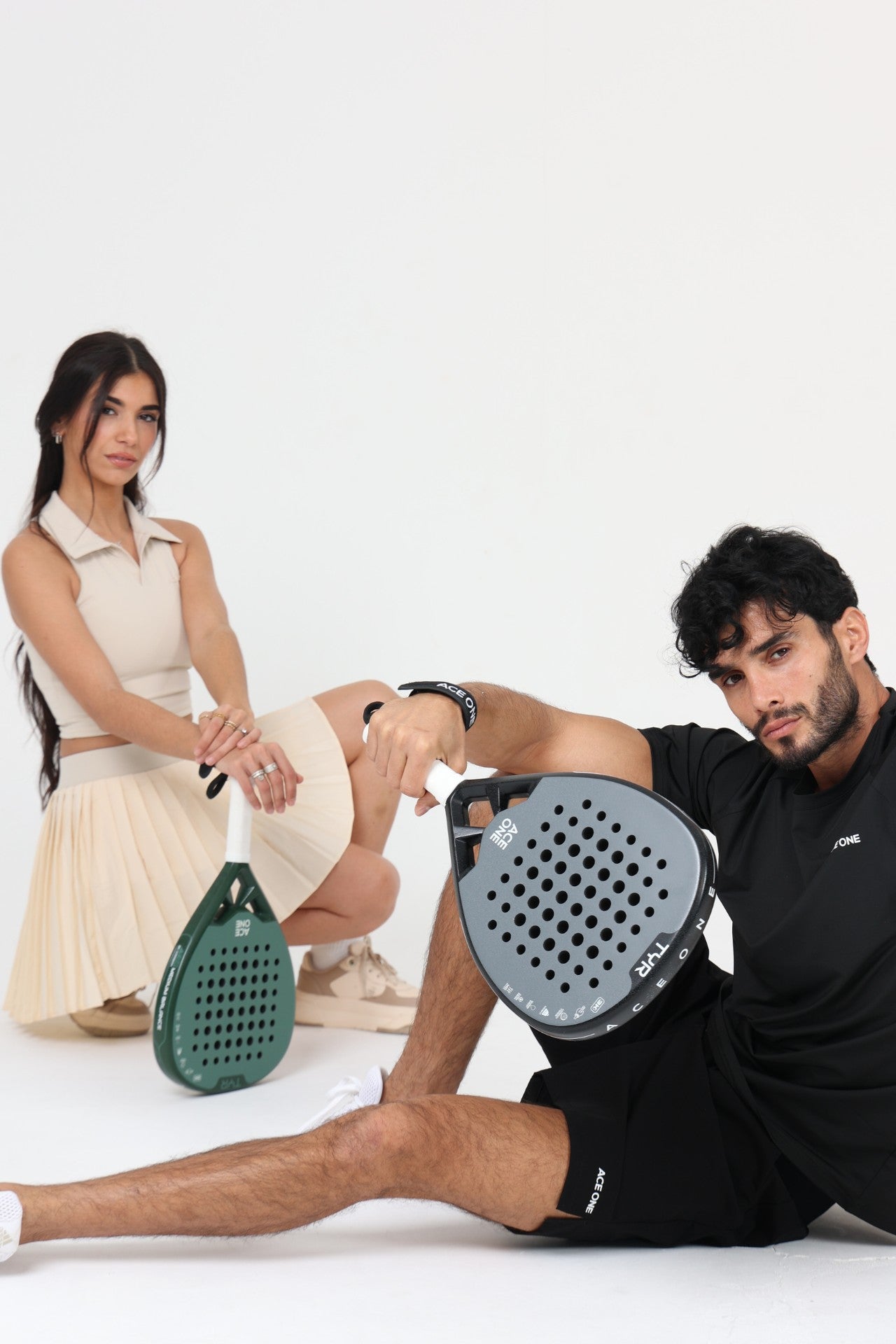
In six days, the 2026 Premier Padel tour kicks off in Asunción before rolling into Buenos Aires the following week. Touring pros will fly with two suitcases each. One holds clothes. The other holds rackets, gear, and the eight or nine items that turn a hotel room into a working tournament base. That second bag is the closest thing professional padel has to a uniform piece of equipment.
If you have ever shown up at a club tournament with a single overgrip and a racket that just spent two hours in a 35°C car boot, you are not packing for padel. You are packing for a casual hit. Pros pack differently because they have learned the consequences of every shortcut. This guide breaks down what they actually carry, and which pieces a Saturday club player should copy.
TL;DR
- Three rackets, not one: pros pack at least two playing rackets and one spare. The spare is insurance against a cracked frame and a humidity swing, not a luxury.
- Thermal compartment is non-negotiable: heat above 30°C softens the EVA core and steals power. A thermal-lined backpack is the single biggest gear-protection upgrade you can buy.
- Four overgrips minimum: humid courts kill a fresh grip in 8 to 10 hours of play. A weekend tournament burns through more than you think.
- The lost-baggage kit lives in carry-on: one racket, one pair of shoes, two overgrips, one match outfit. If your hold bag does not arrive, you can still play round one.
- What pros pack is not aspirational, it is mechanical: every item solves a real problem they have already lost a match over. Copy the logic, not the brand.
Three forces shape a pro travel bag
The classic amateur bag holds one racket, two grips that should have been changed weeks ago, and a half-empty bottle. It works for a Tuesday at the club. It collapses the moment the schedule includes a flight, a transfer, and three matches on day one. Pros pack against three failure modes a club player rarely meets.
Time on the route. Door to court is rarely under six hours, often closer to twelve. The bag must function as carry-on, hotel locker, courtside tool kit. Every item that cannot survive being grabbed twenty times in three days gets cut.
Temperature swing. A racket that ships in a 5°C cargo hold then crosses a 38°C tarmac handles a 30-degree spread in two hours. The EVA core does not enjoy that. Heat softens the foam and the racket loses sting; cold makes it brittle and the frame is one mishit from a crack. A thermal-lined compartment keeps that physics in check.
Lost-baggage worst-case. Airlines mishandle roughly seven bags per thousand passengers. Over forty flights a season, the math is not theoretical. Pros split their setup so that if the hold bag goes missing, they can play round one with what is on their back.

Tier 1: core gear (the non-negotiable layer)
Strip away every smart add and every premium accessory, and you are left with the seven items below. If any are missing on tournament morning, the day is already compromised.
- Two playing rackets. Same model is fine. The point is redundancy: a hairline frame crack at 4-3 in the third set is the kind of problem only a backup solves.
- Padel shoes matched to the surface. Herringbone or omni for outdoor clay courts, smooth or low-profile for fast indoor surfaces.
- Match outfit plus a dry change of clothes. A wet shirt between matches is a fatigue accelerator and a back-tightness trigger.
- Two overgrips minimum (full maths in our overgrip frequency guide).
- Water bottle (1 L, two if outdoors).
- One full-size towel, one courtside towel.
- Sweatband. Padel is wrist-driven. Sweat down the forearm shortens an overgrip's life by a third.
Every Ace One Padel kit we ship, including the Pack Performance bundle, is built around this baseline. Anything less is not a player kit, it is a souvenir.
Tier 2: travel-specific layer (what amateurs forget)
This layer turns "I packed for padel" into "I packed for travel padel". Each item solves a problem that does not exist on a Tuesday at home but materialises the moment you leave your time zone.
- Thermal-lined racket compartment: a thermal cover or a backpack with a built-in thermal pocket. The difference between a racket that arrives in playing condition and one that needs an hour to wake up.
- Multi-tool with mini-scissors: trimming overgrip ends, cutting tape, opening a stubborn ball tube.
- Roll of athletic tape: finger blisters, a tweaked wrist, extending a worn racket by another tournament.
- Plug adapter and power bank: phone for the draw, watch, courtside speaker.
- Match documents and small cash: printed schedule, ID, insurance card, 50 € in local currency.
- Lip balm and travel sunscreen: weight-cheap, rescue an entire outdoor day.
- Sealed wet kit bag: one zip-lock for sweat-soaked shirts so they do not contaminate the rest.
Why four overgrips, not one
A fresh perforated overgrip lasts roughly 8 to 10 playing hours indoors. Outdoor heat or hand humidity drops that to 5 or 6 hours. A weekend with three matches on Saturday and two on Sunday adds up to 7 to 8 hours of court time. That is two grips minimum, three if humid, four if you run both rackets through the weekend. The cost of one extra PRO-LINE perforated overgrip is two euros. The cost of slipping mid-volley because the grip glazed over is a match.

The lost-baggage kit
One principle separates a touring player from a weekend traveller: if your hold bag does not arrive, what is the minimum kit you need to play round one? The answer fits in a backpack carry-on. One racket (your primary), one pair of padel shoes, two overgrips, one full match outfit (shorts, shirt, two pairs of socks), sweatband. Six items, and you can step on court with the rest missing and still compete. Everything else can be replaced at the venue.
Tier 3: pro-only additions
This is where the touring pro diverges from the high-level club player. You may not need any of it. Each item earns its place in a 30-tournament season, and at least one is worth copying at amateur level.
- Three to four rackets across the weave / core mix: typically two 12K for power days plus one 3K for control days (full breakdown in our 3K vs 12K guide).
- Compression sleeves and recovery layers: calf sleeves, elbow strap, foam-roller stick.
- Branded laundry bag: same bag, same pocket, same item every day. Removes morning friction at 7am wake-ups.
- Video tool: small phone tripod or fence-clip mount. Amateur players who copy this single habit progress measurably faster.
- Performance nutrition: electrolyte tabs, between-match gels, a clean carb option for 8am misfires.

Hand luggage vs hold: the racket conundrum
Most full-size padel racket bags exceed European budget-carrier cabin limits (typically 55 × 40 × 20 cm). A six-racket tournament bag is closer to 75 cm long and goes in the hold. A backpack with one to two racket pockets stays in cabin. The choice is not what you prefer, it is what the route allows.
| Bag type | Rackets | Cabin or hold? | Best for |
|---|---|---|---|
| Padel backpack (1-2 racket pocket) | 1 to 2 | Cabin | Day trip, weekend single-venue, lost-bag kit |
| Medium racket bag | 2 to 3 | Cabin (carrier-dependent) | Weekend tournament, single-airline trips |
| Large pro tour bag (thermal) | 4 to 6 | Hold | Multi-tournament swing |
| Backpack plus soft case combo | 2 cabin + 2-3 hold | Both | Pro split: redundancy if hold is lost |
The pro split is the bottom row. Two rackets in cabin, two to three in hold. If the hold bag goes missing, round one is still playable. Our PRO-LINE padel backpack is built for the cabin half: padded racket compartment, ventilated shoe pocket, laptop sleeve, cabin-friendly footprint.
How to pack the bag (5 layers)
Order matters. A bag that is right in content but wrong in layout still slows you down at every queue.
- Top (grab in seconds): phone, ID, schedule, lip balm.
- Mid: match outfit, sweatband, towel rolled tight.
- Side pockets: water bottle, sunscreen, multi-tool, plug adapter, cash. Each in a dedicated pocket.
- Racket compartment: thermal-lined, head-down, frame-protector on. Pad with your match shirt if space allows.
- Shoe compartment: ventilated and separate. Never with clean clothes.
The first time it feels over-engineered. By the third tournament, it is muscle memory and your warm-up starts on time. Weight matters too: a standard 12K Carbon racket weighs around 360 g, and a 3-racket setup pushes past a kilogram once protectors and grips are factored in (full maths in our racket weight guide).
The Ace One Padel Verdict
At Ace One Padel, we have watched enough club players show up with a bag designed for a Tuesday hit to know the gap is not gear, it is logic. Pros do not pack more stuff. They pack against more failure modes: heat, lost luggage, humid courts, dead grips, second-set dehydration. Every item is solving a problem they have already lost a match over.
Two truths. First: a pro padel travel bag is not a flex, it is a checklist audited by every weekend gone wrong. Second: you do not need every tier to start ranking up. Get Tier 1 right and add one Tier-2 item per tournament until your kit stops being the variable that costs you matches.
Three filters before you zip the bag. Pack for the route, not the match. Pack for the worst weather, not the forecast. Pack for the bag that does not arrive, not the one that does. Once those run, the contents look obvious: the same bag a Galán or a Coello carries, sized to your season.
Our PRO-LINE padel backpack is built around the lost-bag kit principle: two-racket compartment, ventilated shoe pocket, laptop sleeve, cabin-friendly footprint. Pair it with a pack of PRO-LINE perforated overgrips and you have covered the two consumables most amateurs travel without. For a full kit-builder bundle with the Cøre 12K racket and a TŸR control racket from our rackets collection, see the Pack Performance bundle.
For more, see our padel bag essentials checklist and the Premier Padel 2026 #1 race, plus the official Premier Padel 2026 calendar. Whether you are flying to a tournament or driving to your Saturday club match, the bag you pack is the first match you play.
Share:
Padel Star Point Scoring 2026: How FIP's New Rule Replaces Golden Point and Endless Advantages
How to Play Off the Back Glass in Padel: The Defensive Reset That Wins Long Rallies (2026 Guide)