
Your first padel match. 0-0. You step up to serve, drop the ball, swing, and it clips the net cord and lands cleanly in the box. Your opponents stand still. Did you lose the point? Did you replay? In tennis you would already know. Padel rules are close enough to feel familiar but different enough to trip up every beginner in the same three places.
This guide covers every padel serve rule that still applies in 2026, what the FIP changed on January 1, the technique step by step, and the silly mistakes that quietly lose amateurs three or four points per match.
TL;DR
- Underhand only: ball dropped, bounced once, struck at or below your waist. No exceptions.
- The 2026 FIP foot rule: only one foot now needs to stay behind or on the service line at impact. Easier forward push.
- Net cord = let, not fault: as long as the ball lands in the diagonal box, you replay. There is no limit to consecutive lets.
- Side-fence trap: if the ball clips the net then hits the side fence before its second bounce, that is a fault, not a let.
- The serve is a key, not a weapon: it opens the point, it does not close it. Move to the net immediately after impact.
How a padel serve works, and the 6 rules that make it legal in 2026
A padel serve is the only time in the game you must hit the ball below your waist. You stand behind the baseline, drop the ball so it bounces in your own service area, then strike it diagonally into your opponent's service box. The ball must clear the net, land in the correct box, and not strike the back fence before its second bounce. Two attempts per point: first fault, you serve again. Double fault, your opponents win the point.
- Underhand contact at or below waist height. The most enforced rule at every level. If your contact point is even slightly above the navel, the umpire will call it.
- The ball must bounce first. You drop the ball, it bounces once on the ground, and only then do you strike. Tossing-and-hitting is illegal.
- One foot behind or on the service line at impact. The relaxed 2026 rule. The other foot is free to step forward.
- You stand inside the imaginary lateral lines of the service box. No drifting sideways past the side glass.
- Diagonal target box. Right-hand court serves to the opposite right box, left to left. After every point switch sides, after every game switch the serving team.
- The ball cannot strike the back fence on the fly. If your serve bounces in the box then hits the back fence (or the back-side corner) before its second bounce, it is a fault.
That last rule traps more first-timers than any other. You hit a fast flat serve, watch it land near the service line, and assume you played a clean ball, only to learn that the ricochet into the back fence handed your opponents a free point.
What actually changed in the 2026 FIP update
The International Padel Federation published a revised rulebook in December 2025, applicable from January 1, 2026. The official FIP rules document spells out two service-related modifications that matter to every player picking up a racket this year.
The one-foot rule (the relaxation)
Until 2025, both feet had to remain behind or on the service line at the moment of impact. The 2026 text now says one foot is enough. The other foot can step forward, weight can transfer, the body can project toward the net. Practically, this rewards an aggressive server: anchor the back foot, push off, lean into the contact, arrive at the net half a second sooner. For beginners the takeaway is even simpler. Stop worrying about the front foot.
The imaginary service line extension (the tightening)
The FIP also clarified the path your ball must take before contact. The service line now has an "imaginary extension" projected sideways, and the ball must not cross it before you strike. The change is mostly about giving umpires an unambiguous reference for tight calls. As an amateur, if you drop the ball cleanly in front of your back foot, you will never come close to violating it.
The beginner serve technique, step by step

1. Set the grip: continental, the same as a volley
Hold the racket as if you were shaking hands with the throat. The "V" formed by your thumb and index finger should sit on the top-left bevel for a right-hander. This is the continental grip, used for the volley, the smash, and every overhead. Learn it once, use it everywhere. A worn or sweat-saturated overgrip ruins this fundamental: if your racket twists in your hand at impact, the issue is the grip surface, not your technique. We covered the symptoms in the overgrip replacement frequency guide.
2. Drop the ball, do not toss it
Hold the ball loosely in your non-dominant hand at hip height. Open your fingers and let it fall. You are not tossing, not flicking, not steering. The ball should bounce in front of your back foot, knee-high or lower at the apex. If it climbs above your waist, you have lost the point before swinging.
3. Swing under the waist, weight forward
Stand sideways, dominant foot back, non-dominant foot toward the net. As the ball reaches contact, transfer weight from back to front, rotate the hips, meet the ball with a smooth low-to-high motion. Aim for the diagonal corner. With the new 2026 rule, the front foot can lift and step forward. Use that.
4. Move to the net immediately
The single most expensive amateur habit is admiring a good serve from the baseline. As soon as the ball leaves the racket, take two steps forward. Padel is a net-game, your service team owns the net by default, and you give that advantage away every time you stay back. The bandeja and víbora overheads exist precisely because you have already moved up. We break both shots down in the bandeja guide and the víbora guide.
Lets, faults, and the surprises that cost beginners points
The biggest source of beginner confusion is the difference between a let and a fault. A serve that touches the net cord and still lands in the correct service box is a let. You replay it, with no limit on consecutive lets. The exception is what makes things confusing.
| Scenario | Verdict | Action |
|---|---|---|
| Ball clips net, lands in box, plays out normally | Let | Replay the same serve number |
| Ball clips net, lands in box, then hits side fence before second bounce | Fault | Use second serve |
| Ball lands in box, then strikes the back fence on the fly | Fault | Use second serve |
| Ball lands in the wrong service box | Fault | Use second serve |
| Server's foot lifts and lands in front of the line before contact | Foot fault | Use second serve |
| Contact point above the waist | Fault | Use second serve |
| Receiver is not ready when ball is struck | Replay | Serve again, no fault counted |
Most common amateur faults, in order: contact above the waist, the side-fence-after-net trap, the back-fence trap on flat serves, foot lifting before contact, serving to the wrong box after a switch. None are technique problems. They are awareness problems, fixed by slowing the routine before the drop.
Three serve variations worth learning (and one to skip)
- The flat serve. Your default. Smooth contact, depth into the box, body weight forward. The aim is placement, not pace. A flat serve at 70% pace into the corner is more useful than 100% pace down the middle.
- The slice serve. Brushing the side of the ball with a continental grip generates side-spin, the ball curves away from the receiver and into the side glass at an awkward angle. Pros use it to force a wall return that sets up the bandeja. Worth learning once your flat serve hits 80% in-box.
- The body serve. Aimed straight at the receiver's hip on the dominant side. Crowds the contact, takes away the angle, particularly effective against tall players.
- The "topspin serve" (do not bother). Tennis topspin needs a high contact point and a brushing low-to-high path. Padel forces contact below the waist, which mechanically prevents real topspin. Skip it.
Choosing a racket that forgives your serve

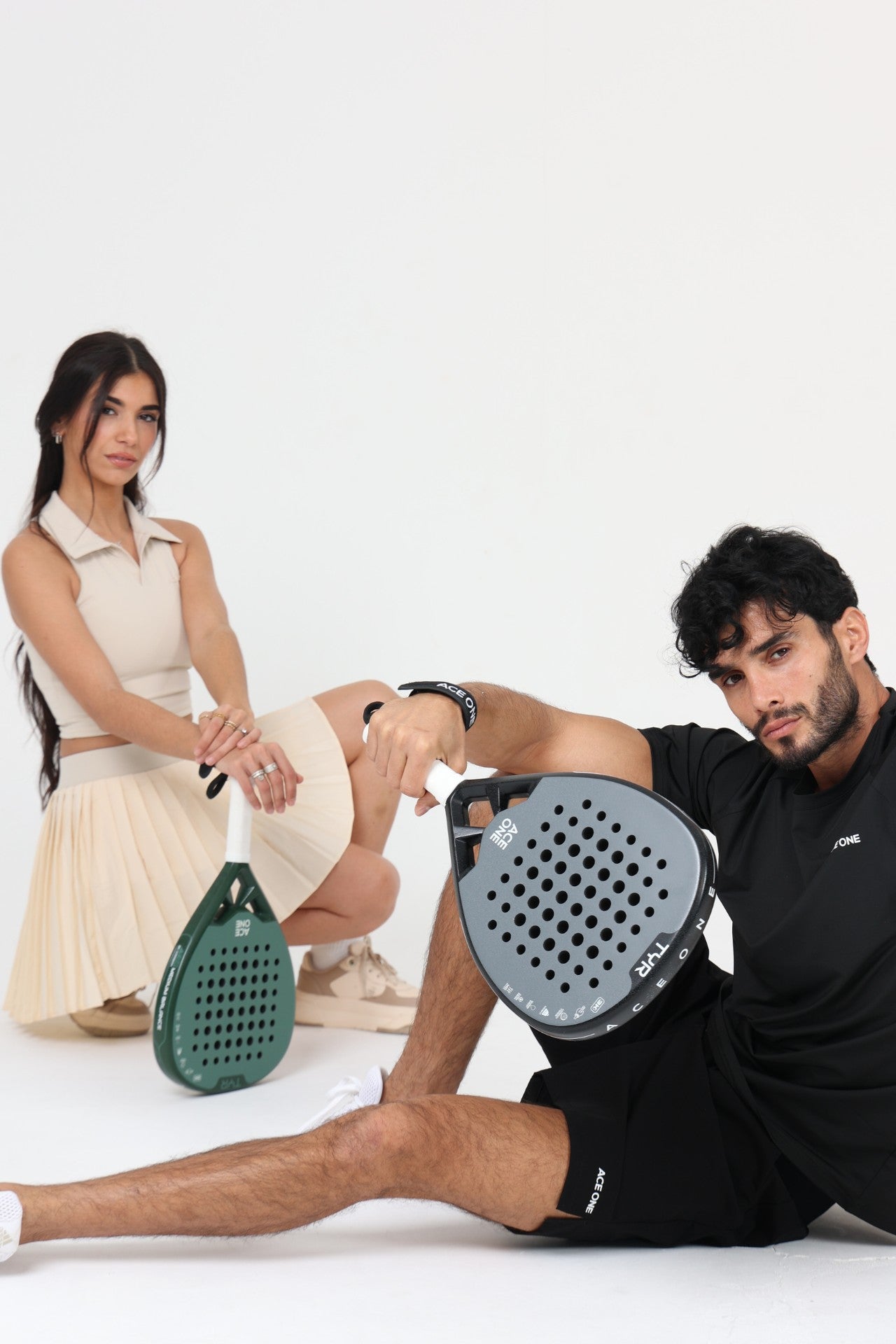
A serve is a contact point. A wider, more forgiving contact point puts more first serves in the box, which means more rallies, which means more learning. Round-shaped frames with a 3K carbon weave and a Soft EVA core, the TŸR family, sit at the forgiving end of that spectrum. The sweet spot covers most of the face, the dwell is longer, the ball stays on the strings just long enough to forgive a slightly mistimed swing. We unpack the carbon and core trade-off in the 3K vs 12K carbon guide and the racket shape guide. Heavier head-heavy 12K rackets like the Cøre exist for a different player, someone who already lands their serve consistently and now wants pace, addressed in the weight guide. If your serve is still finding the net more than the box, weight is not your problem. Forgiveness is. Browse the Ace One Padel rackets collection, and pair the racket with a fresh PRO-LINE perforated overgrip so the handle never twists on a sweaty contact.
The Ace One Padel Verdict
The padel serve is not a weapon. It is a key. It opens the point, it does not close it. The amateurs who learn this fastest internalise three things: drop the ball, contact under the waist, step toward the net the moment the ball leaves the strings. The 2026 FIP rules reward that mindset more than ever, the new one-foot rule literally lets you push your body forward into the court at impact.
If you are about to play your first matches, the cheapest improvement to your serve is not coaching. It is choosing equipment that forgives mistakes while you build the feel. Our Pack Performance bundle covers the racket-grip-bag baseline newer players ask us about most often, and the bag essentials checklist tells you what else belongs in there before your first tournament. Drop the ball, swing low, walk forward. The rest of padel begins after that.
Share:
Padel Racket Weight Guide 2026: Why Grams Matter More Than You Think
Padel Star Point Scoring 2026: How FIP's New Rule Replaces Golden Point and Endless Advantages