
Match point at 4-5 deuce. The ball comes down the middle. You move. Your partner moves. Two rackets meet in the air, the ball lands in the strings of nobody, and you lose the game. You did not lose to better opponents. You lost to silence.
Padel is a doubles sport. Skill is two people moving as one body, and the bridge between two bodies is words. At Ace One Padel, we have watched amateur pairs lose entire matches to the half-second of hesitation that comes from playing without a script. This guide is the script.
TL;DR (the seven calls)
- "Mine" / "Yours": the only two calls every middle ball needs.
- "Switch": the call that asks your partner to cross behind you when a lob breaks formation.
- "Up" / "Back" / "Stay": the three position calls that move the pair as one.
- "Lob" / "Out": the call from the player with the better view of the ball, not the one closer to it.
- Forehand takes the middle by default. Decide who that is before the warm-up, not at 4-4.
- Hand signals begin at intermediate level: one finger for wide, two for body, open palm for poach.
- The 30-second pre-match conversation prevents more lost points than any drill on this guide.
Why most padel pairs lose to silence, not skill
Watch a beginner doubles match for ten minutes and count the balls that drop between two players because nobody called for them. We did the exercise across six club sessions in spring 2026 and the number landed at three to five middle balls per match. That is two to three games of free points handed to the other side. None of those points were technique problems. All of them were communication problems.
In singles you only need to know what your body wants to do. In doubles you need to know what two bodies are doing in the same instant. Padel rallies move at 60 to 90 km/h on the volley, and the window to commit to a middle ball is about 0.4 seconds. If your partner does not say "mine" inside that window, the default is hesitation, and hesitation is a lost point.

The seven calls below cover roughly 95% of the moments where a pair needs to speak. Once they become reflexive, the remaining 5% (the strategic "attack their backhand" reads) comes naturally between players who already share a vocabulary. Start with the seven.
The seven calls that decide every padel point
Every published doubles communication guide we cross-checked across Padel Rules, The Padel School, padellog and the LTA Padel community converges on the same short vocabulary. The seven calls are not "good ideas". They are the standard operating script of every intermediate-and-up pair in Spain, where padel is a national sport.
| Call | Trigger | Who calls | What the partner does |
|---|---|---|---|
| "Mine" | Ball within your reach in the middle or on a shared boundary | The player who will hit it | Pulls back, covers the line behind you, no swing |
| "Yours" | Ball is closer or better-angled for partner | The player giving up the ball | Commits to the ball without hesitation |
| "Switch" | A lob forces one player to chase deep, breaking formation | The chasing player, on the run | Crosses behind to take the open side |
| "Up" | Short return or weak ball, net is now safe | The player reading it first, usually the one closest to the ball | Both players advance to the service-line zone |
| "Back" | Deep lob or aggressive return forces a reset | The player who sees the lob trajectory | Both retreat to the baseline together |
| "Stay" | Tempting half-volley but opponents are still in attack position | The patient partner | Holds the current line, no upward step |
| "Out" | Ball heading past the baseline or sidewall, partner about to swing | The player with the side view, NOT the player about to hit it | Lets the ball go, plays the bounce off the back glass |
Two rules anchor the table. First: the call is made BEFORE the swing, not during. Information given too late is not communication, it is commentary. Second: the player with the better view of the ball owns the call. On a deep lob, that is the player at the back. On an "out" call, that is the partner who is not about to hit. The player closest to the ball is often the worst-placed to judge it.
The middle-ball rule: who calls "mine" before the ball arrives
Middle balls fail in two predictable ways. Either both players go for it and the rackets clash, or both freeze and the ball drops untouched. Both share one cause: the pair never agreed who owns the middle. The fix is a 30-second conversation before the warm-up.
The convention across strategy guides and LTA Padel educational materials is simple: the player whose forehand is in the middle takes the middle ball. For two right-handed players the LEFT-side player covers the middle on their forehand. For a right-handed and left-handed pair, the lefty almost always plays the right side so that both forehands cover the middle, which is why high-level mixed-handed pairs are so dominant.

The exception is the high-middle ball. When the ball is bouncing chest-high or higher, the smash-side player calls "mine" because they have the better overhead, not the better forehand. This is the difference between a control middle (forehand drive) and a finishing middle (smash). The caller owns the consequence. The partner covers the line behind, not the ball.
Hand signals for the serving net player
From intermediate level upward, the server's partner shows a hand signal behind their back before each serve. The signal tells the server where to aim so the net player can step in for the first volley with full conviction. The system is universal across the pro circuit and described identically in The Padel School coaching content. Three signals cover the standard catalog.
- One finger pointing left or right: serve to the wide T or wide outer corner of the box. The net player will step toward the corresponding sideline and hunt the cross-court return.
- Two fingers: serve at the body or the central T. The net player stays anchored and prepares to volley the central reply.
- Open palm: net player intends to poach (cross to intercept the return). The server should aim for whatever the signal pairs with and be ready to cover the line behind the poacher.
The discipline that separates intermediate pairs from beginner pairs is the silent confirmation. The server glances at the signal, registers it, and commits without renegotiating during the toss. A pair that signals and then audibles is communicating worse than a pair that does not signal at all. Consistent beats clever.
The 30-second pre-match conversation
Most partner-communication problems at amateur tournaments could be solved by a 30-second conversation before the warm-up. Run through the five questions below with any new partner before the first ball is hit.
- Who takes the middle ball? The forehand-in-the-middle player by default; the smash-side player on high middles.
- Who lobs from the back? Default is the right-side player: more time, better diagonal view.
- Hand signals or not? If yes, agree the catalog (one-finger wide, two-finger body, open-palm poach). If no, default to aiming the body serve.
- Who calls "out"? The non-hitter, always. Confirm aloud.
- What is our reset shot? Deep cross-court lob, low body shot to the smasher, or chiquita to feet. Pick one. A pair with the same Plan B beats a pair with two different Plan Bs.
What your kit asks of a communicating pair
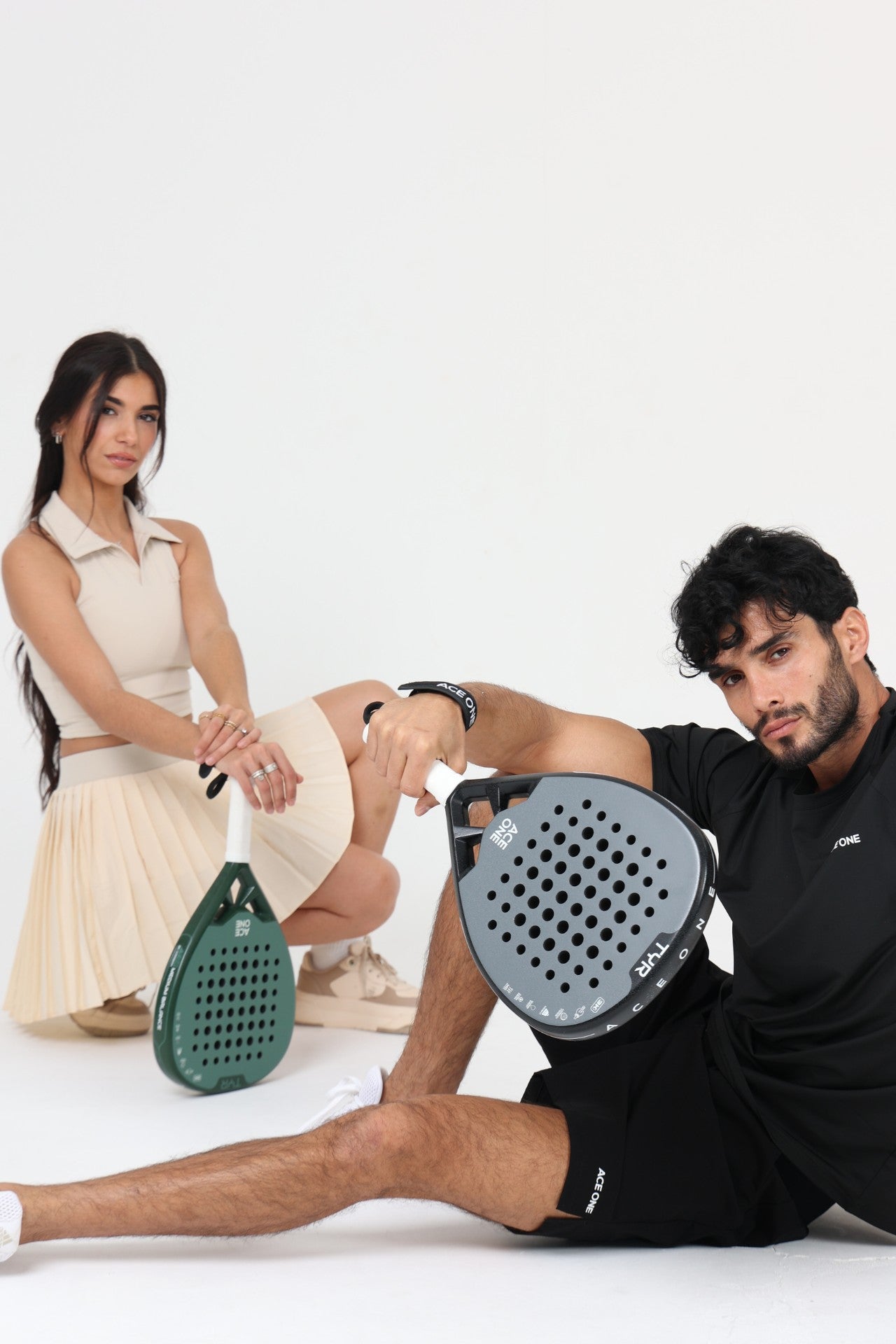
Communication is doctrine, but the racket has to support the role you call out. The right-side player is the team's voice and patient builder: a 3K control frame like the TŸR collection rewards consistency on returns, controls reset lobs, and forgives the half-volleys that come from holding ground while the partner finishes.
The left-side player is the finisher. A 12K rigid frame like the Cøre 12K Carbon converts the "mine" call on a high middle into a point-ending smash. A soft control frame on the same smash wastes the partner's call on a flat finish the opponents recover.
For a brand-new pair, the simplest path is the Pack Performance bundle for the finisher and a TŸR for the builder, plus the PRO-LINE overgrip 3-pack to keep both players' contact tuned. For the deeper roles, see our cluster on third-ball positioning and back-glass defensive resets: both rely on partner calls to work.
FAQ on padel partner communication
- Should I call "mine" out loud or use hand signals?
- Out loud, and early. Hand signals are reserved for serve-pattern coordination between the net player and the server. During a live rally, voice is faster, hands are not free, and your partner cannot watch your hand and the ball at the same time.
- What if my partner calls "mine" but I think I have a better shot?
- Honor the call. Mid-rally renegotiation costs more points than a sub-optimal shot. Discuss it between points, not during them. The team that follows the wrong call still beats the team that argues mid-rally.
- Who calls "out" if both of us are at the net?
- The partner who is NOT about to swing. They have the side view of the line and the time to track the ball's trajectory. The player about to hit is the worst-placed to judge a baseline call because their attention is on contact, not on the bounce.
- Is it okay to communicate during a rally if my partner is at the back?
- Yes, but keep it to one syllable. "Up", "back", "lob", "switch", "mine". Full sentences mid-rally arrive too late to act on. The information your partner needs is the next decision, not your reasoning.
The Ace One Padel Verdict
Padel is not a singles sport played twice. It is a doubles sport played as one body, and the body speaks in seven words. Master those seven calls and you skip the entire plateau where two technically-equal players keep losing to teams who simply hesitate less. The investment is not training time. It is a 30-second conversation before the warm-up.
The pair that calls early beats the pair that hits hard. The pair that signals the serve beats the pair that improvises it. The pair that follows the wrong call beats the pair that argues the right one.
You did not lose to better opponents. You lost to silence. Speak first, swing second, and the points come back.
Share:
How to Choose a Padel Racket in 2026: The Master Decision Flow Guide
Padel Net Zone Positioning: Where to Stand Once You Both Reach the Net (2026 Guide)