
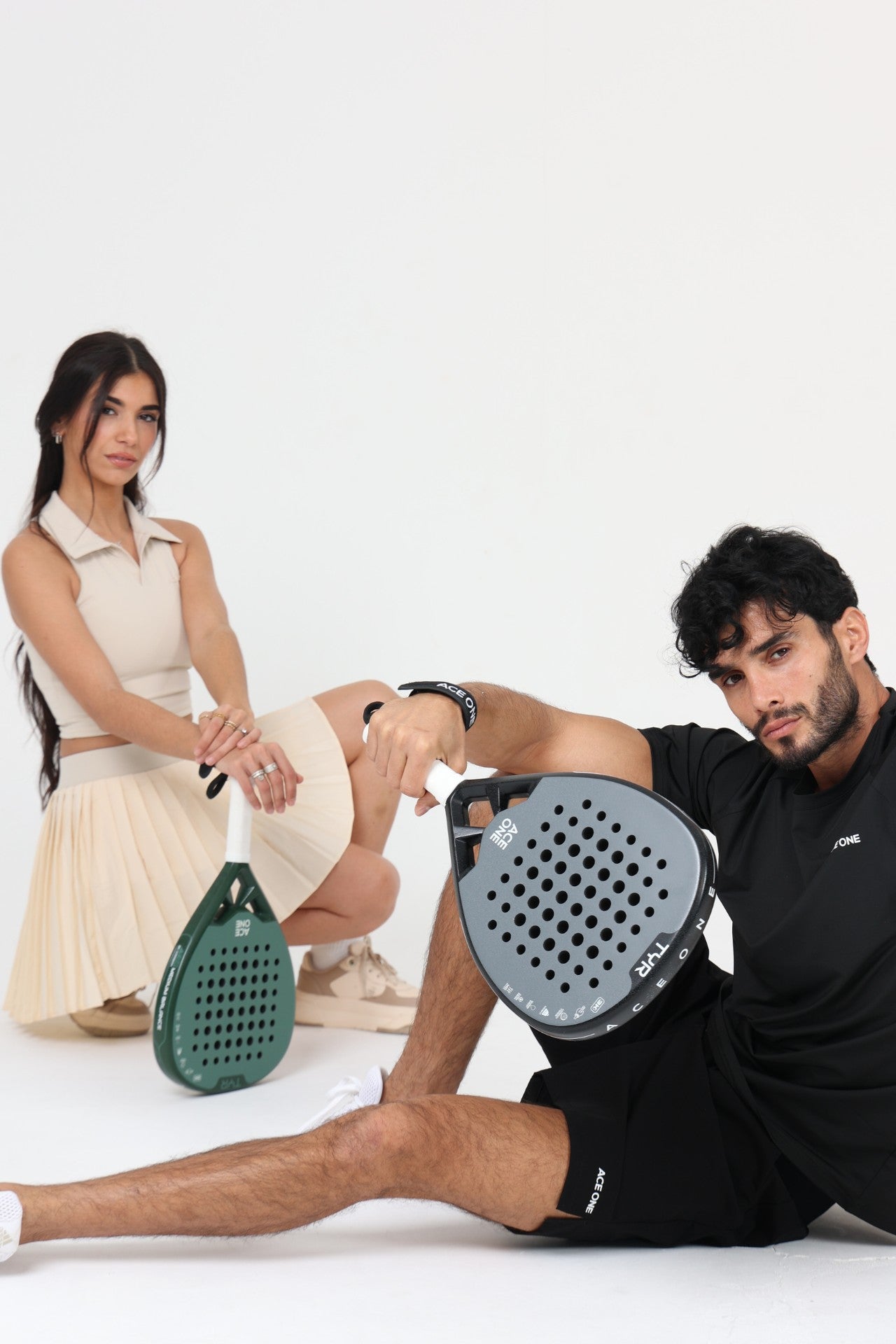
Two players each pick up a racket marked 365 grams. One swings it like a wand for two sets. The other fights it for forty minutes, watches their bandeja arrive late three times in a row, and quietly blames the wind. Both rackets weigh exactly the same on the scale. Both feel completely different on the court. The gap between the number on the box and the number on your wrist has a name. It is called swingweight, and it is the most under-understood spec in padel.
TL;DR
- Static weight lies: two rackets at 365 g can feel 30 g apart in the swing because mass distribution multiplies effort at the racket head.
- Swingweight is moment of inertia: measured around an axis ~10 cm from the butt, in kg·cm². Most padel rackets land between 280 and 360 kg·cm².
- Balance is the third axis: high balance (≥27 cm) means head-heavy and more power. Low balance (<26 cm) means head-light and more maneuverability.
- You can measure at home: a flat table edge, a ruler, a kitchen scale and four minutes get you to a usable balance point and a felt-weight estimate.
- Profile match wins matches: control players want a lower swingweight band; finishers want a higher one. Match the number to the role, not the gram count to the brochure.
Static weight, swingweight, balance: three numbers, three different things
Most padel spec sheets show one number: total weight in grams. That number is static weight and it is the easiest to measure (drop the racket on a scale). It is also the least informative spec on the page. Static weight tells you what the racket weighs at rest. Padel is not played at rest.
The second number, the one most brands skip, is balance. Balance is where the racket would tip if you laid it on a knife edge. A balance point of 27.5 cm from the butt means mass is biased toward the head. A balance point of 25 cm means the head sits almost weightless in your hand. Padel.fyi calls anything above 27 cm "high balance" (head-heavy) and anything below 26 cm "low balance" (head-light).
The third number, the one almost no padel brand publishes, is swingweight. It is the racket's resistance to being rotated around an axis roughly ten centimetres from the butt. It is measured in kilogram-centimetres squared (kg·cm²) and it combines static weight AND balance into a single feel-weight number. Per Tennis Warehouse University, padel rackets typically land between 280 and 360 kg·cm². That 80-unit spread is the entire difference between "lethal head-heavy weapon" and "fast control wand".

| Spec | Unit | Padel range | What it tells you |
|---|---|---|---|
| Static weight | grams (g) | 350-385 g | Total mass at rest. Almost nothing about feel. |
| Balance point | centimetres from butt | 24-29 cm | Where the mass sits. Head-heavy vs head-light. |
| Swingweight (MOI) | kg·cm² | 280-360 kg·cm² | Felt weight in the swing. The only number your wrist cares about. |
| Twistweight | kg·cm² | ~12-18 kg·cm² | Stability on off-centre hits. Side-to-side resistance. |
| Hittingweight | grams equivalent | varies by impact point | Effective mass at the contact point. Decides ball speed off the racket. |
Two rackets can share the first row and feel completely different. They can share the first two rows and still produce different ball speeds. The honest spec, the one that closes the gap between "what the box says" and "what your forearm feels in the eighth game", is the third one.
The physics in plain English: the ten-centimetre pivot
Engineers call swingweight a moment of inertia. For a padel racket, the convention agreed on by the Springer Sports Engineering literature (Taraborrelli et al., 2019) is to compute MOI around an axis ten centimetres from the butt, perpendicular to the racket face. Ten centimetres because that is roughly where your hand grips and where the swing pivot actually lives. You do not swing the racket from the butt cap. You swing it from your wrist.
Why does mass at the head matter so much more than mass at the handle? Because moment of inertia is mass multiplied by the squared distance from the pivot. A gram added at the top of the head, 35 cm from the pivot, contributes (35)² = 1225 units of resistance. The same gram added at the handle, 5 cm from the pivot, contributes (5)² = 25 units. The head-gram is 49 times harder to swing than the handle-gram. This is why an overgrip barely changes felt weight while a strip of lead tape at the top of the frame transforms it.
Two practical consequences. First, two rackets at the same gram count can be tuned for completely different roles: one for power (mass at the head, swingweight 340+ kg·cm²), one for control (mass toward the handle, 295-310 kg·cm²). Second, you can change a racket's behaviour at home with tiny amounts of weight placed correctly. A 4-gram lead strip at the 2-and-10-o'clock frame positions plays noticeably more aggressively than a 4-gram counterweight in the butt cap, even though the scale reads the same delta.
How to measure your racket's balance and swingweight at home
Most amateurs never know their racket's balance point. You do not need a $1,200 Babolat RDC machine to find it. Four steps, four minutes, three household items get you to a balance-point measurement accurate to within 0.5 cm and a felt-weight band good enough to compare two rackets.

- Weigh the racket strung, with grip, no overgrip. Drop it on a gram-accurate kitchen scale. Note the static weight. A fresh overgrip adds 5-8 g at the handle, which lowers swingweight slightly.
- Find the balance point on a table edge. Slide the racket butt-first off the edge until the head tips upward. Mark where it starts to tip. Measure from the butt to that mark in centimetres. Below 26 cm is head-light. Above 27 cm is head-heavy. Between 26 and 27 cm is "balanced".
- Estimate the swingweight band. Without a machine you cannot publish a kg·cm² number. You can place the racket in one of three bands: low (light static + low balance, ≤310 kg·cm² estimated), medium (311-330 kg·cm²), high (331+ kg·cm²). The Springer 2019 paper notes that even lab measurements carry a ±5 kg·cm² uncertainty, so a band is honest.
- Compare side by side. Repeat steps 1-3 for a second racket. Differences between two rackets are far more reliable than any absolute number. If racket A balances at 25.8 cm and racket B at 27.4 cm, B will feel "heavier" in the swing even if A is 5 g heavier on the scale.
For most amateurs, knowing the balance point and the qualitative band is the actionable information. The exact MOI number is for tournament players matching a second racket to their primary.
What swingweight actually does to your game
Higher swingweight does three things. It generates more ball speed at any given swing speed, because mass at impact transfers directly into momentum (Tennis Warehouse University quantifies it: a 5% swingweight increase at constant swing speed produces roughly 2-3% more ball speed). It slows down reaction time, because more torque is required to change direction. And it accelerates forearm fatigue, because every block volley and defensive lob is a new acceleration that costs energy proportional to swingweight.
Lower swingweight reverses all three: faster reaction (great for fast-hands at the net), lower ball speed (you must generate more swing speed), less cumulative fatigue. The trade-off is direct. There is no "best" swingweight, only the right swingweight for your role on the court.
Studies on racket sports (Allen et al. on tennis MOI sensitivity; Nakashima et al. on badminton smash speed) show players can detect swingweight differences as small as 10-15 kg·cm² with their preferred racket. The pros tune to ±2 kg·cm² across a four-racket bag. You can probably feel a 20 kg·cm² gap in one set of swings. This is why borrowing your friend's racket "for a game" tells you nothing: the static weight is close enough that you blame your own swing, but the swingweight gap is large enough that nothing is working.
The wrong-feel trap: three ways amateurs misread their racket's weight
Most weight complaints in amateur padel are not weight complaints. They are swingweight complaints in disguise. Three traps come up over and over.
Trap 1, buying by the gram count. A player tries a friend's 370 g power racket, loves it, walks into the shop and buys "any 370 g racket". The new one has its mass biased lower and a balance point 1.5 cm shorter. Same gram count, completely different swingweight. Compare balance points before comparing static weights.
Trap 2, adding an overgrip and expecting more power. Overgrips add 5-8 g at the handle, where the squared-distance multiplier is minimal. They slightly lower swingweight and shift balance toward the handle. Players who say "the racket feels lighter" are correct in feel, wrong in physics: it is not lighter, it is slightly less head-heavy.
Trap 3, assuming "head-heavy means power for everyone". Head-heavy rackets reward players who already swing fast and contact cleanly. For an amateur with a developing swing path, a high-swingweight racket arrives late, the smash drops short, the bandeja brushes the cage. The right entry point for most amateurs is a balanced or slightly head-light frame with a medium swingweight. The TŸR in 3K carbon and Soft EVA was tuned for that band.
Match your profile to a swingweight band
Three player profiles map cleanly to three Ace One Padel kit decisions. This is the buying logic, condensed.
- Control-first amateur or right-side defender → low-to-medium swingweight band. The TŸR collection in 3K carbon with Soft EVA sits here. Faster reactions, lower fatigue, forgiving on the back glass. The right entry point if your bandeja arrives late or you log more than two hours per week.
- Left-side finisher or competition player → medium-to-high swingweight band. The Cøre 12K Carbon produces the rigid head response that converts a clean swing into ball speed. The right racket if you smash from the net and your forearm sustains three sets.
- New player without a base reference → start in the middle and adjust. The Pack Performance bundle pairs the Cøre 12K Carbon with PRO-LINE overgrips and the PRO-LINE backpack, letting you tune felt weight as your swing develops.
- Any player tuning between sessions → the PRO-LINE perforated overgrip 3-pack is the cheapest swingweight lever you have. Two layers wrapped tight equals a slightly head-light shift. One layer loose equals closest to spec.
Frequently asked questions
Is swingweight the same as racket weight?
No. Static weight is total mass at rest, measured in grams. Swingweight is moment of inertia around the swing pivot, measured in kg·cm². Two rackets with the same static weight can have a 30 kg·cm² swingweight gap, which is the difference between "smooth swing" and "wrist fatigue at game 7".
What is a good swingweight for a beginner padel racket?
A low-to-medium swingweight, roughly 295-315 kg·cm² estimated, with a balanced or slightly head-light balance point (25.5-26.5 cm from the butt). This range gives a beginner faster reactions, lower fatigue, and a more forgiving response on off-centre hits, without losing meaningful ball speed.
Does adding a heavier overgrip change swingweight a lot?
Not much. Overgrips add 5-8 g at the handle, where the squared-distance multiplier is minimal. The change to swingweight is typically 2-4 kg·cm² (under 1%). It shifts balance toward the handle slightly and lowers the felt weight by a perceptible amount, but it does not transform a power racket into a control racket.
Can I measure my padel racket's swingweight without a special machine?
Not in absolute kg·cm² terms, no. You can measure the balance point at home with a table edge and a ruler to within 0.5 cm accuracy, and combine that with the static weight to place the racket in a qualitative band (low, medium, high felt weight). For a true MOI number you need either a Babolat RDC machine or a calibrated pendulum setup, both of which are typically only found at a stringer or specialist shop.
The Ace One Padel Verdict
Swingweight is not a marketing number. It is the racket you actually play. Static weight describes a racket at rest. Balance describes where its mass lives. Swingweight describes what your wrist feels in the eighth game of the third set when the bandeja is late and you cannot work out why.
At Ace One Padel we tune for the band, not the gram count. The TŸR in 3K carbon sits in the lower swingweight band: a control profile that hides its mass and rewards fast reactions. The Cøre 12K Carbon sits in the higher band: a power profile that punishes late swings but converts clean ones.
The racket on the scale is not the racket in the swing. The racket in the swing is not the racket in your forearm at game seven. Buy the band, not the gram. Weigh the swing, not the box. The number on the box is the racket. The number on your wrist is the swingweight.
Share:
Your First Padel Tournament: The 7-Step Checklist That Wins Before the First Point (2026 Guide)
Buenos Aires P1 2026: The Round of 16 That Decides the South American Crown