
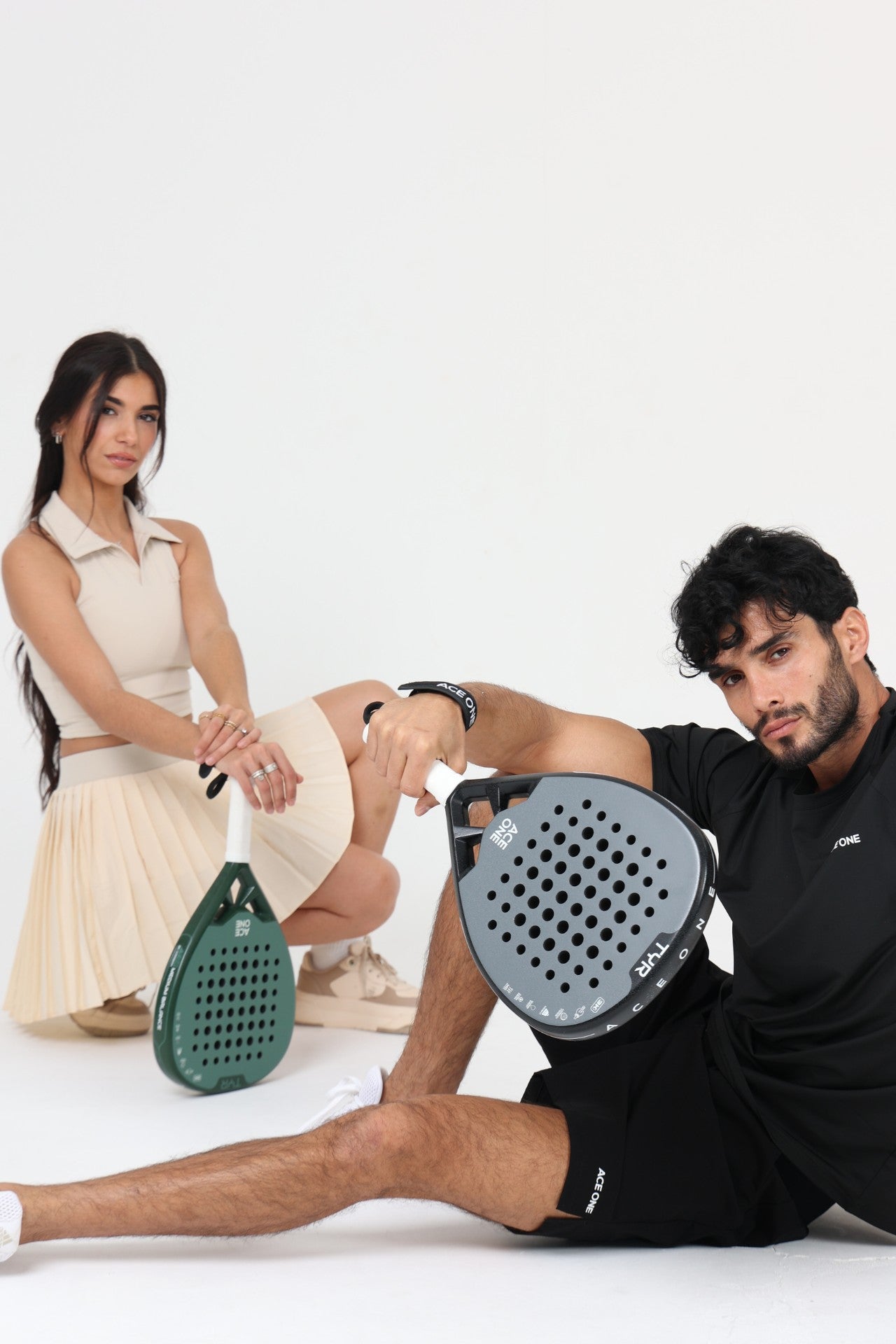
You picked up padel for the joy of it. The fast points, the glass, the partner banter. Nobody handed you a warning label. Yet if you play a few times a week, the part of your body most likely to complain is not your knee, not your shoulder, and not your back. It is your elbow.
That is not a hunch. It is what the research keeps finding, study after study. And here is the part most players miss: the biggest lever you actually control is not how often you play. It is the racket in your hand and the way you make contact. At Ace One Padel, we have read the injury literature so you can choose your gear with your tendons in mind, not just your forehand.
TL;DR
- The elbow is padel's number one injury: most frequent site in 5 of 5 studies reviewed, up to 74.4% of players in one survey.
- Most of it is tendon damage: tendon injuries are the largest category, the same family as tennis elbow.
- Padel has no strings: the core and faces do the shock absorbing, so a stiffer core sends more impact into your arm.
- Three real culprits: a core too stiff for you, a death grip or wrong grip size, and off-center mishits on a heavy racket.
- The fix is a system: a softer core like the TYR helps, but only alongside grip fit, clean contact and sensible load.
The number nobody warns you about
When researchers pool the padel injury data, one body part keeps winning the wrong contest. A 2023 systematic review by Dahmen and colleagues in BMJ Open Sport & Exercise Medicine found the elbow was the most frequently injured site in five out of five studies it reviewed. Overall injury prevalence across the sport ran anywhere from 40% to 95%, with an incidence of roughly 3 injuries per 1000 hours of training and 8 per 1000 matches.
The numbers for the elbow specifically are striking. One survey (Castillo-Lozano and Casuso-Holgado, 2017) reported elbow complaints in 74.4% of players. The next most common sites trailed well behind: lower back around 27.5% and knee around 22.9%. And the tissue type matters. In another dataset (García-Fernández et al., 2019), tendon injuries were the single largest category at roughly 40%, ahead of muscle injuries. Tennis elbow, clinically lateral epicondylitis, lives squarely in that tendon bucket.
Read that chart once and the priority is obvious. The elbow is not one risk among many. It is the headline risk, by a distance. So the smart question is not whether you might get it, but what you can do to load it less.
Padel has no strings. Your core is the shock absorber.
Here is the structural fact that changes how you should shop. A tennis racket has a string bed, and that bed flexes and helps regulate force at the moment of contact. A padel racket has no strings at all. It is a solid sandwich: two carbon faces around a foam core. When the ball lands off-center, the job of soaking up that impact falls to the core and the faces, then whatever is left travels down the handle into your wrist and elbow.
Clinicians have flagged exactly this. Reviews of padel elbow pain note that the missing string bed may be one reason tendon injuries are so common, and that stiffer rackets transfer greater impact and cause repeated micro-traumas over thousands of shots. The honest caveat: the unstrung racket is also described in some literature as self-regulating force, so the science is not one-sided. What is not in dispute is the practical takeaway. With no strings to tune, the hardness of your core becomes the main shock setting you actually choose.
This is where Ace One's two families pull apart on purpose. The soft versus hard EVA core choice is not a gimmick. A softer, lower-density core flexes longer at impact and dampens more vibration, which is the comfort and control profile. A rigid core returns energy faster for explosive power, which is the attacking profile but a less forgiving one for a sensitive arm.

The three things that actually load your elbow
If you only remember one section, make it this one. Most elbow pain in padel traces back to three controllable causes, not bad luck.
| What loads the elbow | Why it hurts | The fix |
|---|---|---|
| A core too stiff for you | A rigid core transfers more impact straight into the forearm tendons, shot after shot. | Drop to a softer, lower-density EVA core that flexes and dampens. |
| A death grip or wrong grip size | An overly tight or ill-fitting grip increases stress on the elbow and locks the forearm. | Fit the grip to your hand, add an overgrip, and hold light until contact. |
| Off-center hits on a heavy racket | Mishits send peak vibration to the arm, and heavier frames (350 to 370g) add load. | Hit nearer the sweet spot and keep total weight manageable. |
Notice what these have in common. None of them is about playing less. They are about the tool and the contact. That is genuinely good news, because tools and technique are fixable in an afternoon, while giving up padel is not on anyone's list.
How to choose a racket that protects your arm
Turn the three culprits into a shopping checklist. When you are comparing frames, run down this list before you look at the paint job.
- Core density first. For a sensitive or recovering arm, prioritize a soft, lower-density EVA core over raw power. This is the comfort and control direction, the reason the TYR line exists.
- Weight you can actually swing. A racket that fatigues your forearm by the third set changes your mechanics and loads the elbow. If you are choosing between two, the lighter, more balanced one is usually kinder to the joint. Our racket weight guide breaks down the trade-offs.
- Balance toward the handle. A more head-light or even balance keeps the swing easy to control and reduces the strain of muscling the head through contact.
- Grip that fits. The cheapest elbow upgrade in the sport is the right grip thickness, so you never squeeze.
One honest line, because we sell rackets and you deserve straight talk. A soft core is not a medical device. If your technique sends the ball off the edge of the face every other shot, no foam will save your tendon. The racket lowers the baseline load. You and your coach lower the rest. And if your frame is already old and dead, that is a separate problem we cover in when to replace a padel racket.
Beyond the racket: grip, contact, and load
Gear is necessary but not sufficient. The padel elbow is a load story, and load adds up from three taps you can each turn down.

Grip pressure. Hold the handle as if it were a small bird: secure, not crushed. A relaxed forearm until the instant of contact is the single habit most likely to spare your tendon. The right overgrip makes that easier by giving you a handle that fills the hand.
Contact quality. The center of the face is your friend. Drills that groove a clean strike zone do more for your elbow than any anti-vibration sticker, because they cut the peak impact at the source.
Total load. Three matches in a weekend after a quiet winter is a classic flare-up. Warm the forearm, build volume gradually, and treat early twinges as information, not weakness.
The Ace One Padel Verdict
The elbow is padel's most common injury, and that is not a reason to fear the sport. It is a reason to choose your racket like the load-bearing tool it is. Padel took away the strings, so your core is the shock absorber you get to pick.
Who the soft-core route is worth it for: anyone with a sensitive or recovering arm, players logging high weekly volume, and improvers who still mishit often. For them the TYR with its 3K carbon face and Soft EVA core is the sensible default: built for dwell, control and absorption.
Who it is not for: the strong, technically sound attacker with a healthy arm who genuinely wants the rigid, explosive feel and can handle it. A stiff core is a legitimate tool, just not an elbow-friendly one.
Choose soft if your arm needs guarding. Fit the grip so you never squeeze. Hit the middle of the face. Do those three, and the number that nobody warned you about stops being your story.
Padel tennis elbow: quick FAQ
Is tennis elbow common in padel? Yes. The elbow is the most frequently injured site in the sport, ahead of the back and knee, and most cases are tendon injuries.
Does a softer racket core help? It lowers the impact reaching your arm, but it works alongside grip fit, clean contact and sensible load, not instead of them.
What racket if I already have elbow pain? A soft, lower-density core, a manageable weight, and a grip sized to your hand. The TYR is built for that comfort and control profile.
Why is padel harder on the elbow than tennis? The padel racket has no strings, so the solid core and faces do the shock absorbing, which puts core hardness and clean contact under your control.
Share:
Playing the Walls in Padel: A Beginner’s Guide to the Back Glass
Valladolid P2 2026 Recap: Coello and Tapia Make Padel History, Josemaria and Gonzalez Claim Their Sixth Title