
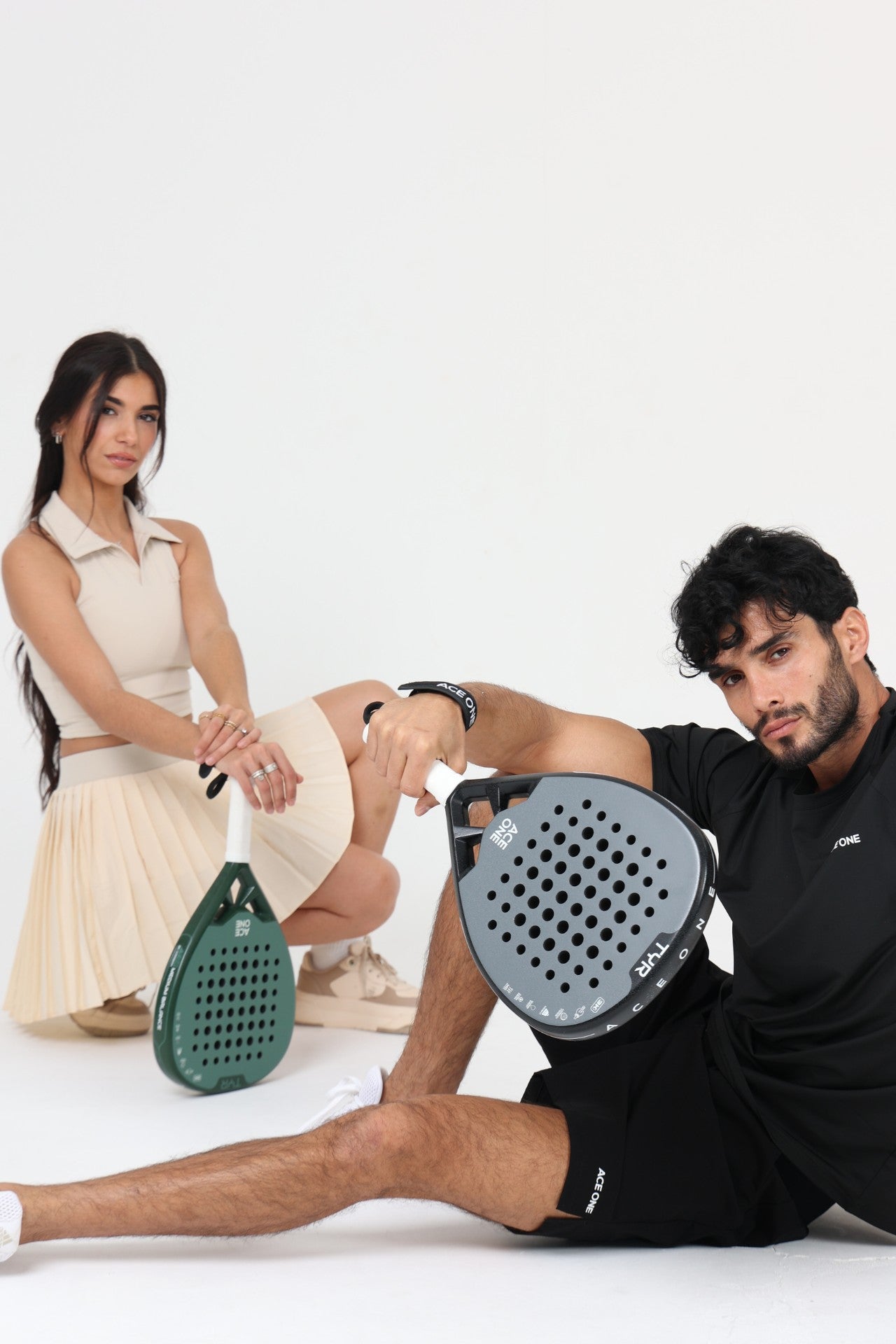
Two players walk into the same shop with the same budget. One asks for a 12K carbon racket. The other asks for a 3K. They both walk out happy, and they both walk out having answered the wrong question. The number they argued about is printed on the carbon skin. The thing their arm will actually feel for the next ten thousand shots is hidden underneath it, and almost nobody asks about it by name.
That hidden thing is the core. It is the block of foam between the two carbon faces, and it does more to decide how your racket plays, how your elbow ages, and how long the racket stays alive than the weave you spent the whole conversation debating. This is the spec sheet line you skipped. Here is why it matters more than the one you read.
TL;DR
- The core is the engine: the EVA foam between the carbon faces decides feel and comfort, while the carbon skin mostly decides surface power and spin.
- Soft EVA = control and comfort: longer dwell, bigger sweet spot, far gentler on the elbow. Less free power on fast balls.
- Hard EVA = power and crispness: faster ball exit and a firmer response, but more vibration and a smaller margin for error.
- Your core is a consumable: EVA compresses and hardens after roughly 10,000 hits. A racket that feels dead is usually a dead core, not bad form.
- Match it to you: control and elbow comfort point to a Soft EVA TŸR; finishing power points to the firmer Cøre 12K.
What the core actually is
A padel racket is a sandwich. Two carbon or fiberglass faces on the outside, a frame around the edge, and a slab of foam filling the middle. That foam is the core, and on almost every performance racket today it is EVA (ethylene-vinyl acetate), the same family of resilient foam used in good running-shoe midsoles.
You will also see cheaper rackets advertised with a soft generic FOAM core. That polyethylene-style foam feels plush in the shop, but it lacks the rebound and durability of EVA, which is why serious rackets moved to EVA years ago. The real decision for a player who has left the beginner aisle is not FOAM versus EVA. It is which EVA: soft, medium, or hard.
EVA comes in densities, and density is the whole story. A low-density block is springy and absorbs impact. A high-density block is firm and returns energy fast. That single property is what your forearm interprets as "comfortable" or "powerful" long before you can read the badge.
Soft vs hard EVA: what your arm actually feels
The carbon weave debate (3K versus 12K) gets the attention, and it does change the surface stiffness and the spin you can bite onto the ball. We broke that down in our 3K vs 12K carbon guide. But weave is the skin. The core is what the ball pushes into on every single contact, so the core is what your hand and forearm read as the racket's personality.
Here is the honest trade-off, triangulated across coaches, manufacturers, and players, with one nuance most guides skip: on slow balls a soft core can actually give you more power because the ball loads and springs out, while on fast, heavy balls a hard core accelerates the ball better. So "hard equals power" is true mostly when you are the one providing the speed.
| What you feel | Soft EVA | Medium EVA | Hard EVA |
|---|---|---|---|
| Ball exit | Slower, ball dwells | Balanced | Fast, crisp |
| Control | Highest | High | Demands clean contact |
| Sweet spot | Large, forgiving | Medium | Small, punishing |
| Vibration to elbow | Lowest | Moderate | Highest |
| Best for | Control players, long rallies, arm health | All-rounders | Strong, advanced finishers |
| Ace One match | TŸR (3K + Soft EVA) | TŸR for most players | Cøre 12K |

The core and your elbow
This is the part of the spec sheet that should matter most and gets discussed least. The elbow is the most commonly injured area in padel, and lateral epicondylitis (tennis elbow) is the most frequently reported specific injury, according to a systematic review of padel injuries. The racket you choose is one of the few variables you fully control.
Why the core specifically? Because a firmer racket transmits more of the impact as vibration, and that vibration travels up to the common extensor tendon at the elbow, which research on the biomechanics of padel links to a higher risk of tendinopathy. A soft EVA core absorbs more of that impact before it reaches your arm. If you have ever felt your forearm cook in the third set, the core is a bigger lever than any wristband.
One honest caveat: a vibration dampener on the strings does not exist in padel, and even in tennis those dampeners have not been shown to prevent tennis elbow. The real damping happens inside the racket, in the foam. That is the whole argument for a softer core if your elbow has any history.
How to feel a racket's core in four steps
- Press the face. Push your thumb into the center of the face. A soft core gives slightly. A hard core feels like a table.
- Tap the sweet spot. Bounce a ball on the strings-free face. A soft core gives a deeper, duller bounce, a hard core a higher, sharper one.
- Hit ten slow balls. Soft cores reward a relaxed swing with depth. Hard cores feel flat until you swing fast.
- Check your forearm after. The honest test is not the shop, it is your elbow the next morning.
The hidden truth: your core is a consumable
Here is what no badge tells you. The core does not last forever. After roughly 10,000 hits, which is only 50 to 70 hours of regular play, the cellular structure of the EVA begins to rupture at a microscopic level. The foam compresses, hardens, and the sweet spot shrinks. The racket you loved slowly turns into a flatter, harsher version of itself.
You can hear it. A fresh core gives a sharp, crisp "clack." As the carbon skin and the foam start to separate, that sound dulls into a flat "thud." If your shots feel shorter and your timing feels off and you are blaming your form, check the racket first. A dead core is not a technique problem.
This puts the core in the same mental bucket as your other padel consumables. It wears out on a clock, and heat speeds up that clock dramatically. Leaving a racket in a hot car or trunk softens and warps the foam, the same enemy that ruins your padel balls. Recreational cores last 6 to 12 months, competitive players burn through them faster, and pros change rackets every few weeks. For more on extending that window, our racket lifespan research aligns: store it cool, never crush it in a bag, and accept that the foam is mortal.
The wrong-core trap: three ways players misread the foam
The core is invisible, so it is easy to get wrong. Three traps account for most of it.
- Trap 1: buying hard for "power" as a developing player. A hard core only returns power you put in. If your swing speed is still growing, you get the small sweet spot and the vibration without the payoff. Soft gives you usable power and saves your elbow while you build.
- Trap 2: blaming your technique when the core is dead. Players grind for months on a racket whose foam quietly compressed 5,000 hits ago. The drills are not failing. The core is.
- Trap 3: shopping the carbon number and ignoring the core. Two 12K rackets can feel completely different because their cores differ. The weave is half a spec. The core is the other half, and it is the half your arm reads.

Which Ace One core fits you
At Ace One Padel, we have built the range around the core decision, not around it. Match your game to the foam, then let the weave and weight follow. For the full sequence, our how-to-choose guide and weight and balance guide sit on top of this one.
- Control player, long rallies, any elbow history. The Soft EVA TŸR in the rackets collection. Dwell, forgiveness, comfort.
- Strong, advanced finisher who supplies the speed. The firmer Cøre 12K. Fast exit and a crisp, rigid response.
- New pair starting from zero. The Pack Performance bundle gets you playing without overthinking the spec.
- Tuning feel between core replacements. A fresh PRO-LINE overgrip changes how the handle reports back to your hand, the cheapest feel adjustment you can make.
For how the core sits among the head, heart and handle of the frame, see our frame anatomy guide.
Frequently asked questions
Is a soft or hard padel racket core better for beginners?
Soft, almost always. A soft EVA core gives a larger sweet spot, more forgiveness on off-center hits, and far less vibration to the elbow while your swing develops. Hard cores reward swing speed most players do not have yet.
Does the core matter more than the carbon face?
For feel and comfort, yes. The core decides how the ball dwells and how much shock reaches your arm. The carbon face mostly decides surface stiffness, spin grip and a portion of the power. Both matter, but the core is the one your forearm reads on every shot.
How do I know if my padel racket core is dead?
Listen and feel. A dead core sounds like a dull thud instead of a crisp clack, the sweet spot feels smaller, shots land shorter, and the racket feels harsher. This usually appears after about 10,000 hits or 6 to 12 months of regular play.
Can heat damage the EVA core?
Yes. Heat softens and can permanently deform EVA. A racket left in a hot car or boot loses rebound and ages faster. Store it at room temperature and never crush it under weight in a bag.
The Ace One Padel Verdict
You shop the weave. You feel the core. The carbon number on the box is the skin you pay for, and the EVA underneath is the engine you actually play. A soft core is not the beginner option and a hard core is not the pro option. A soft core is the control-and-comfort option, and a hard core is the supply-your-own-power option.
The badge tells you what the racket is made of. The core tells you what it will feel like. The clock tells you when it dies. Choose for your elbow first, your game second, and the carbon number last. Two players walked into a shop arguing about 3K and 12K. The one who walked out happy was the one who pressed the face, not the one who read the sticker.
Share:
BNL Italy Major 2026: The Rome Semifinals and the No. 1 Race Explained
BNL Italy Major Rome 2026: Coello and Tapia End Their Drought to Claim the First Major of the Season