
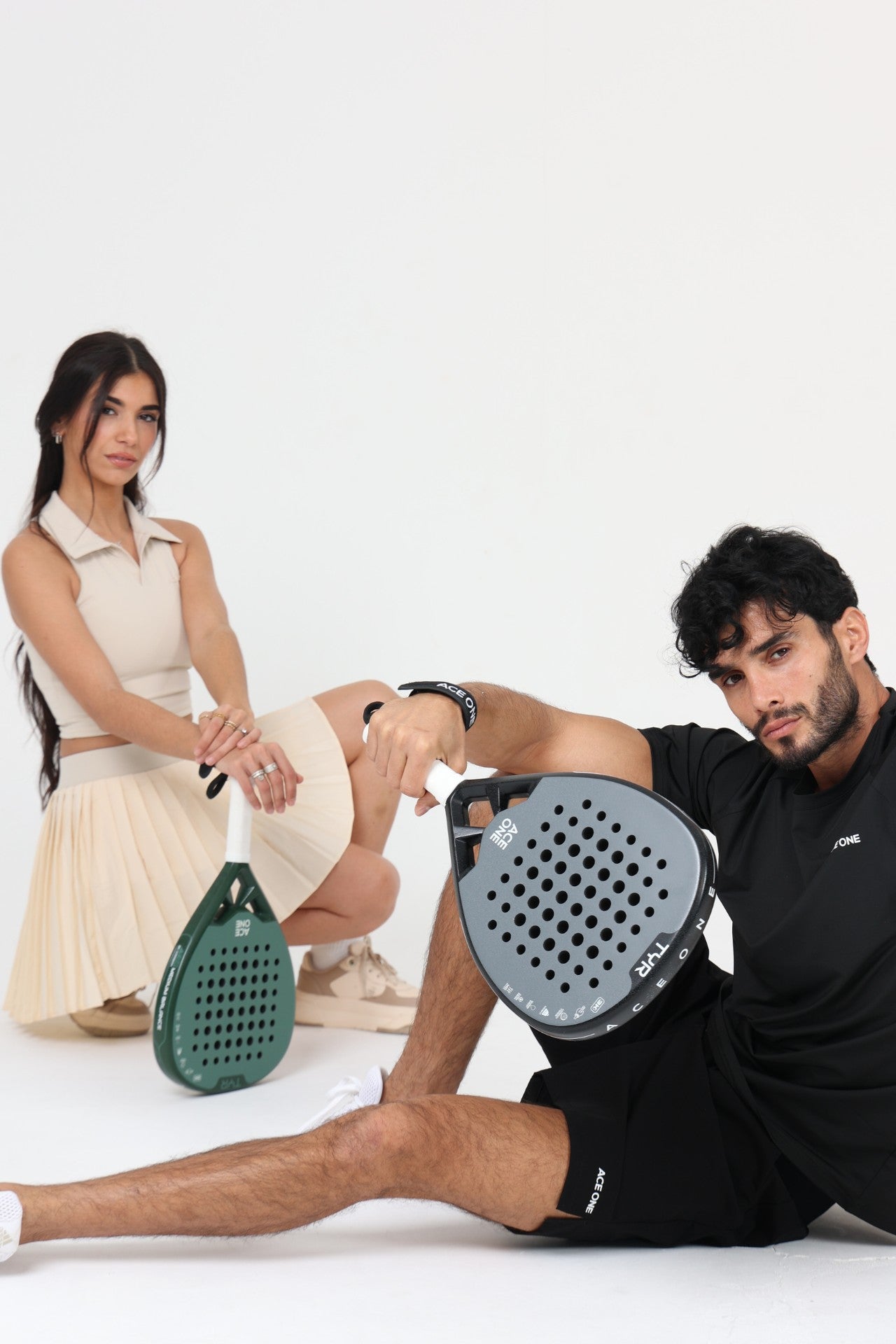
Watch a club player miss an easy smash and you will almost always see the same thing: a big arm, a frozen lower body, and a ball that sails long or sits up for the counter. The instinct is to swing harder. The data says the opposite. In competitive padel players, the single best physical predictor of smash speed is not arm strength at all. It is how far you can throw a medicine ball with your whole body.
At Ace One Padel, we broke down what actually happens when a padel smash works, and the answer reorders almost everything beginners are told. Your smash does not live in your arm. It lives in your legs, your hips, and the half-second of timing that turns the bounce into a winner.
TL;DR
- It is a throw, not a swing: medicine-ball throw predicts smash speed at r=0.93, while raw grip strength is the weakest link at r=0.75.
- Power comes from the ground up: legs and hips load first, the arm only delivers what the kinetic chain already built.
- The bounce beats the bomb: a controlled por tres with topspin goes out of the glass more reliably than a flat cannonball.
- Contact point is non-negotiable: highest reachable point, slightly in front of the head, full extension.
- Know when not to smash: the bandeja protects your net position and your shoulder more often than the highlight reel suggests.
The smash myth: it is not an arm shot
Ask ten amateurs where smash power comes from and nine will point at the shoulder. It feels right. The arm is the part that moves fastest, so it must be the engine. It is not. It is the last link in a chain that started at the floor.
A 2025 study of young competitive padel players measured smash ball speed against a battery of physical tests. The mean smash velocity for the male players was around 112 km/h, peaking near 127 km/h. Then the researchers checked which physical qualities correlated with that speed. The medicine-ball forehand throw, a whole-body explosive movement, correlated with smash velocity at r=0.93. The counter-movement jump, which is pure leg power, came in at r=0.77. Dominant-hand grip strength, the most "arm" measure of the lot, was the weakest of all at r=0.75.
Read that again. The thing most players train when they want a bigger smash, raw arm and grip, is the quality that explains the least. The throw and the jump explain the most. The smash is a coordinated launch, and the arm is just the tip of the whip.
The numbers: what actually predicts smash speed
Here is the same study laid out as the correlation between each physical test and smash velocity. The longer the bar, the more that quality moves the needle on how fast you can hit.
This is why so many strong, gym-fit players have a disappointing smash, and why some smaller players hit a heavy ball. Coordination and explosive power transfer beat brute arm strength. If you want to build a smash, train the launch: jumps, rotational throws, and timing, not just curls.
Contact point and the anatomy of the overhead
Power you cannot place is just a gift to your opponent. The kinetic chain gives you speed. The contact point turns that speed into a shot that lands in. Three things decide whether the ball goes in or into the back fence.
The kinetic chain, in order
It fires from the ground up, and reversing the order is the most common amateur error:
- Legs load: you turn sideways, weight on the back foot, knees soft, ready to push up.
- Hips and core rotate: the pelvis opens toward the target before the arm does anything.
- Shoulder and elbow follow: the upper arm comes through late, like the second half of a throw.
- Wrist snaps last: this is where spin is added, not where power is created.

Where the ball meets the strings
Contact happens at the highest point you can comfortably reach, slightly in front of your head, with the arm fully extended. Hit it behind your head and the ball goes long. Let it drop too low and you lose the downward angle that makes a smash a smash. Reach up and slightly forward, and you give yourself the steep trajectory that bounces high.
Por tres, por cuatro, kick and flat: choosing the smash
Not every overhead should be a flat bomb. In fact the flat smash is the highest-risk, lowest-margin option on the list. The pros mostly win with spin, because spin lets the ball bounce up and out of the cage while staying inside the lines. The famous por tres sends the ball over the three-metre side fence after the bounce, and it is built on angle and topspin, not on a swing from the heels.
| Shot | What it does | When to use it | Risk |
|---|---|---|---|
| Flat smash | Maximum speed, minimal spin, straight down | Short, easy ball with the net open | High: long or into the net |
| Kick / por tres | Topspin, high bounce, exits over the side glass | High centred lob, opponents deep | Medium: needs spin and angle |
| Por cuatro | Even higher bounce, out over the back fence | Perfect short lob, rare gift ball | High: low-percentage, big reward |
| Víbora | Side-spin, curving kick, keeps you at the net | Aggressive ball without overcommitting | Low to medium |
| Bandeja | Control shot, holds the net, not a winner | High ball you cannot finish cleanly | Low: the safe default |
If you are still learning the overhead family, build it in order: the bandeja for control, the víbora for aggression without risk, and the smash as the finisher. Our shot-selection guide walks through choosing between them in real time.
When not to smash, and the shoulder you are protecting
The smash is the most physically demanding shot in padel. Overhead strokes load the rotator cuff and the front of the shoulder hard, and the research on padel shoulder biomechanics is blunt about it: the high volume of overhead, high-velocity strokes, often hit under time pressure with late adjustments, is a real driver of shoulder pain. Studies comparing experienced and recreational players found meaningful differences in glenohumeral rotation and scapular control, which is a technical way of saying good technique protects the joint and bad technique grinds it.
So the discipline is this: if the ball is not comfortably finishable, play the bandeja, hold your net position, and wait for a better one. A smart bandeja beats a desperate smash every single point. And whatever you do, warm the shoulder up first. Our padel warm-up routine covers the overhead-specific mobility that keeps you hitting all season.
Gear: does the racket actually matter?
Technique first, always. A better racket will not fix an arm-only swing. But once your kinetic chain is sound, the frame does change the ceiling of your smash. A rigid, power-oriented frame transfers a clean strike into faster ball exit, which is exactly what a finisher wants.
This is the job our Cøre 12K Carbon is built for. The 12K weave is stiff and explosive, designed for players who generate their own power and want the ball to leave the strings fast on the put-away. If you are still developing touch and want more dwell time and forgiveness, the softer 3K TŸR line is the gentler path, and you can compare the whole range in our padel rackets collection. The honest version: the racket is the multiplier, your body is the engine.

For the deeper mechanics of how the whole stroke loads and releases, our padel swing biomechanics breakdown is the companion read to this one.
The Ace One Padel Verdict
The padel smash looks like an arm shot. It is the opposite. The fastest smashes belong to the players who throw with their whole body and place with their wrist, not the ones who swing the hardest. Train the launch, master the contact point, and learn to pick the bounce over the bomb. The smash is not where you prove how strong your arm is. It is where you prove how well your body works together.
Hit it from the ground up. Place it over the glass. Win the point before the bounce even lands.
FAQ
How fast is a padel smash?
In a study of young competitive players, the average smash speed was around 112 km/h for the male players, peaking near 127 km/h. Top professionals hit considerably faster, but speed alone does not win points. Placement and bounce angle do.
Where does smash power come from in padel?
From the kinetic chain: legs, hips, and core, transferred up through the shoulder and released by the wrist. Research shows whole-body throwing power predicts smash speed far better than arm or grip strength.
What is a por tres smash?
A topspin (kick) smash hit so the ball bounces high and flies out over the three-metre side fence, ending the point. It relies on spin and angle, not raw speed, which is why control beats power here.
Should beginners smash or play the bandeja?
Beginners should default to the bandeja on most high balls. It holds your net position and protects your shoulder. Reserve the full smash for short, comfortable balls you can finish cleanly.
Share:
Padel Recovery and Stretching: The 15-Minute Cool-Down That Actually Helps (2026 Guide)
How to Hold a Padel Racket: The Continental Grip and the 3 Mistakes Capping Your Game (2026)