
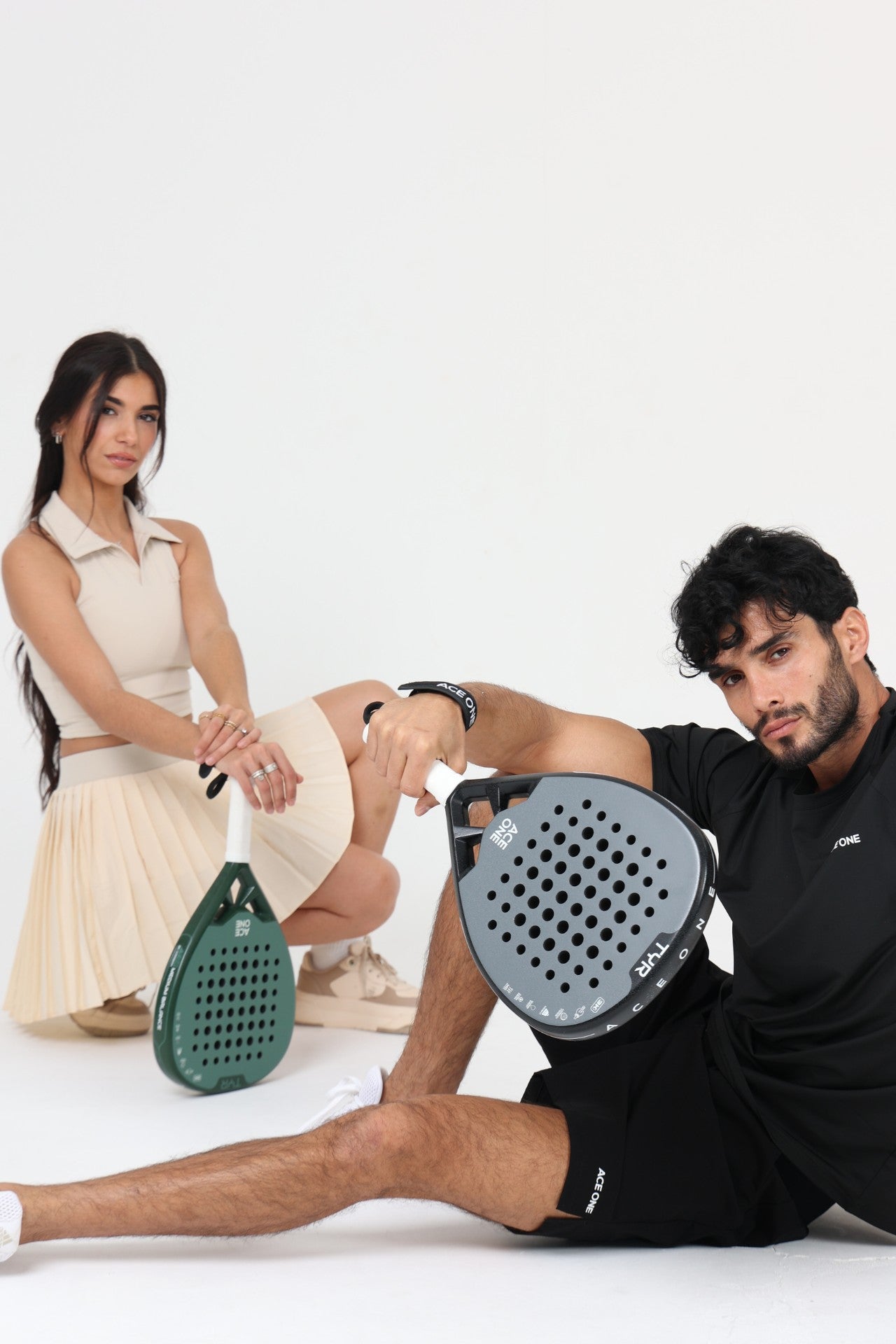
Tennis taught you to carry four grips and swap between them mid-rally. Padel asks you to forget almost all of that. Learning how to hold a padel racket is the first real skill in the sport, and for roughly 80% of the shots you will ever hit on a padel court, one grip does the job. The sooner you commit to it, the faster everything else clicks.
That grip is the continental. It feels slightly wrong for about a week, then it quietly becomes the foundation of your whole game. Most beginners never give it that week. They default to the grip that feels natural, and they spend two seasons wondering why their volleys float and their backhand at the net keeps popping up. This guide fixes that on day one.
TL;DR
- One grip, not four: the continental grip covers about 80% of padel shots (volleys, serve, bandeja, víbora, smash, lob).
- How to find it: hold the racket like a hammer, "shake hands" with the handle, and put the V of your thumb and index on the top bevel.
- Mistake 1: the frying-pan (forehand) grip. It feels powerful and wrecks your net game and glass play.
- Mistake 2: the death grip. Squeeze at roughly 5 out of 10 in rallies, brief 7 at contact, then relax. Over-gripping feeds forearm fatigue and padel elbow.
- Mistake 3: shuffling grips mid-rally like tennis. At the net you have no time. Stay continental.
The one grip that runs 80% of padel
Padel is a game of fast hands at the net and awkward angles off the glass. You rarely get the long, clean setup that a tennis baseline rally gives you. That is exactly why padel rewards simplicity at the handle.
The continental grip sits in the neutral position between a forehand and a backhand grip. Because it favors neither, it lets the same hand handle a forehand volley, a backhand volley, a bandeja, a serve and a defensive lob without any change. The racket face naturally sits slightly open, which is precisely what you want for slice, control and touch, the three currencies of padel.
The name comes from tennis, where the continental is the classic grip for serves and volleys. In padel it stops being one option among several and becomes the default. If you want the textbook definition of the grip and its history, the grip reference on Wikipedia covers the bevel system clearly.
How to find the continental grip in 10 seconds
You do not need a coach for this. Two methods get you there, and they both land on the same spot.
- The hammer test. Pick up the racket as if you were going to hammer a nail with the edge of the frame. That natural hammer hold is the continental grip.
- The handshake. Hold the racket vertically with your free hand, then "shake hands" with the handle. Wrap your fingers as if greeting someone.
- Check the V. Look at the V shape formed by your thumb and index finger. It should sit on or just beside the top bevel of the handle.
- Set the thumb and the gap. Let your thumb rest along the back of the handle, and leave roughly a finger's width of space between your palm and your fingertips so the wrist can stay loose.
That is the whole setup. If it feels a little neutral and unspectacular, you have it right. Power grips feel powerful because they are specialized, and specialization is the enemy of fast hands.
Mistake 1: the frying-pan grip
This is the big one, and it is almost universal among players who arrive from tennis or from the local park. The frying-pan grip is a strong forehand grip, the racket held flat like, well, a frying pan. It feels great on a waist-high forehand drive. Then the match starts.
At the net, the frying-pan grip forces an ugly, late, wristy backhand volley because the face is angled wrong. Off the back glass, it closes the face and buries your defensive lob into the net. The grip that felt powerful on one shot quietly sabotages four others.
| Situation | Frying-pan grip | Continental grip |
|---|---|---|
| Forehand volley | Decent, but flat and hard to control | Controlled, naturally sliced, stays low |
| Backhand volley | Late, wristy, pops up | Instant, firm, no grip change needed |
| Bandeja | Face too closed, ball dumps short | Slightly open face, controlled slice |
| Off the back glass | Lob buried into the net | Open face lifts the ball deep |
| Reaction time at net | Lost to mid-rally grip changes | Zero setup time, ready for both wings |
If you only fix one thing this month, fix this. The frying-pan grip is comfortable the way a bad habit is comfortable, right up until it caps your ceiling.
Mistake 2: the death grip
Once players find the continental, the next trap is squeezing the life out of it. The "death grip" locks your wrist, kills the feel that touch shots depend on, and tires the forearm fast. It also feeds tennis elbow, the repetitive-strain ache that comes from over-gripping under tension.
The fix is a pressure rhythm, not a constant clench. A useful coaching guideline looks like this.
A grip that is too thin makes this worse, because a thin handle forces you to squeeze harder just to stop the racket twisting. If your racket feels skinny in the hand, an extra wrap can do more for your tension than any technique cue. Our PRO-LINE perforated overgrips build the handle up to a size where you can hold light, and they soak up the sweat that makes you clench in the first place. If you are unsure what size you are starting from, our padel grip size guide walks through measuring it.

Mistake 3: shuffling grips mid-rally
This is the tennis hangover. In tennis you have time to rotate from a forehand grip to a backhand grip between shots. In padel, at the net, you do not. A fast exchange of volleys can be two or three balls per second between four players in a small box.
If you try to change grips, you arrive late to half of them. The whole point of the continental is that it removes the decision. You hold one grip, you point the face, you block. The reaction time you save is the reaction time that wins the net battle. If you want to see exactly how that plays out shot by shot, our breakdown of the block volley versus the punch volley shows the continental grip doing both jobs.
When it is fine to leave continental
Honesty matters more than dogma. The continental is the default, not a religion. As you climb the levels, you will borrow small variations.
- Big flat forehand drives from the back of the court can use a slightly more closed grip for extra pace, especially on a sitting ball.
- Some serves use a modified continental for a touch more flat power, though many players keep it pure for placement.
- Advanced topspin lobs and certain finishing smashes can shade toward a forehand grip in the hands of strong players.
The key word is borrow. You leave continental for one specific shot and return immediately. You do not rebuild your game around the exception. For your first season, stay home on the top bevel and let the rest of your technique catch up. The bandeja, the most important rally shot in padel, is built on continental, which tells you everything about where to start.
The Ace One Padel Verdict
The grip that feels wrong for a week is the grip that is right for the next decade. Tennis gave you four grips and the reflex to swap them. Padel gives you one grip and the discipline to keep it. Learn the continental, hold it light, and stop shuffling, and your volleys, your bandeja and your defense all improve at once, from a single change you can make before your next session.
Your hand is the first piece of equipment you own. Set it on the top bevel and build the handle to a size you can hold loosely. At Ace One Padel, we build the TŸR with a Soft EVA core for players who want a forgiving, low-vibration feel while they groove these fundamentals, the kind of comfort that keeps a relaxed grip honest and the elbow happy. New to the gear side of all this? Start with our new-pair onboarding guide.
One grip. Held light. Never shuffled. That is the whole secret, and it is available to you today.
Frequently asked questions
What grip should a padel beginner use?
The continental grip. Hold the racket like a hammer or "shake hands" with the handle so the V of your thumb and index sits on the top bevel. It covers around 80% of padel shots, so you can learn one grip instead of several.
Is the padel grip the same as the tennis grip?
Padel borrows the continental grip from tennis, but it relies on that single grip far more. Tennis players rotate between four or five grips during a rally. In padel you mostly stay continental, which is why ex-tennis players often have to unlearn the habit of switching.
How tight should I hold my padel racket?
Around 5 out of 10 during rallies, firming up to roughly 7 at the moment of contact, then relaxing again. A constant death grip locks the wrist, kills feel and contributes to forearm fatigue and padel elbow.
Why do my volleys keep popping up?
Usually a frying-pan (forehand) grip. It angles the face wrong for the backhand volley and forces a late, wristy contact. Switching to the continental grip lets the same hand block both forehand and backhand volleys cleanly.
Share:
The Padel Smash, Decoded: Why Power Comes From the Ground, Not Your Arm
Rough vs Smooth Padel Rackets: Does Surface Roughness Really Add Spin? (2026)