
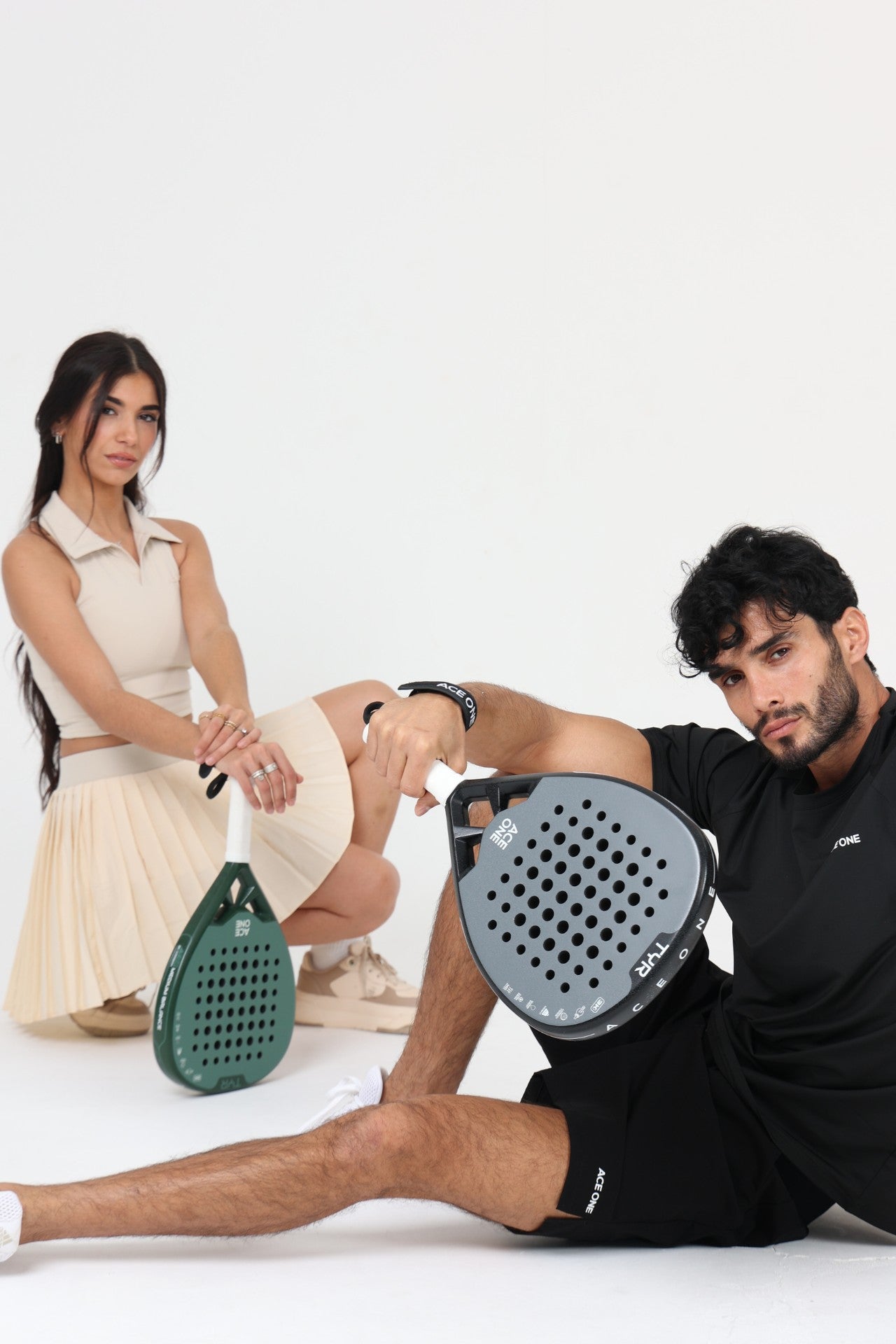
The racket is the cheapest part of owning a racket. You buy it once. Then, for as long as you keep playing, you keep buying the four small things that actually decide how your padel feels week to week: overgrips, balls, a ball pressurizer, and a frame protector. Nobody budgets for them, nobody schedules them, and that is exactly why most amateurs play half their season on dead grip, flat balls, and a frame quietly chipping itself toward a crack.
This is the consumables map. Not a comparison of brands, but a single decision page that tells you what you keep replacing, how often, what it actually costs, and which of our deeper guides to read for each one. Think of it as the maintenance dashboard for your padel kit.
TL;DR
- Four consumables, four clocks: overgrip (every 8 to 10 hours of play), balls (every 3 to 5 matches), pressurizer (refilled with every new can), frame protector (every 6 to 12 months).
- The grip matters most: it is the cheapest item and the one you touch every single shot, yet it is the one amateurs neglect longest.
- Balls are a feel decision, not a bin decision: pressurized balls go flat in days, pressureless balls wear bald instead. Different clocks, different fixes.
- Running cost is real but small: an active amateur spends roughly 150 to 300 euros a year on consumables, far less than court fees, and entirely controllable.
- Replace on a clock, not a whim: the cost of replacing on time is trivial; the cost of replacing late is lost matches and, with the protector, a cracked frame.

What counts as a padel consumable (and why your racket does not)
A consumable is any part of your kit that degrades through normal use and is designed to be replaced, not repaired. Your racket is not a consumable. Treated well, it lasts seasons. The four items below are the ones that wear out on a predictable schedule, and budgeting for them is the difference between a kit that performs and a kit that slowly betrays you.
There is a useful split inside our gear coverage. One side is the racket-selection decision you make rarely: weave, shape, weight, grip size. The other side is the consumables decision you make again and again. This guide is the hub for that second side. If you are still on the first side, start with how to choose a padel racket and come back here once the racket is sorted.
The four consumables, in order of how often your hand and eye notice them:
- Overgrip: the wrap on the handle. Touched every shot. Cheapest, fastest to die.
- Balls: the felt and the pressure. Decides bounce, speed, and how the rally reads.
- Ball pressurizer: not a part of the racket, but a consumable-extender that resets ball pressure between sessions.
- Frame protector: the tape guarding the top of the head. Slowest to wear, highest cost if you ignore it.
The four consumables and their replacement clocks
Each consumable has its own clock, its own warning signal, and its own honest cost cadence. We have a full deep-dive guide for each, linked in the final column. This table is the map; the linked articles are the territory.
| Consumable | Replacement clock | The warning signal | Cost cadence | Deep-dive guide |
|---|---|---|---|---|
| Overgrip | Every 8 to 10 hours of play (recreational: every 4 to 6 matches; heavy sweater: every session) | Slipping on contact, hard or glazed feel, fraying at the edge | A few euros per pack of three, several packs a year | How often to change your overgrip |
| Pressurized balls | Every 3 to 5 matches (competitive: every 1 to 2) | Dead bounce, dull thud off the strings, balls sitting up to be smashed | 5 to 8 euros per can of three, budget 5 to 15 euros a month | Pressurized vs pressureless balls |
| Ball pressurizer | Refill every time you open a new can; the device itself lasts years | Balls that no longer recover pressure overnight (rubber is worn, not the device) | One-time purchase, then it pays for itself across cans | Is a ball pressurizer worth it |
| Frame protector | Every 6 to 12 months (heavy back-wall players: every 3 to 6 months) | Tape thinned to the frame, chips appearing at the top of the head | A few euros per strip, one or two strips a year | How to install a frame protector |
Read the table top to bottom and a pattern appears. The items you replace most often are the cheapest, and the item you replace least often is the one that protects your most expensive asset. The overgrip is a coffee. The protector is your racket's insurance policy. Neither costs much; both cost you dearly when skipped.

The running-cost reality, in actual numbers
Here is the part nobody puts on paper. An active amateur who plays two or three times a week spends, across a full year, somewhere between 150 and 300 euros on consumables. That sounds like a lot until you compare it to court fees, which for the same player run several times higher. The consumables are the small, controllable line on the budget, and they are the line that most directly touches how you play.
Break it down. Balls are the biggest recurring item: at 5 to 8 euros a can lasting 3 to 5 matches, a twice-weekly player goes through roughly a can every week or two, landing around 5 to 15 euros a month. Overgrips are next: a few euros per pack of three, with an active player using six to ten packs a year. The pressurizer is a one-time purchase that quietly lowers the ball line by extending each can. The protector is the smallest annual spend, one or two strips a year, and the highest-leverage one, because the alternative is a chipped or cracked frame worth far more.
The honest caveat: these are ranges, not a price list, and they swing with how often you play and the climate you play in. A heavy sweater in a hot indoor hall burns through overgrips and balls faster than a once-a-week player in a mild outdoor club. Use the numbers as a planning frame, not a promise.
The consumables-budgeting trap (three ways amateurs get this wrong)
Most consumables mistakes are not technique problems or money problems. They are scheduling problems, fixed by replacing on a clock instead of on a whim. Three traps catch nearly everyone.
Trap 1: spending 200 euros on the racket, then neglecting the 3-euro grip
This is the most common and the most backwards. The racket is the rare purchase; the grip is the part your hand actually holds on every shot. A glazed, slipping overgrip undoes a premium frame faster than any spec gap. If you upgrade nothing else this season, keep the overgrip fresh.
Trap 2: binning pressureless balls on the pressurized clock
Pressurized and pressureless balls die differently. Pressurized balls go flat in days as gas escapes the core, so you replace them on a short clock. Pressureless balls hold pressure but wear their felt bald over a much longer life, so you replace them on a wear clock, not a bounce clock. Throwing out pressureless balls because they feel a touch slower wastes money; keep playing until the felt is gone.
Trap 3: replacing the frame protector only after the chip appears
The protector is the one consumable where late replacement is genuinely expensive. By the time you see a chip in the frame, the protective tape has already worn through and the damage is in the carbon, not the tape. Replace the protector when it thins toward the frame, not after the frame takes the hit. This is insurance logic: you renew before the claim, not after.
How to build your padel consumables kit in four steps
You do not need a spreadsheet. You need a small, repeatable habit so that a worn item is a 90-second swap from your bag, never a reason to play a worse match. Here is the routine we use.
- Stock the anchor first. Keep a fresh three-pack of overgrips in your bag at all times. It is the cheapest item, the fastest to wear, and the one you will reach for most. This is your kit's foundation.
- Keep one spare can sealed. A single unopened can of balls in the bag means a flat set is never the end of your session. If you own a pressurizer, store the half-used can inside it so the next session starts on full pressure.
- Carry one protector strip. One spare strip lives in the bag for the day you notice the tape thinning. Installing it takes minutes and saves your frame.
- Audit on a fixed day. Once a month, on a day you will remember, open the bag and check all four. Replace anything past its clock. The audit is the whole system; the clocks only work if someone reads them.
If you want the whole kit in one move, the Pack Performance bundle pairs a racket with overgrips and a bag, which is the fastest way to start with the consumables drawer already half-stocked. For the consumables alone, the accessories shop carries the PRO-LINE overgrips and the backpack that holds them.

Padel consumables FAQ
What is the most important padel consumable to replace on time?
The overgrip. It is the cheapest item and the one your hand contacts on every shot, so a worn grip degrades feel faster and more directly than any other consumable. Replace it roughly every 8 to 10 hours of play, sooner if you sweat heavily.
How much should I budget per year for padel consumables?
An active amateur playing two or three times a week typically spends 150 to 300 euros a year across overgrips, balls, the occasional protector, and a one-time pressurizer. That is a small, controllable line next to court fees, and it scales with how often you play.
Does a ball pressurizer actually save money?
Over time, yes, by extending how long each can of pressurized balls stays lively. The device is a one-time purchase that lowers your recurring ball spend, though it cannot revive balls whose rubber has already worn out after many repressurizations.
Do pressureless balls count as a consumable?
Yes, but on a different clock. Pressureless balls hold pressure far longer than pressurized ones, so you replace them when the felt wears bald rather than when the bounce goes flat. They are a slower, wear-based consumable.
The Ace One Padel Verdict
The racket is the decision you make once. The consumables are the decisions you make all season, and they are the ones your game actually feels. At Ace One Padel, we have written the full guide for each of the four, and this page is the map that ties them together: overgrip on an hours clock, balls on a match clock, pressurizer to extend every can, protector on a calendar clock.
The big idea is simple. Your kit does not get worse all at once. It gets worse one neglected consumable at a time, and you stop noticing because the decline is slow. The fix is not more money, it is a clock and a monthly audit.
Manage the consumables and the racket takes care of itself. Neglect them and the best frame in the world plays like a tired one. Budget the small line and the whole kit performs. Skip it and you pay the same money for a slower game.
Start with the grip, because the grip is where your hand lives. Keep one of everything in the bag, because a spare is the difference between a swap and a sacrifice. Audit on a fixed day, because the clocks only matter if someone reads them. Browse the PRO-LINE accessories to stock the drawer, and pair them with a TŸR or Cøre racket worth protecting.
For reference on the wider numbers, the International Padel Federation documents the competitive standards these consumables are built around, and independent breakdowns such as the Racquet Sports Institute spend analysis confirm that consumables are a small, controllable share of what playing padel actually costs.
Share:
How a Padel Backhand Actually Works: Two Hands, One Hand, and the Kinetic Chain That Decides Both (2026 Guide)
Padel Scoring Rules Explained: 15, 30, 40 and the Three Ways to Settle a Deuce (2026 Guide)