
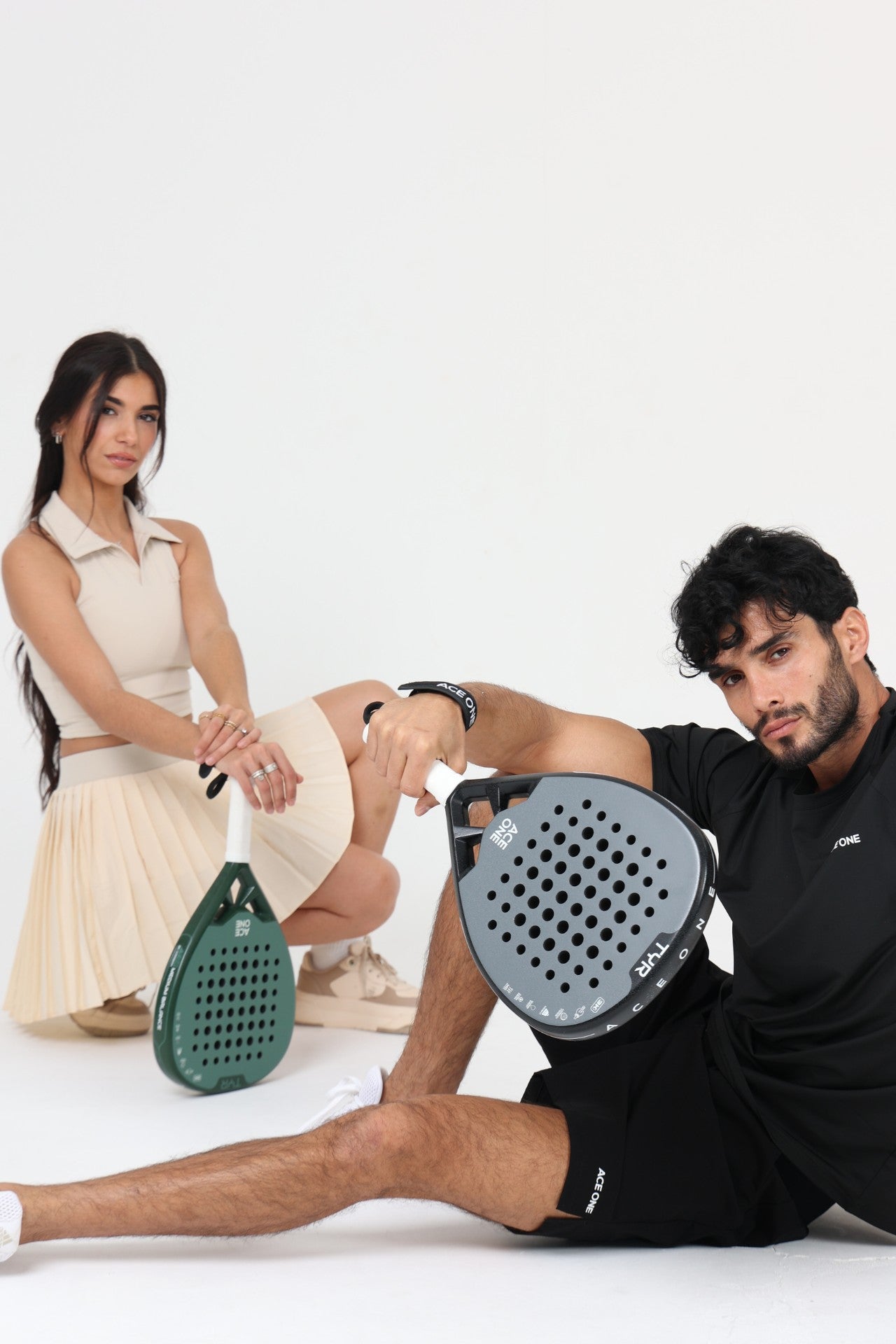
Most padel racket guides hand you a list of features: weave, shape, weight, balance, grip. Then leave you with twelve product pages and four browser tabs. The problem is not the information. The problem is that no one shows you the order in which the four decisions depend on each other. Pick weight before level, and the racket fights you for a season before you sell it.
At Ace One Padel, we have published a four-piece cluster: a weave guide, a shape guide, a weight and balance guide, and a grip-size guide. This article ties all four into one decision flow you run before you click buy.
TL;DR
- Decisions in order: level, then shape, then weight, then weave. Grip is tuned after. Inverting the order is the most common buyer mistake.
- Weave drives feel: 3K plus Soft EVA gives forgiveness and control, 12K gives stiffness and power. Brand calls it comfort vs power, lab calls it dwell time vs energy return.
- Shape decides angle: round equals sweet spot, teardrop equals balance, diamond equals power. Stroke biomechanics decide, not fantasy.
- Weight scales endurance: 355 to 370 grams head-light is the safe answer for two-to-three sessions a week. Above 380 head-heavy is for trained competitors.
- Grip is tuning: one stock size, you add overgrips to dial. The only step that is consumable and reversible.
Why most padel racket guides fail you
If you have read three buying guides this month, you know the four ingredients. You probably know the shortcut: beginners get round and light, intermediates get teardrop and medium, advanced players get diamond and heavy.
That is true the way a recipe ingredient list is true: necessary, and useless on its own. What it leaves out is dependency order. Pick a diamond plus 380-gram head-heavy plus 12K when your shoulder tolerance is two sessions a week, and you have not bought a racket. You have bought a four-month elbow injury and a Vinted listing.
The fix is to run the four decisions in dependency order. Level constrains shape. Shape constrains weight. Weight constrains weave. Grip is tuned after.
The four decisions that build a padel racket
A padel racket is the sum of four design choices. Three of them are fixed at purchase. The fourth is yours to tune.
Decision 1, the carbon weave (and the EVA core behind it). A 3K weave has thicker bundles spaced apart. It flexes on contact, dwells longer on the ball, forgives off-centre hits. Pair 3K with Soft EVA and you get the most tolerant feel on the market. A 12K weave packs thinner bundles tighter. It is stiffer, returns energy faster, punishes mishits. The brand position is the industry consensus: 3K plus Soft EVA equals control, 12K equals power. The educational pages of the International Padel Federation and the LTA padel guidance confirm this stack.
Decision 2, the head shape. Round, teardrop, or diamond. Round has the largest sweet spot, low on the face, most forgiving. Teardrop pulls the sweet spot slightly higher, splitting forgiveness and power. Diamond pushes it to the top, rewarding a clean swing path with explosive output and punishing anything else. Your honest stroke biomechanics, not your aspirational profile, decide which works.
Decision 3, the weight and balance. A strung racket weighs 350 to 400 grams. Balance sits between 255 millimetres (head-light) and 290 millimetres (head-heavy). Light plus head-light equals quick volleys and low fatigue. Heavy plus head-heavy equals smash speed at the cost of arm load. Two rackets at the same total weight feel different if their balance points differ by 20 millimetres.
Decision 4, the grip. Padel rackets ship with one stock handle circumference. You tune it with overgrips. One PRO-LINE perforated overgrip adds 1 to 2 millimetres. Two stacked add 3 to 4. The biggest grip-related mistake is treating it as fixed.

The decision flow, step by step
Run the four decisions in this order. Each one narrows the next.
Step 1. Honest player level. Beginner: under one year of regular play, points still won by errors more than winners. Intermediate: two to four years, you can construct a point and you have one shot you trust under pressure. Advanced: five-plus years, you train, you compete, and fitness is part of your padel calendar.
Step 2. Shape, dictated by level. Beginner picks round. Intermediate picks teardrop. Advanced picks teardrop or diamond, depending on whether their best stroke is a smash or a flat finish. The most common error is jumping a tier. Round to diamond skips the geometry that teaches you a clean contact point.
Step 3. Weight and balance, dictated by shape and load tolerance. Round pairs with 355 to 370 grams head-light. Teardrop pairs with 365 to 375 grams medium balance. Diamond pairs with 370 to 385 grams head-heavy. Subtract 5 to 10 grams from the upper end if you have any history of tennis elbow, shoulder impingement, or wrist pain. Hard rule: do not exceed 380 grams unless you have trained for it.
Step 4. Weave, dictated by all of the above. Round-light or teardrop-medium with priority on feel and longevity: 3K plus Soft EVA. Teardrop-medium-heavy or diamond-heavy with priority on power and shot speed: 12K. The weave decision is the last because the first three already wrote it.
Step 5. Grip tuning. Wrap one perforated overgrip, play three sessions. If the handle still slips under sweat, add a second. If the racket feels disconnected from your wrist on overheads, the overgrip is too thick, peel one. This is the only step you iterate on without buying a new racket.
The wrong-stack trap
Getting one decision slightly off is forgivable. Getting two off in opposite directions is the wrong-stack trap. It is the silent reason most amateurs sell their first serious racket before the year is out.
The classic wrong stack is aspirational: diamond plus 380-gram head-heavy plus 12K, picked by an intermediate who watches Premier Padel and thinks the gear pulls the level up. It does not. The diamond demands top-of-face contact you have not drilled. The mass loads your shoulder on every overhead. The 12K returns energy you cannot direct, so unforced errors climb. Three months in, the racket feels alien and you blame the brand.
The signal you have hit a wrong stack: after three to four weeks of adaptation, the racket fights your strongest shot, not your weakest. The weakest will always be hard. If the strongest also stops working, the stack is wrong, not your form.
| Player profile | Shape | Weight + balance | Weave + core | Ace One match |
|---|---|---|---|---|
| Beginner placement | Round | 355 to 365 g, head-light 255 mm | 3K plus Soft EVA | TŸR (any colorway) |
| Intermediate all-court | Round-teardrop hybrid | 365 to 372 g, balanced 270 mm | 3K plus Soft EVA | TŸR |
| Intermediate finisher | Teardrop | 370 to 378 g, slightly head-heavy 275 mm | 12K | Cøre 12K Carbon |
| Advanced power | Diamond or aggressive teardrop | 375 to 385 g, head-heavy 280 mm+ | 12K | Cøre 12K Carbon |
| Returning from injury | Round | 350 to 360 g, deeply head-light | 3K plus Soft EVA | TŸR (any colorway) |
Three player profiles, three correct stacks
To make the flow actionable, here are three concrete amateur profiles. If your situation does not match any, average the two that bracket you.
Profile A, the placement player who plays twice a week. Three years in, points won by depth and patience, smashes functional but not your weapon. Stack: round, 360 grams, head-light at 255 millimetres, 3K plus Soft EVA. Match: the TŸR collection. Tune one perforated overgrip and you are done.
Profile B, the intermediate finisher who plays three or four times a week. Four years in, your forehand smash and your víbora are the shots you trust under pressure. Stack: teardrop, 372 grams, mildly head-heavy at 275 millimetres, 12K. Match: the Cøre 12K Carbon. One overgrip, reassess after eight matches.
Profile C, the kit-builder buying a complete first serious setup. Two years in, upgrading from a no-research beginner racket. You want racket, consumables, and bag in one decision instead of three. Match: the Pack Performance bundle, pairing the Cøre 12K Carbon with a PRO-LINE backpack and a 3-pack of perforated overgrips.

FAQ: the questions buyers actually ask
Should beginners buy a 12K racket because it lasts longer? No. 12K is stiffer, not more durable. Both 3K and 12K are rated for thousands of hits inside their design envelope. Beginners who buy 12K for longevity sell it inside a year because it punishes off-centre contact. Buy 3K plus Soft EVA, learn clean contact, the same racket outlasts the wrong-stack 12K.
How heavy is too heavy for an amateur? 380 grams strung is the ceiling for amateurs not strength-trained for padel. Above 380 you load the shoulder and elbow on every overhead in a way that compounds across a season. Most tennis-elbow cases start with a 385-plus-gram head-heavy racket and three sessions a week.
Does grip size really not matter? Stock size is a starting point, not a final dimension. One overgrip adds 1 to 2 millimetres, two stacked add 3 to 4. That tuning range exceeds the variance between stock rackets. Tune, do not chase.
Can two partners share the same racket? Sometimes, if both are in the same profile. More often they are at different levels with different biomechanics. The cheaper solution is two rackets with different overgrip stacks. Padel rackets are personal kit.
How often should I replace a correctly chosen racket? 18 to 36 months for an amateur playing two to four sessions a week. The wear point is the EVA core, not the carbon face. EVA compresses and loses bounce after 200 to 400 hours of contact. You feel it before you see it.
The Ace One Padel Verdict
Most amateurs buy a padel racket the way they buy running shoes: by colour, by feel in the shop, by the brand. With shoes that gets you a shoe. With a padel racket it gets you a four-month coaching invoice and a Vinted listing.
The order is not optional. Level decides shape. Shape decides weight. Weight decides weave. Grip is what you tune after. The badge is what you stick on Instagram. The stack is what you take to court.
Browse the Ace One Padel rackets collection for the TŸR control line, the Cøre 12K Carbon for power, or the Pack Performance bundle if you want the complete decision shipped in one box. The right stack does not make you a better player overnight. It stops your gear from making you a worse one.
Share:
Padel Weekly Training Plan: The 5-Day Rhythm That Actually Improves Amateurs (2026 Guide)
Padel Partner Communication: The 7 Calls That Turn Two Players Into One Team (2026 Guide)