
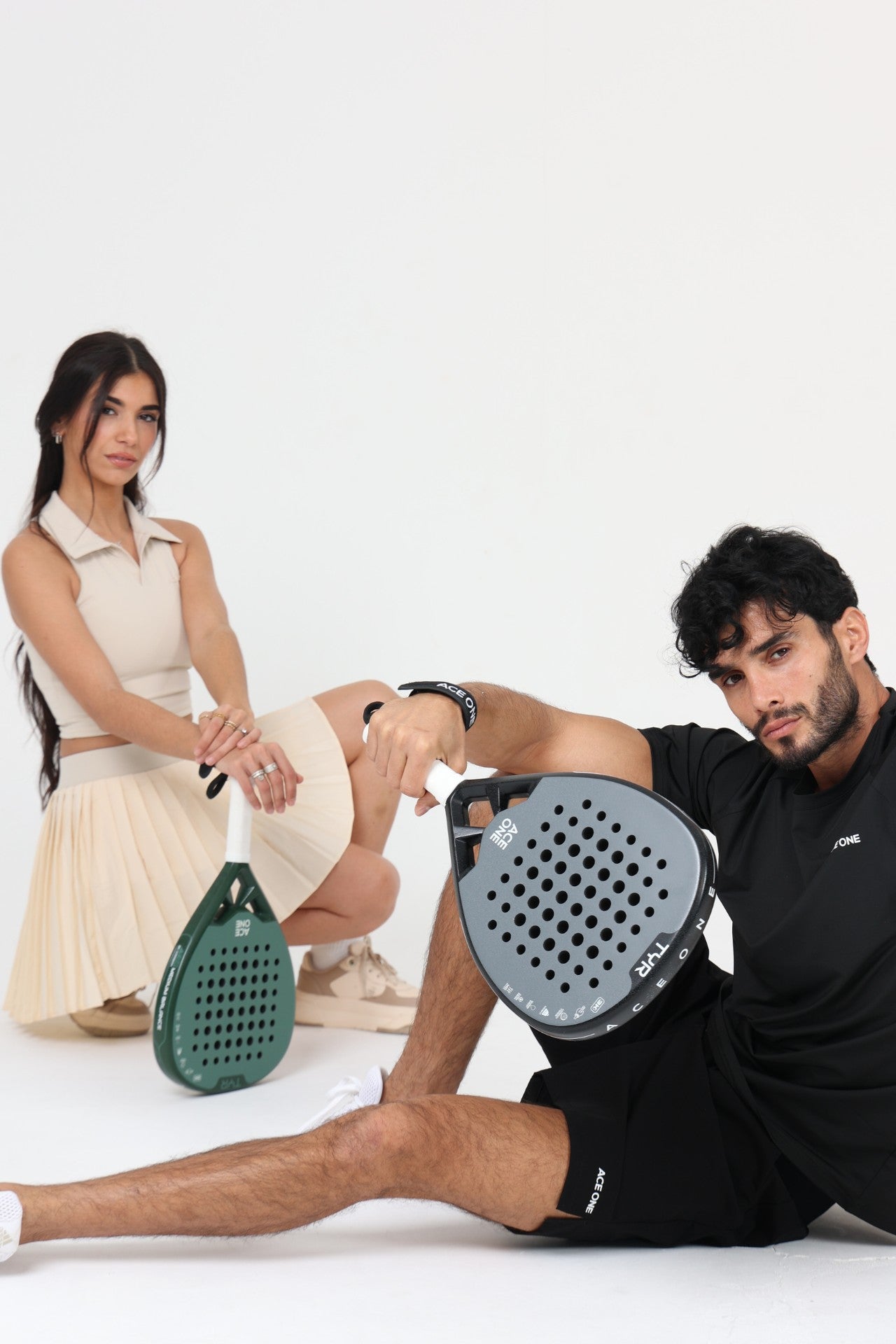
You probably cannot name three parts of the racket in your hand. You know it is a 12K or a 3K. You know it is heavy or light. You know it has a black handle and a few stickers. Beyond that, the object you swing five thousand times a season is, to most amateurs, a single black blob. That gap between what you carry and what you can describe is the gap between buying a racket and tuning one.
At Ace One Padel, we get the same question every week from new players: "what is actually inside this thing, and which part decides what?" This guide is the answer. Three regions, one bridge, one protector, and the four levers you can pull on a racket you already own.
TL;DR
- Three regions: handle for the hand, heart for the connection, head for the strike. Every racket has the same three.
- The bridge owns rigidity: open bridge for manoeuvrability, closed bridge for stability and vibration absorption.
- The protector is your one in-life mod: 3 to 10 grams, head-zone weight, can shift balance up to 5 mm.
- Three protector traps: the cheap silicone, the un-balanced wrap, the no-protector ego.
- Match the parts to your stack: closed-bridge frame for control, open-bridge for finishing, protector tuned to balance, overgrip tuned to feel.
Why most amateurs cannot name a single part of their own racket
The padel industry talks in shape and weave. Round, teardrop, diamond. 3K, 12K, 18K. That is enough vocabulary to walk into a shop and walk out with something. It is not enough to play with the racket you bought.
The frame is not one piece. It is an assembly of three regions, two of which the player never touches with the ball, and one of which the player can replace in fifteen minutes for under ten euros. That tells you which part is the most under-discussed and which is the most over-discussed.
If a player cannot point to the bridge of their racket and say "that is what makes this frame stiff," they cannot diagnose why their wrist is sore, why their volleys feel dead, or why the racket they loved at Christmas feels wrong in May. The frame is not abstract. It is a map, and you can read it.

The three regions every padel racket has
Every padel racket on every shelf in every shop on every continent has the same three regions. The materials change. The names sometimes change between brands. The geometry does not.
The handle. 20 cm long by FIP regulation. This is the cylindrical column you grip. It hides a foam-filled bone (the inside structure) and is wrapped in a base grip from the factory. You add overgrip layers on top to tune circumference. The handle's only on-court job is to transmit feel from the head back to your hand. A handle that is too thin pinches your fingers. A handle that is too thick locks your wrist.
The heart, also called the throat. This is the narrow tapered region between the handle and the head. Most amateurs assume the heart is decorative. It is not. The heart is the structural junction between the cylindrical handle bone and the wide playing face. It is also where most of the rigidity-vs-flex compromise gets made, because the bridge that closes off the bottom of the head sits inside the heart. We will come back to the bridge in the next H2.
The head. The wide playing region at the top, with two faces, holes, a frame, and an outer rim. The faces are where the ball strikes. The frame surrounds and stiffens. The holes (between 9 and 13 mm by FIP rules) tune aerodynamics. The outer rim is where the protector goes.
The bridge: where rigidity actually lives
If the heart is the connecting region, the bridge is the structural piece inside it. The bridge is the curved or angular bar that closes the bottom of the playing face and joins it to the handle bone. Without the bridge, the head would flap. With the bridge, the head holds shape under impact.
Bridges come in three families:
- Open bridge. The most common geometry. A single curved arc with empty space between the bridge and the bottom of the faces. Less air resistance on swing, more manoeuvrability, slightly less stability on off-centre hits.
- Closed bridge. A solid panel that fills the heart cavity. Pushes a few grams of weight back toward the handle (a small balance shift toward control), absorbs more vibration, costs you a sliver of swing speed.
- Reinforced or double bridge. A closed bridge with a second internal rib, often carbon-reinforced. Maximum stability and vibration absorption, used on competition and power frames where rigidity is the headline spec.
This is why two rackets with identical 12K weave and identical 360 g static weight can feel completely different. The bridge geometry is what your forearm reads on every contact. We covered the weave decision and the weight decision in their own pieces; the bridge is the third axis those guides reference and never fully unpack. Every Cøre 12K Carbon ships with a closed reinforced bridge for stability under power. Every TŸR ships with a more open geometry for handling.
The frame protector: the only part you can swap mid-season
The shape, the weave, the weight, the bridge. All four of those are decided by the manufacturer and frozen the moment you buy the racket. The protector is the only frame component you can change without changing the racket itself.
A frame protector is a strip of silicone, rubber, PVC, PU, or carbon-fibre that wraps the outer edge of the head. It does three things, in order of importance to your wallet:
- Stops scraping damage. The first time your racket head hits the corner of the wall or scrapes the plexiglass on a high lob, the protector takes the hit instead of the carbon.
- Tunes balance. A protector adds 3 to 10 grams at the very top of the head. That is the highest-leverage gram in the entire frame, because it sits at the maximum lever-arm distance from your hand. According to industry data, 5 g at the head shifts the balance point by roughly 2 to 3 mm toward head-heavy.
- Modulates vibration. Silicone and rubber protectors absorb a small but felt amount of high-frequency vibration. PVC and carbon protectors are stiffer and let more feel through.
The trade-off table looks like this:
| Material | Weight added | Balance shift | Vibration | Best for |
|---|---|---|---|---|
| PVC | 3-5 g | +1-2 mm | Low absorption | Players who chose their balance |
| Silicone | 6-8 g | +2-3 mm | Medium absorption | Most amateurs, easiest install |
| Rubber | 8-10 g | +3-4 mm | High absorption | Sensitive elbows, vibration-prone |
| PU / hybrid | 5-7 g | +2-3 mm | Medium absorption | Tournament players |
| Carbon-fibre weave | 2-4 g | +1 mm | Minimal | Players who want feel, not protection |
Install rule of thumb: clean the rim with isopropyl alcohol, peel the adhesive backing, anchor at the top of the head, and warm the strip with a hairdryer as you press it down each side. Twenty minutes including drying. FIP-affiliated shops and LTA Padel coaching pages both classify the protector as a maintenance item, not a performance accessory, but the gram-shift is real and worth knowing.

The wrong-protector trap: three ways players sabotage their own balance
Every guide tells you "use a protector". Almost none tell you which protector or how it changes your racket. These are the three traps we see most often in the shop.
Trap 1: the cheapest silicone tube. Five-euro generic silicone protectors are usually 9 to 11 grams of unevenly distributed material. On a 360 g head-light racket the extra weight is fine. On a 365 g head-heavy power frame it pushes balance an extra 4 mm forward, beyond the design intent, and the swing weight you bought for is no longer the swing weight you carry. If you bought a power frame, do not blunt it with a heavy protector.
Trap 2: the un-balanced wrap. A protector applied with a thicker mid-section than ends, or twisted, or with bubbles, creates an asymmetric weight along the rim. The racket no longer rotates around the same axis you trained on. Net volleys feel laggy on one side. Fix is mechanical: remove, clean, reapply with a heat gun working from the centre outward.
Trap 3: the no-protector ego. Some intermediates refuse a protector because "it adds weight and ruins the feel". After two seasons their frame edge is chipped, the carbon is exposed, and a small wall scrape becomes a structural crack. A 5 g silicone strip costs 8 euros. A new frame costs 250 to 400. The maths writes itself. Same family of cost-math we walked through in our overgrip frequency guide.
What this asks of your kit
You can read the anatomy of any racket on any shelf now. The next question is which racket and which protector match how you actually play.
Right-side defenders and control players who want a wide sweet spot and forgiving handling are best served by the TŸR collection: 3K weave, soft EVA core, more open bridge geometry. Pair it with a 6 to 8 g silicone protector to add a touch of stability without changing the head-light feel.
Left-side finishers and attacking players who already generate their own power want the Cøre 12K Carbon: rigid 12K weave, reinforced closed bridge, head-heavy balance. Keep the protector light (3 to 5 g PVC or carbon) so you do not push balance further forward than the design intent.
Brand-new pairs and kit-builders get the Pack Performance bundle: Cøre 12K racket, three PRO-LINE overgrips, padel backpack. Anatomy and consumables in one box. Add the PRO-LINE perforated overgrips separately if you grip up two layers per session.
Frame parts decide what the racket can do. The protector and overgrip decide what it does for you on Saturday.
Frame anatomy FAQ
What is the heart of a padel racket?
The heart, also called the throat, is the narrow tapered region between the handle and the head. It contains the bridge, which is the structural piece that closes the bottom of the playing face and joins it to the handle bone. The heart is where most of the rigidity-vs-flex compromise gets made on every padel racket.
Does a frame protector really change racket weight and balance?
Yes. A protector adds 3 to 10 grams at the very top of the head, which is the highest leverage point on the entire frame. Five grams at the head shifts the balance point by roughly 2 to 3 millimetres toward head-heavy. That can move a head-light racket into a neutral category, or push a head-heavy racket beyond its design intent.
Open bridge or closed bridge: which is better?
Neither is better. An open bridge has less air resistance, more manoeuvrability, and slightly less stability. A closed bridge pushes a few grams toward the handle, absorbs more vibration, and adds stability at the cost of swing speed. Pick open for control and reflex play, closed or reinforced for power and stability.
How often should I replace my frame protector?
Replace it the moment you see the carbon underneath, or every season for amateurs who play 2 to 3 times per week. A protector that is chipped, peeling, or visibly thinned is no longer protecting and is also throwing off the balance unevenly. Twenty minutes and 8 euros to swap; cheaper than any other frame repair.
The Ace One Padel Verdict
The frame is not a single object. It is a three-part assembly with one structural anchor (the bridge) and one user-replaceable surface (the protector). Most amateurs only know the racket by its weave and its colour. Players who know the parts can pull four levers on the racket they already own, and they will out-tune the player who is still saving for a new one.
Anatomy is not the buying decision. Anatomy is the maintenance decision. The bridge decides what your racket says on contact. The protector decides what it says back to your forearm. The handle and overgrip decide what it says to your hand.
The shop sells you the head. The bridge sells you the rigidity. The protector sells you the balance. The overgrip sells you the fit. Your racket is not what you bought. It is what you tune.
Share:
Premier Padel South American Swing 2026: How Asuncion P2 Quarterfinals Set Up Buenos Aires Home Soil for Tapia
Padel Shot Selection: The Master Decision Flow That Picks Bandeja, Vibora or Smash in 1.4 Seconds (2026 Guide)