
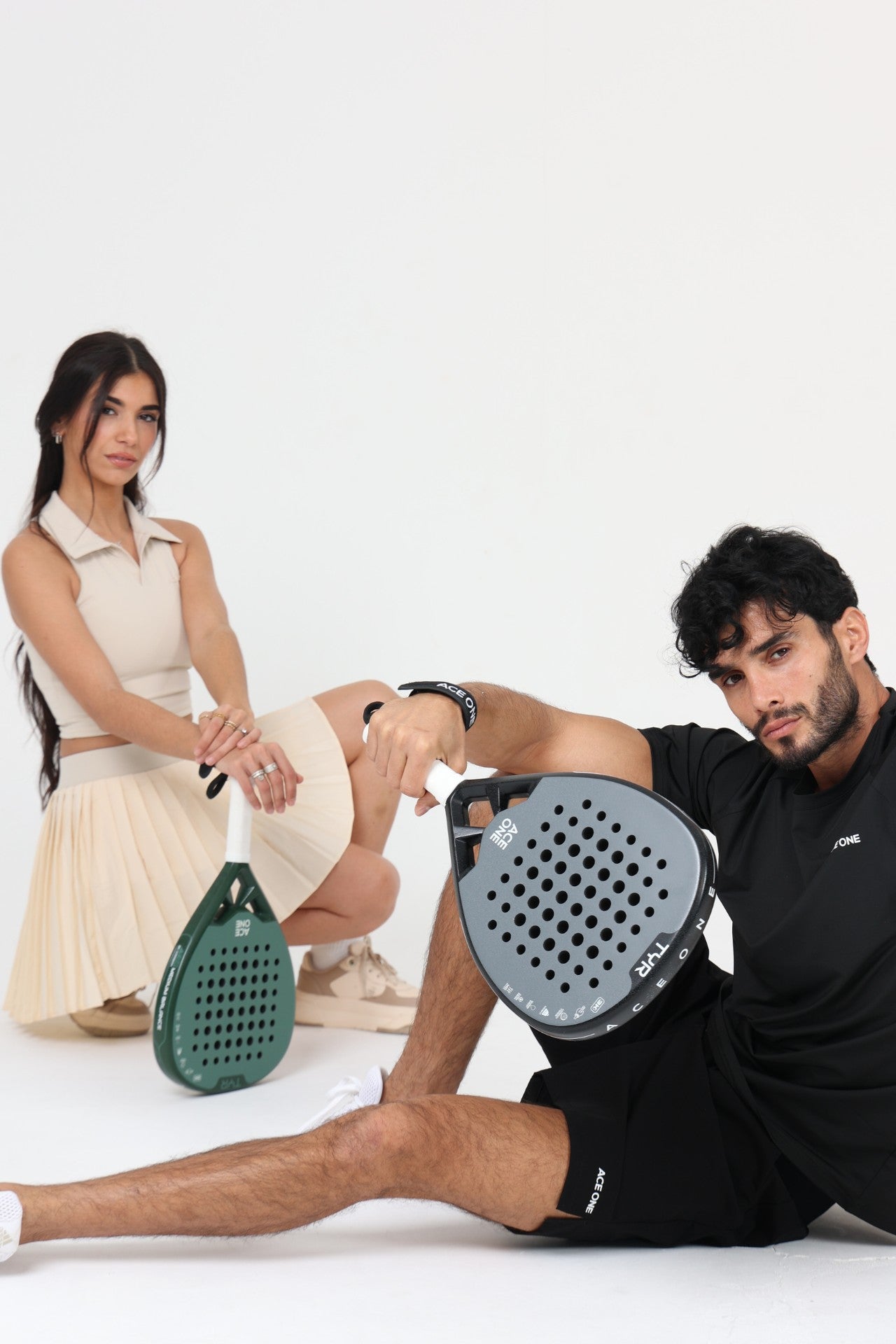
A frame protector is a five-euro accessory. Installed right, it buys you six to twelve months of saved paint, stable balance and resale value. Installed wrong, it lifts off the head in fourteen days and takes the top layer of carbon weave with it on the way out.
Most amateurs never install one. The ones who do split into two camps: the players who heat the tape and clean the frame, and the players who slap it on cold during a five-minute break between matches. Six months later, one camp has a clean racket head. The other camp has a half-peeled strip of PVC, a dust line trapped in adhesive residue, and a frame that already shows the first chip from a back-wall scrape.
This is the install method that separates those two outcomes. Seven steps, a hair dryer, an alcohol wipe, and twenty minutes you spend ONCE every six months instead of every two weeks.
TL;DR
- The protector is the head guard, not a structural part: it shields the contact zone with the back glass and the floor, and shifts your balance by three to twelve grams toward the head.
- The 7-step heat method is the only install that lasts a full season: clean, fold, align, peel halfway, press, heat, set. Skip the heat and you re-install every two weeks.
- Material choice depends on the frame: PVC for heavy hitters, silicone for repositioners, PE foam for the lightest 3K builds that hate added head weight.
- Replace every 6-12 months for amateurs, every 3-6 months for heavy back-wall players: the protector is single-use, not reusable. Once peeled, the adhesive is finished.
- Three install mistakes kill the bond fast: cold install (no heat), dirty frame (no alcohol clean), and midweek pressure (playing within two hours).

What the frame protector actually does (and what it does not)
The padel frame protector is a strip of adhesive tape, typically 30-40 cm long, that wraps around the top of the racket head. Its single job is to take the abrasion when your frame meets the back glass, the side wall, or the floor.
It is not a structural part. It does not change how the frame flexes. It does not add power. It is the cosmetic and abrasion layer between your carbon weave and the things you scrape it on. We covered this slot in our frame anatomy guide. The protector sits above the bridge, on the head's leading edge, and tracks the curve of the frame from one shoulder to the other.
Three things the protector actually does:
- Shields the contact zone: the top 30 cm of the head is where 80% of frame scrapes happen, because that is the part you swing through the back glass on a defensive lob recovery.
- Shifts your balance head-up by 3 to 12 grams: a thin PE foam adds about 3 g, a silicone strip about 6 g, a heavy PVC strip up to 12 g. That changes your swingweight category by a small amount, especially on lighter frames.
- Adds a small aerodynamic noise: the textured grain of a granulated protector catches air on a fast swing, which produces the faint whoosh you hear on a pro broadcast. Cosmetic only, not performance.
What the protector does NOT do: it does not stop a crack from propagating once the frame is already damaged, and it does not protect the heart or the bridge from a hard floor scrape. If you smash your racket on the floor in frustration, the protector saves the paint but not the structure.
The 7-step heat-assisted installation method
This is the canonical method, triangulated from six independent sources and used by every pro stringer we know. Total time: 18-25 minutes, including the 4-hour rest that finishes the bond.
- Clean the frame: wipe the top half of the head with an alcohol pad (70% isopropyl is fine). Two passes minimum. Let the frame air-dry for 60 seconds. If the frame is greasy or has chalk dust, the adhesive bonds to dirt instead of carbon and lifts within a week.
- Fold the protector in half: find the visual center of the strip and crease it lightly. This gives you a reference point for the racket's top apex.
- Peel back the backing on one half: do not peel the whole thing. Half the backing, exposed adhesive on one side only.
- Align the center crease with the racket's top apex: the 12-o'clock point of the frame head. Press the crease down first, then work outward along the exposed half.
- Press from center outward: thumb pressure, slow, no air bubbles. When you reach the shoulder of the racket, stop. Now peel the rest of the backing and repeat on the other side.
- Heat the entire strip with a hair dryer: 30 seconds at medium heat, holding the dryer 10 cm away. Heat softens the adhesive and makes it conform to the curve. Press again with a soft cloth as it cools. Three heat passes is the sweet spot.
- Let it rest for 4 hours minimum before playing: 24 hours is better. The adhesive needs time to cure. Play within 2 hours and the first impact shifts the strip, and the bond never sets.
That is the entire install. The hair dryer step is the one that separates a 6-month bond from a 2-week bond. Skip it and the edges curl on the first humid day. The same heat-activation principle applies across all adhesive-foam tapes, including the industrial benchmark 3M VHB family used in many premium protector bonds.
PVC vs silicone vs PE foam: which protector for which frame
Not all protectors are the same. The three families on the market produce visibly different installs and different durabilities. Most amateurs buy whatever the shop has, and the choice matters more than the price.
| Material | Weight added | Flex | Best for | Visible install marks | Removability |
|---|---|---|---|---|---|
| PVC (standard) | 8-12 g | Rigid | Heavy hitters who scrape walls often | Low (dark adhesive hides smudges) | Single-use, residue likely |
| Silicone (premium) | 5-7 g | Soft, conformable | Players who reposition or change rackets often | Medium (semi-transparent) | Single-use but cleaner peel |
| PE foam (ultra-light) | 2-4 g | Cushioning | 3K Soft EVA frames that hate added head weight | High on light finishes | Single-use, brittle on removal |
| Granulated (rough finish) | 6-10 g | Rigid | Hard-court / outdoor heavy-wear environments | Low | Single-use |
| Transparent (cosmetic) | 3-5 g | Soft | Players who want zero visual change | High (every smudge visible) | Single-use |
| Wide / oversize | 10-15 g | Rigid | Repeated back-wall destroyers | Low | Single-use, heavy residue |
The rule of thumb: lighter frames want lighter protectors, heavier frames can absorb a heavier protector without changing the balance category. A 360 g Cøre 12K Carbon with an 8 g PVC strip still sits in the same swingweight band. A 355 g TŸR 3K with a 12 g PVC strip might tip into a heavier feel than the player wants.
When to replace and when to leave it alone
The frame protector is single-use. Once you peel it off, the adhesive is finished. Reusing a protector is one of the most common pre-tournament mistakes amateurs make: they peel last season's strip thinking it still looks fine, slap it on the new racket, and it lifts off in three games.
Replacement frequency depends on your back-wall habit.
- Amateur, 2-3 sessions a week, mostly net play: replace every 9-12 months, or earlier if you spot peeling.
- Competitive amateur, 4-5 sessions a week, mixed positions: replace every 6-9 months.
- Heavy back-wall player (right-side defender, lots of lob recoveries): replace every 3-6 months. The contact zone takes far more abrasion.
- Coach / club player hitting 6+ sessions a week: replace every 3 months.
Visible wear signs that mean "replace now": edge peeling at either shoulder, cracks along the top apex, loss of color (the matte black going grey), and the dreaded "dust line" (when adhesive residue is visible through the strip because dirt got under the bond).
The leave-it-alone case: if the strip is still flush, fully colored, and has at least 3 mm of grip-edge at each shoulder, do not touch it. A protector that is bonded properly and undamaged should not be replaced on a calendar schedule alone. Inspect monthly, replace on signs. The international padel federation FIP does not regulate protector specs (unlike ball pressure or court dimensions), so manufacturer recommendations are the only standard you have.

The wrong-install trap: three mistakes that strip your protector in 14 days
Most install failures are not material failures. They are method failures. Three patterns account for almost every premature peel we have seen on courts.
Trap 1: the cold install. The player skips the hair dryer step entirely. They press the strip on, eyeball the alignment, and put the racket back in the bag. The adhesive never reaches its activation temperature. On the first humid morning, edge lift starts at one shoulder, propagates inward, and within ten to fourteen days the protector is half-off the frame. Fix: 30 seconds of medium heat, three passes, after pressing.
Trap 2: the dirty frame. The player wipes the frame with a sweat towel and calls it clean. Towel residue is full of cotton fibers and skin oil. The adhesive bonds to that micro-layer, not to the carbon weave underneath. The bond looks fine for 5-7 days, then the entire dust layer slides as one piece and takes the strip with it. Fix: alcohol pad, 70% isopropyl, two passes, 60 seconds dry time.
Trap 3: the midweek pressure. The player installs the protector on a Tuesday at 7 PM, plays on Wednesday at 6 PM. Twenty-three hours is below the curing minimum for most adhesives. The first hard contact at the apex shifts the strip by 0.5 mm, and now the bond has a stress line it cannot recover from. Fix: install on a Saturday morning, play Sunday afternoon. Give the adhesive at least 18-24 hours undisturbed.
Which Ace One Padel kit owners should care most
The protector matters differently depending on which frame is in your hand. Direct kit-bridge for each player profile:
- Right-side defender hitting the TŸR 3K: the 3K Soft EVA finish shows scrape marks fastest because the lighter cosmetic layer is thinner. A silicone or PE foam protector preserves the look without shifting the balance into a heavier feel. Browse the TŸR collection for the colorway that matches your protector choice.
- Left-side finisher hitting the Cøre 12K Carbon: the 12K rigid head concentrates stress at the apex on hard smashes and back-wall lob recoveries. A PVC or granulated protector takes the abrasion and saves the carbon weave. The 8-12 g of added weight is welcome on the 12K's already head-heavy balance.
- Brand-new pair just starting out with the Pack Performance bundle: install the first protector at month 2-3 of play, not at unboxing. New rackets benefit from a brief uncovered period that lets the finish settle and reveals where you actually scrape the frame.
- Anyone carrying the PRO-LINE backpack: a spare protector plus an alcohol wipe lives in the front pouch alongside the PRO-LINE overgrip 3-pack. Two minutes of court-side preparation if the strip lifts mid-tournament.
The pattern across all four profiles: choose the protector material that matches your frame's weight category, install with heat and a clean surface, and replace on signs of wear, not on a calendar. A well-installed protector is invisible work. A badly installed one is a weekly chore.
FAQ
Can I reuse a protector after taking it off? No. The frame protector is designed for single-use. The adhesive loses effectiveness once peeled, and the strip will lift on first contact. Always start with a fresh protector when changing rackets or replacing a worn one.
Do I need a heat gun, or is a hair dryer enough? A hair dryer is enough. A heat gun is overkill for amateur installs and risks overheating the protector. Medium heat from a standard hair dryer at 10 cm distance is the consensus method. Three passes of 10 seconds each is plenty.
How long should I wait before playing after installing a protector? A minimum of 4 hours, and 24 hours is the safer target. The adhesive needs time to fully cure. Playing within 2 hours risks shifting the strip on first contact and breaking the bond before it sets.
Does the protector affect the racket's swingweight or balance? Yes, slightly. The protector adds 3-12 g at the head, depending on material. On a 360 g 12K frame the change is small and usually beneficial. On a lighter 3K frame, a heavy PVC strip can tip the balance into a noticeably heavier feel. Match material to frame weight.
What if my protector starts peeling at one shoulder after a month? Do not press it back down with heat alone. Peel the affected side cleanly, wipe with alcohol, and replace with a fresh strip. Re-pressing a partially lifted protector creates an uneven bond that fails again within days.
The Ace One Padel Verdict
The frame protector is the cheapest, easiest, most overlooked piece of racket maintenance in padel. Five euros, twenty minutes, six to twelve months of saved frame paint and stable balance.
The install is not where you spend. The install is where you tune. Clean the frame. Fold the strip. Heat the bond. Rest the racket. Skip any one of those four and you re-install every two weeks instead of every six months.
The protector is not what saves your racket. The method is what saves your racket. The strip is the cost. The heat is the bond. The rest is the bond that lasts.
Share:
Padel Court Geometry Explained: The Spatial Map Every Shot Reads (2026 Foundation Guide)
Women's Padel Outfit Layering: The Three-Layer Kit From Cold Morning to Hot Afternoon (2026 Guide)