
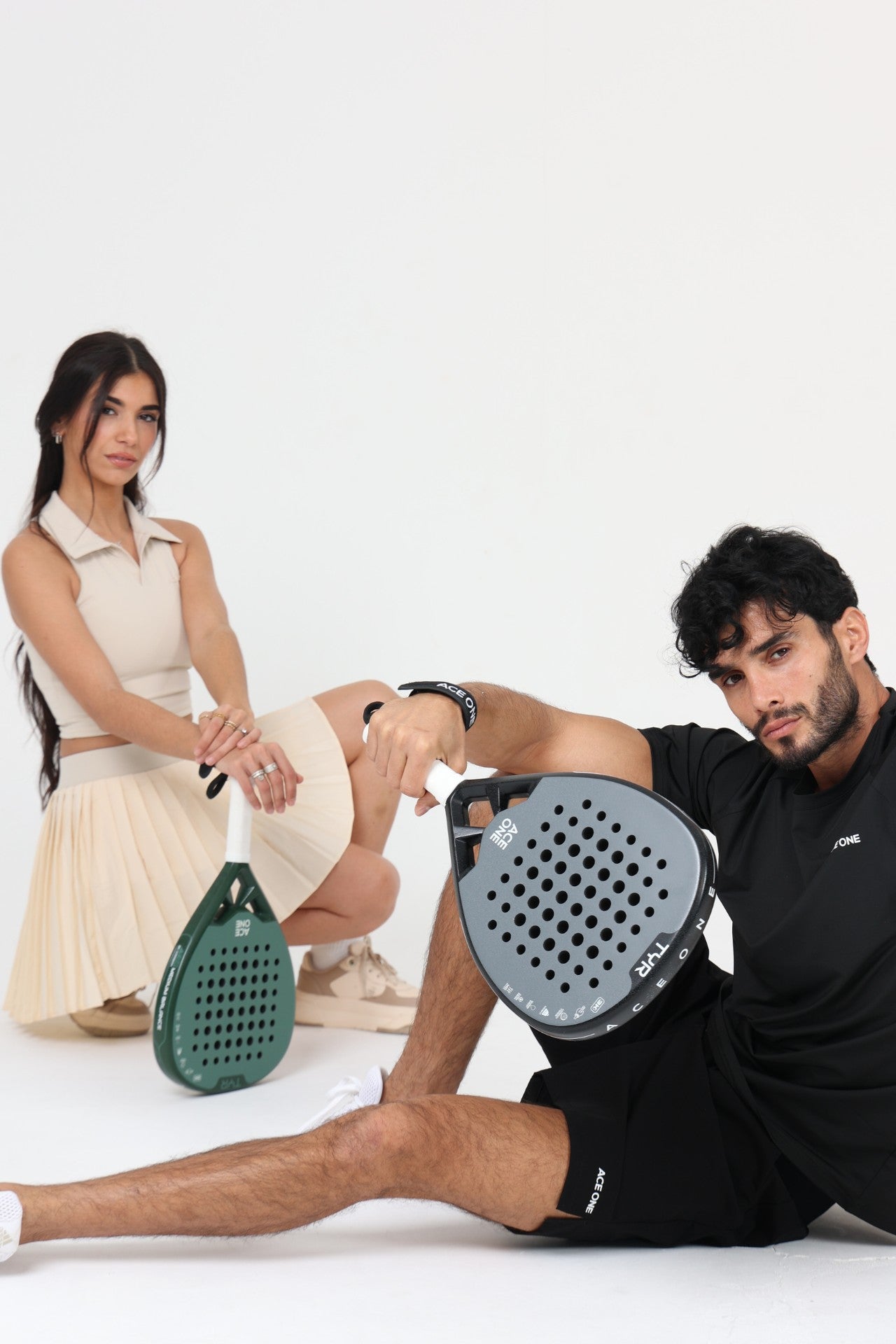
Watch an amateur miss a backhand and you will swear it was the hand that failed. It almost never is. The padel backhand breaks at the feet, breaks at the shoulder turn, breaks a tenth of a second before contact. By the time the racket moves, the point is already lost or already won. This guide breaks down the padel backhand biomechanics so you can see where your shot actually leaks power, and why the choice between one hand and two is a choice between two completely different machines.
TL;DR
- It is a chain, not a swing: power travels feet to hips to trunk to arm to racket. The hand is the last link, not the engine.
- Two backhands, two machines: the two-handed backhand is a 3-segment closed chain (stable, powerful). The one-handed is a 5-segment open chain (longer reach, easier slice).
- Most errors are timing, not grip: research and coaches agree the backhand fails from being late or off-balance far more often than from hand choice.
- Use both: two hands for power and high or fast balls, one hand for reach, slice and the lob off the back glass.
- Gear helps the chain, not the gap: a 3K control racket lengthens dwell and forgives a late contact. It will not fix a missing shoulder turn.
The padel backhand is a chain, and the hand is the last link
Here is the single idea this whole article rests on. A padel stroke is a kinetic chain. Force starts at the ground, travels up through the legs into the hips, from the hips into the trunk, from the trunk into the arm, and only at the very end into the racket face. Sport-science literature on groundstrokes describes exactly this sequence, legs to hips to trunk to arm to racket.
That order matters more than anything you do with your wrist. When the chain fires in sequence, each link adds speed to the one above it, like a whip. When a link is skipped, usually the legs or the trunk, the arm tries to do the whole job alone. That is the arm-only backhand: tense, weak, and the first thing to fall apart under pressure.
We covered the full feet-to-racket sequence for the forehand and overhead in our padel swing biomechanics guide. The backhand uses the same engine. What changes is how many links the chain has, and that depends entirely on whether you hold the racket with one hand or two.

Two-handed vs one-handed: two different kinetic chains
This is where padel backhand biomechanics gets genuinely interesting. A two-handed backhand and a one-handed backhand are not the same stroke with one hand removed. They are two different chains with different numbers of links.
Peer-reviewed biomechanics research on backhand strokes describes the two-handed backhand as roughly a 3-segment sequence (hips and trunk, then the upper arms, then the hands) performed as a closed chain. The one-handed backhand is a longer 5-segment sequence (hips, trunk, upper arm, forearm, hand) performed as an open chain. Fewer links means more rigidity and more direct trunk-driven power. More links means more reach and more freedom at the wrist.
This is the same 7-segment kinetic-chain logic we mapped in the swing biomechanics guide, now split into its two backhand variants. The takeaway is simple. The two-handed backhand trades reach for rigidity and trunk-driven power. The one-handed backhand trades rigidity for reach and wrist freedom. Neither is better. They answer different questions on court.
When to use which: a practical decision table
The two-handed backhand and the one-handed backhand are not a permanent identity you pick once. Strong players carry both and switch by situation. Here is how the consensus among coaches and the biomechanics literature lines up, ball by ball.
| Situation | Best choice | Why |
|---|---|---|
| Fast, high ball at the body | Two hands | Closed chain gives stability and a compact block with intent. |
| Hard drive low over the net | Two hands | Trunk rotation feeds more power into a flat, pressuring ball. |
| Ball pulling you wide to the side wall | One hand | The open chain extends to reach balls two hands cannot. |
| Defensive slice off the back glass | One hand | Wrist freedom makes the slice and the lob far easier. |
| Low ball you must lift to reset | One hand | Slice control buys margin on the defensive lob. |
If you play mostly two-handed and panic the moment a ball drags you wide, the fix is not a new racket. It is learning to drop the top hand and extend with one. That single addition closes the biggest gap in an amateur backhand: the wide ball that used to be a clean winner against you.
How to build a backhand that holds up under pressure
You cannot drill biomechanics in the abstract. You drill a sequence. Here is the order that lets the chain fire correctly, the order coaches return to again and again. Work it in this exact sequence, because each step sets up the one after it.
Step 1: read and split (the ball is still on the other racket)
The backhand starts before the ball crosses the net. Split-step as your opponent strikes so your weight is balanced and you can push off either foot. Late readers are late everywhere downstream.
Step 2: turn the shoulders, not just the arm
Rotate your shoulders and hips away from the net so your side faces your target. This loads the trunk. Skip this turn and you have already cut the trunk link out of your chain, leaving the arm to do everything.
Step 3: set the base, feet about shoulder width
Place your feet roughly shoulder width, knees softly flexed, weight even. A stable base is the single biggest predictor of a clean backhand. When the base is solid, the swing simplifies on its own.
Step 4: keep the preparation compact
Short backswing, not a full wind-up. A compact backhand gives you margin. Under pressure the backhand should feel like a firm block with intent, not a haymaker. Big swings are where late contact turns into a frame shot.
Step 5: contact in front, then let the chain release
Meet the ball in front of your body. For the two-handed version the contact point sits a touch further back than the one-handed. Let the energy you loaded in steps 2 and 3 release through the ball. The follow-through is the result of the chain, not a separate effort.

The wrong-backhand trap: three ways amateurs leak the shot
Almost every broken backhand we see at intermediate level traces back to one of three mistakes. None of them is the hand. All of them are upstream of it.
Trap 1, the arm-only swing. No shoulder turn, no base, just the arm flicking at the ball. The chain is missing its two biggest links, so the shot is weak and the timing window is tiny. Fix: force the shoulder turn in step 2 before you allow the arm to move.
Trap 2, the late contact. The ball is read late, so contact happens beside or behind the body instead of in front. The kinetic chain literature is clear and coaches echo it: most backhand errors come from being late or off-balance, not from grip choice. Fix: split earlier in step 1, not harder at the ball.
Trap 3, the wrong tool for the ball. Forcing two hands on a wide ball that needed one hand of reach, or forcing one hand on a fast body ball that needed two hands of stability. Fix: learn both and let the situation table above pick for you.
Where your racket fits, and where it does not
Gear cannot install a shoulder turn. But the right frame does make a correctly built backhand more forgiving, and that matters most on the control-first backhand that most amateurs are trying to groove.
At Ace One Padel, we built the TŸR in 3K carbon with a Soft EVA core for exactly this reader. The 3K weave flexes a little more and holds the ball on the strings a few milliseconds longer. That extra dwell is forgiveness: when your contact runs slightly late, the softer response keeps the ball on your intended line instead of spraying it. For a backhand that is still being grooved, that tolerance is worth real points.
If your backhand is already a weapon and you are chasing flat, low drives that pressure opponents, the stiffer Cøre 12K carbon rewards the trunk-driven power of a clean two-handed strike. And if you are building the whole package from scratch, the Pack Performance bundle gets you racket, overgrips and bag in one go. Just remember the order: chain first, racket second. A great frame amplifies a good backhand. It does not replace a missing one.

The Ace One Padel Verdict
The backhand that breaks is not the one with the wrong hand on the racket. It is the one with no base under it and no shoulder turn behind it. Fix the chain, and the hand stops being the problem you thought it was.
So build it in order. Read and split first. Turn the shoulders second. Set the base third. The hand is the last thing that moves, and it should be the last thing you worry about.
Get the chain right, then pick the frame that forgives it. Explore the TŸR 3K control line if you want a backhand that forgives a late contact, and keep one hand free for the wide ball that used to beat you.
Padel backhand FAQ
Is a one-handed or two-handed backhand better in padel?
Neither is universally better. The two-handed backhand gives more power and stability on fast, high or low-drive balls. The one-handed backhand gives more reach and easier slice for wide balls and defensive lobs. Strong players use both and switch by situation.
Why do I keep missing my padel backhand?
Most backhand misses come from being late or off-balance, not from grip choice. If your contact happens beside or behind your body instead of in front, split-step earlier and turn your shoulders before the ball arrives. The hand is rarely the real fault.
Does my racket affect my backhand?
It influences forgiveness, not fundamentals. A 3K control racket holds the ball on the strings slightly longer, which forgives a late contact. It cannot create a shoulder turn or a stable base. Build the technique first, then let the frame amplify it.
Where should I make contact on a padel backhand?
In front of your body. The two-handed contact point sits a touch further back than the one-handed, but both should be in front, not level with or behind your hip. Contact in front is what lets the kinetic chain release through the ball.
Share:
BNL Italy Major 2026: How Foro Italico Decides the Race to Barcelona Before It Even Reaches Madrid
The Padel Gear You Keep Replacing: A 2026 Consumables Guide (Overgrips, Balls, Protectors)