
It is 4-3, second set, your serve. The point runs long. Your forearm tightens, the racket twists in your hand on a clean enough off-centre hit, the ball flies wide. You walk back and blame your strings. Except padel rackets do not have strings.
The thing failing you is the grip, not the brand or the tackiness, but the actual size of the handle inside your hand. And here is the part the internet keeps getting wrong: in padel, you do not choose your grip size when you buy the racket. You tune it after, every time you wrap a fresh overgrip. Once you understand this, you stop blaming your forearm for a setup problem.
TL;DR
- One standard size: padel rackets ship with a single base grip circumference around 10.5 cm (4 1/8"). Tennis offers L0 to L5; padel does not.
- You adjust up, never down: brands ship small on purpose so big-hand players can build it up with overgrips. Small-hand players keep it as-is.
- Each overgrip layer adds 1.5 to 2 mm of circumference. Double-wrap with 50/50 overlap adds 3 to 4 mm. That is your tuning range.
- Two honest self-tests: the finger-gap test (index finger fits between fingertips and thumb pad) and the ruler test (palm crease to ring fingertip).
- The body tells you first: forearm fatigue, wrist rotation, thumb-pad blistering, and racket twisting on off-centre hits all point to a grip problem before you ever notice it consciously.
Why padel grip size is the spec everyone gets wrong
Walk into a tennis pro shop and the first question is "L1, L2, L3?". Six SKUs on the wall, each marketed as crucial. That is tennis.
Walk into a padel club and ask the same question and you get a confused look. Padel rackets are made in one size. The handle out of the factory is the handle that goes home with you, every brand, every model, every price point, give or take half a millimetre.
This is not a flaw. Padel swings are shorter, the wrist works harder, and the racket is held tighter on the volley than on a groundstroke. Manufacturers ship a small base grip on purpose, knowing the player will tune it up if they need more, or leave it bare if they do not. Most articles online still write "find your padel grip size" as if you had a choice at checkout. You do not. The choice happens at home, with a fresh overgrip in your hand.
The one number every padel racket starts at
The standard padel handle measures roughly 10.5 cm in circumference (about 4 1/8 inches), with manufacturing tolerance of plus or minus 0.5 mm. Length is around 20 cm. Cross-section is mildly oval, never perfectly round.
For context, the tennis equivalent grid runs from L0 (4 inches, 10.16 cm) up to L5 (4 5/8 inches, 11.75 cm) in 1/8-inch jumps. Padel sits at the very bottom of that range, and it stops there.
A small base handle can be wrapped up. A large base handle cannot easily be shaved down. Starting everyone at the small end solves both a logistics problem (one SKU, one line) and a player-experience problem (everyone can adjust upward).
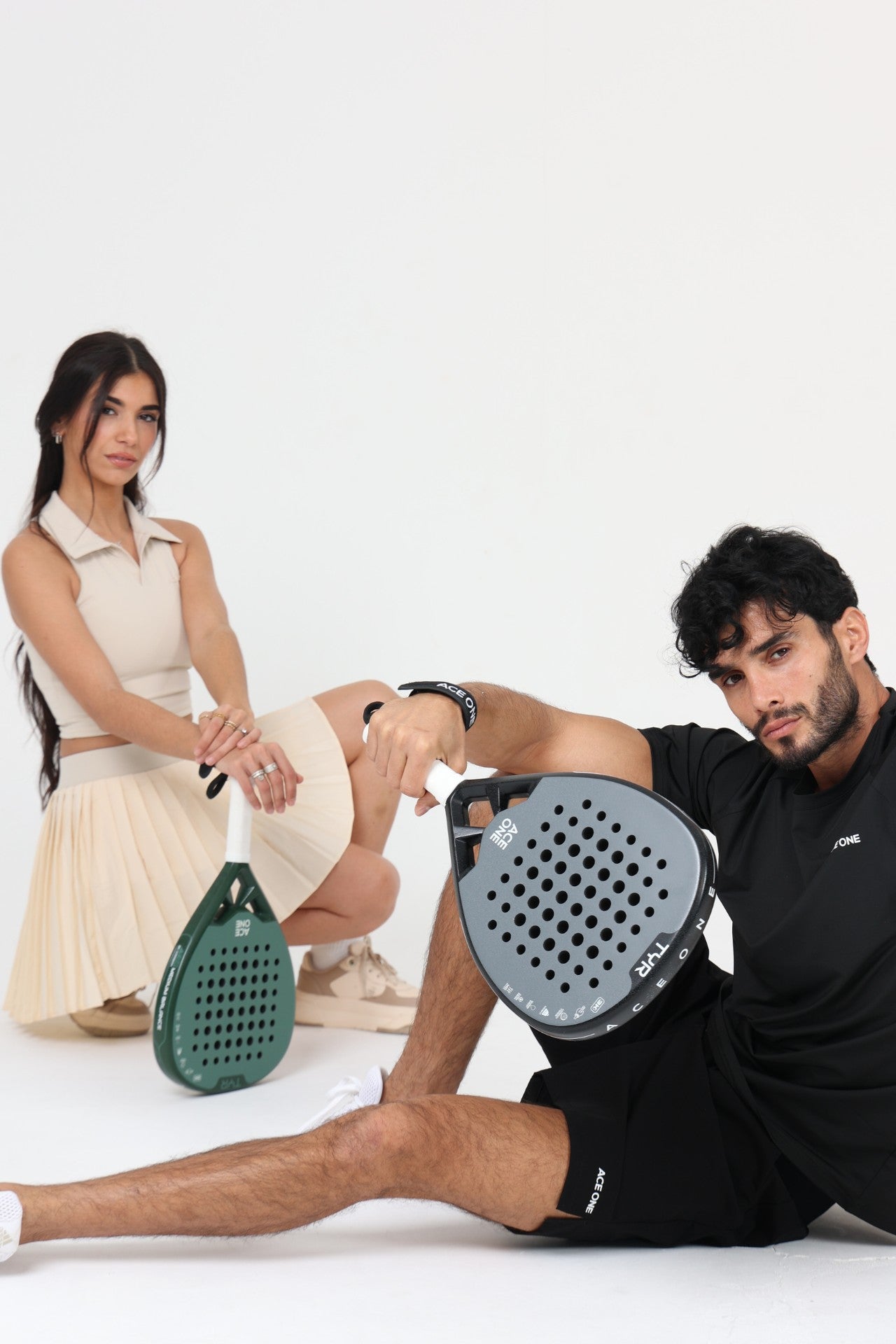
The practical implication: every Ace One Padel racket ships with a handle essentially identical in circumference to every other padel racket on the market. The difference between a TŸR and a Cøre 12K is the carbon weave, the core, the weight and the balance. The handle is a constant.

The two honest tests for your grip-size sweet spot
Two methods come up across every credible padel and racquet-sport source. They take less than a minute and they agree more often than not. If they disagree, trust the on-court tell at the bottom of this section.
Test 1: the finger-gap test
Hold the racket in your hitting hand, flat against your palm, fingers wrapped naturally without squeezing. Look at the gap between the tips of your fingers and the pad of muscle below your thumb (the thenar eminence). Slide the index finger of your other hand into that gap.
If your index finger fits cleanly with no force, the grip is sized correctly. If it has to be jammed in, the grip is too thick. If you can see daylight around it, the grip is too thin. Some sources prefer the pinky for a tighter spec; pick the finger you find easier to read and stick with it.
Test 2: the ruler test
Open your hitting hand flat. Find the bottom horizontal crease on your palm (where the palm meets the wrist). Place the end of a ruler on that crease and measure to the tip of your ring finger. The number you read in centimetres is your target grip circumference.
For most adult men this lands between 10.5 cm and 11.5 cm. For most adult women between 9.5 cm and 10.5 cm. Junior hands measure smaller still. If your reading is below 10.5 cm, you are at or below the factory baseline and you do not need to tune up. If you read above 10.5 cm, that is your overgrip math.
Test 3: the on-court tell
Self-tests get you 80% of the way. The last 20% comes from your hand on a real racket in the second hour of play. The four warning signals further down override every measurement.
How to tune up or down with overgrips: the math
This is where the article you came here to read finally cashes in. Each PRO-LINE perforated overgrip wrapped over the base grip adds 1.5 to 2 mm to the handle's circumference, depending on tackiness, perforation pattern and how tight you wrap it. That single layer is the standard adult adjustment.
The overlap technique controls how much you add. A "minimum overlap" wrap (the next turn just touches the edge of the previous turn) keeps the layer thin and is the default for hands that need almost no adjustment. A "50/50 overlap" wrap (each turn covers half of the previous one) doubles the effective material and adds another 1.5 to 2 mm on top. Stack a second overgrip with 50/50 overlap and you are at 3 to 4 mm of total build-up over the base.
The table below maps measured ring-finger length to the recommended setup. Use it as a starting point, then let the on-court tell adjust by half a layer either way.
| Hand reading (palm crease to ring fingertip) | Setup | Approx. final circumference |
|---|---|---|
| Below 10.0 cm (junior, small adult) | Base grip only, no overgrip | 10.5 cm |
| 10.0 to 10.5 cm (most women, slim male hands) | 1 overgrip, minimum overlap | 10.7 to 11.0 cm |
| 10.5 to 11.0 cm (most adult men) | 1 overgrip, 50/50 overlap | 11.0 to 11.5 cm |
| 11.0 to 11.5 cm (large male hands) | 2 overgrips, 50/50 overlap on the second | 11.5 to 12.0 cm |
| Above 11.5 cm (very large hands) | 2 overgrips plus undergrip cushion or tape build-up | 12.0 to 12.5 cm |

One detail the math hides: each overgrip adds 6 to 9 grams to the handle end, pulling the balance a millimetre or two toward the grip (slightly head-light). The full balance picture is in the racket weight guide; the headline is that heavy overgrip stacking is also a quiet head-light tuning lever.
When the grip is wrong: the four warning signals your body sends
Long before your conscious brain says "this grip feels off", your body is telegraphing it. These four signals show up in roughly this order during a match.
1. Wrist over-rotation on the volley
A grip that is too thin lets the wrist roll further than the swing path needs. You see it on volleys: the racket face opens or closes a few degrees beyond what you intended, balls float wide or sail long. If you correct mid-rally and the issue keeps coming back, suspect the grip before you suspect the technique.
2. Forearm fatigue in the second hour
A grip too small forces a tighter squeeze to keep the racket stable. Flexor muscles work harder per shot, the elbow loads more, and contact tightness becomes contact rigidity. Half a layer too small is the most common cause of "my arm is dead today" on weekend players.
3. Blistering at the base of the thumb
The diagnostic signal of a grip that is too thick. The thenar pad rubs the same point of the handle on every swing because the hand cannot open and close naturally. A blister in week one means one layer too many. Strip back, do not "break it in".
4. Racket leak on off-centre hits
Every padel hit has a margin of off-centre contact. A correctly sized grip absorbs that margin; a wrong grip lets the racket twist in your hand on impact. A clean swing producing a wobble two or three times a set means the racket is losing micro-contact with your palm. Tune up half a layer, not a full one.
Climate and sweat: the variable nobody plans for
Grip size is not static. The same hand on the same handle measures differently in summer than in winter because of two factors: hand swell from heat and overgrip absorption from sweat.
Hands swell up to 2 to 3% in volume in heat. A grip that fit perfectly in March may feel half a millimetre too tight in July. A wet overgrip swells slightly and then compresses on impact, behaving like a thinner layer than the dry spec implies.
The practical rule: outdoor play above 25 °C, strip one half-layer (swap a 50/50-overlap layer for a minimum-overlap one). Winter indoor play below 15 °C with cold dry hands, add a half-layer. The wear timing is in the overgrip replacement guide; the climate dimension stacks on top of the use-hours dimension.
The Ace One Padel Verdict
Padel does not give you a grip size at the cash register the way tennis does. It gives you a starting point and a roll of overgrip. The decision moves from the shop to your kitchen table.
This is the missing piece of the racket-selection master cluster. Carbon weave sets the dwell. Shape sets the sweet spot. Weight and balance set the swingweight. Grip size sets the handshake between you and the racket on every swing. Get the first three right, fail the fourth, and the racket still feels foreign.
At Ace One Padel, we ship every TŸR and Cøre at the same standard 10.5 cm baseline so you can take it from there. Three lines stitch this article together. Tennis players choose their grip. Padel players tune theirs. The shop sells you the racket, the overgrip sells you the fit.
If you are starting out, the cleanest setup is to browse the TŸR collection for a 3K Soft EVA control frame, add a single PRO-LINE perforated overgrip 3-pack for tuning, and commit to one self-test (finger gap or ruler) before your first session. If you want the full match-ready bundle without thinking about it, the Pack Performance bundle ships the Cøre 12K, the overgrips and the bag together, and you tune from there.
Share:
How to Play Off the Back Glass in Padel: The Defensive Reset That Wins Long Rallies (2026 Guide)
Premier Padel Asuncion P2 2026: 150-Point Race and a Returning Stupa-Lebron