
You can play padel three times this week and still play exactly the same way in three months. Or you can play three times this week and be visibly better in three months. The difference is not effort. It is structure.
A padel weekly training plan is not a pro athlete spreadsheet. It is a sustainable rhythm that protects your elbow, builds repeatable technique, and stops you re-learning the same shot every Saturday. At Ace One Padel, we have watched amateurs plateau for years on two unstructured matches a week, and we have watched competitors level up in months on a properly weighted three-on-court, two-off-court week. Below is the plan that survives real life.
TL;DR: Padel weekly training plan, 2026 edition
- 3 padel sessions per week is the sweet spot for steady progress (twice is the floor, five+ is competitor territory).
- Add 2 off-court strength sessions and daily 10-minute mobility, not because you want to be ripped but because your elbow and shoulders demand it.
- One full rest day is non-negotiable. Skip it and you accumulate fatigue, not skill.
- Each padel session should target one thing: technique drills, match play, or pattern repetition. Mixing all three in 60 minutes teaches nothing.
- The 10-minute dynamic warm-up before every session is the single biggest injury-prevention lever you control.

How many padel sessions a week is actually enough?
Once a week is recreation, not improvement. Twice a week is the realistic floor for steady progress. Three times a week is where amateurs reliably level up. Five times a week is competitor territory and demands deload weeks built into the calendar.
The number that matters is not "sessions" in the abstract. It is repeated exposure to the same patterns, close enough together that your nervous system retains them. If your second session of the week happens 13 days after the first, you are not training. You are starting over.
The cross-checked recommendation across coaching sources, federations, and serious amateur communities is consistent: 2-3 padel sessions per week, 60 to 120 minutes each, alternated with strength and recovery. After three months at that volume, you are playing 8 to 12 hours per month and your hands are starting to know what to do without you thinking about it. After six months, you are an honest intermediate.
The trap most amateurs fall into: they play four matches a week with no off-court work, no warm-up, no rest day, and no targeted drills. Volume without structure is how you find tennis elbow, not progress.
The 5-day amateur week (sustainable, not extreme)
This is the plan we recommend to a player who works a full-time job, sleeps a normal amount, and wants to be visibly better at padel six months from now without burning out. It assumes you can book three court hours per week.
| Day | Session | Duration | Focus |
|---|---|---|---|
| Mon | Off-court strength | 30 min | Lower body + core (squats, lunges, plank) |
| Tue | Padel session 1 | 75-90 min | Technique drills (one shot only: bandeja OR víbora OR back-glass) |
| Wed | Active recovery | 15-20 min | Mobility, light walk, foam roll |
| Thu | Padel session 2 | 75-90 min | Pattern play (third-ball positioning, net-zone coverage) |
| Fri | Off-court strength | 30 min | Upper body + shoulder stability (rows, external rotation, push-up) |
| Sat | Padel session 3 | 90-120 min | Match play (apply the week's drills under pressure) |
| Sun | Full rest | 0 min | No padel, no gym. Sleep, eat, rest. |
Three on-court hours, one hour of strength, twenty minutes of mobility, one full rest day. Roughly 5 hours of training per week. It fits inside a working life. It is the floor of what produces visible improvement, not the ceiling.
On-court priorities: what each session should target
Every padel session you book should answer one question: what specifically am I trying to get better at today? "Playing well" is not a target. "Hitting 30 bandejas in a row, then 30 víboras, then 30 of each on the move" is.
The amateur week we just outlined gives each session a job. Tuesday is technique: pick one shot from our bandeja, víbora, or back-glass guides and drill it for 30 minutes before any free play. Thursday is patterns: chain shots together: serve plus first volley, third-ball positioning, lob-to-bandeja-to-net-recovery. Saturday is match play: apply the week's drills under pressure, accept that you will lose some points trying to use them, and resist reverting to the safe shot you already had.
Three sessions, three jobs. If the same session tries to do all three, none of them get done. The hour you spend mixing drills and matches teaches your hands less than 30 focused minutes on a single shot. Specificity beats volume every time.
Off-court conditioning that protects your elbow and shoulders
Tennis elbow (lateral epicondylitis) is the most common overuse injury in padel. The forearm and shoulder structures take repeated, asymmetric, eccentric loads every session: the off-hand drives, the rotator cuff brakes, the elbow absorbs vibration. Skip the off-court work and one of three things happens within six months: you taper down to one session a week, you reach for ibuprofen before every match, or you stop.
The two strength sessions in the plan are short and focused. They are not bodybuilding. Monday: lower body and core: 3 sets of 10 squats, 3 sets of 8 lunges per side, 3 sets of 30-second planks. Twenty minutes. Friday: upper body and shoulder stability: 3 sets of 10 rows, 3 sets of 12 external rotations with a light band, 3 sets of 8 push-ups, 3 sets of 30-second side planks. Twenty-five minutes.
Add daily 10-minute mobility before bed: hip openers, thoracic rotations, calf and ankle circles, shoulder pass-throughs with a towel. Boring, repetitive, non-glamorous. Also the difference between a forty-five-year-old who plays three times a week and a forty-five-year-old whose elbow has been on fire since March.

The 10-minute warm-up nobody does but every pro repeats
The single largest injury-prevention lever you control is the warm-up. Static stretching before a match is the wrong tool. Dynamic mobility plus light cardio is the right tool. The protocol that comes up across federation guides, coaching sites, and physiotherapy resources is essentially the same.
Minutes 1-3, light cardio: jog around the court, high knees, side shuffles in both directions, butt-kicks. Get the heart rate above 110 bpm and the body actually warm.
Minutes 4-7, dynamic stretching: 12 leg swings each side, 30 seconds of arm circles small-then-large, 10 torso twists, 8 lunges with rotation per side. No holding, no bouncing. Movement only.
Minutes 8-10, padel-specific: 20 split-step hops, 10 shadow swings on the forehand, 10 on the backhand, 10 imaginary bandejas. Step on court, hit 5 minutes of mini-tennis from the service line, then start the warm-up rally proper.
Skip this and you will play your first six points stiff, miss three of them, and chase the rest of the match from behind. Do it and you walk on court already inside the rally.
What this asks of your kit (and your body)
Three padel sessions a week plus two strength sessions plus daily mobility produces a specific kind of wear. Your overgrip dies in 4-6 weeks instead of 3 months. Change it on schedule, not when it is shredded. Our overgrip frequency guide explains the felt-not-seen signals to watch.
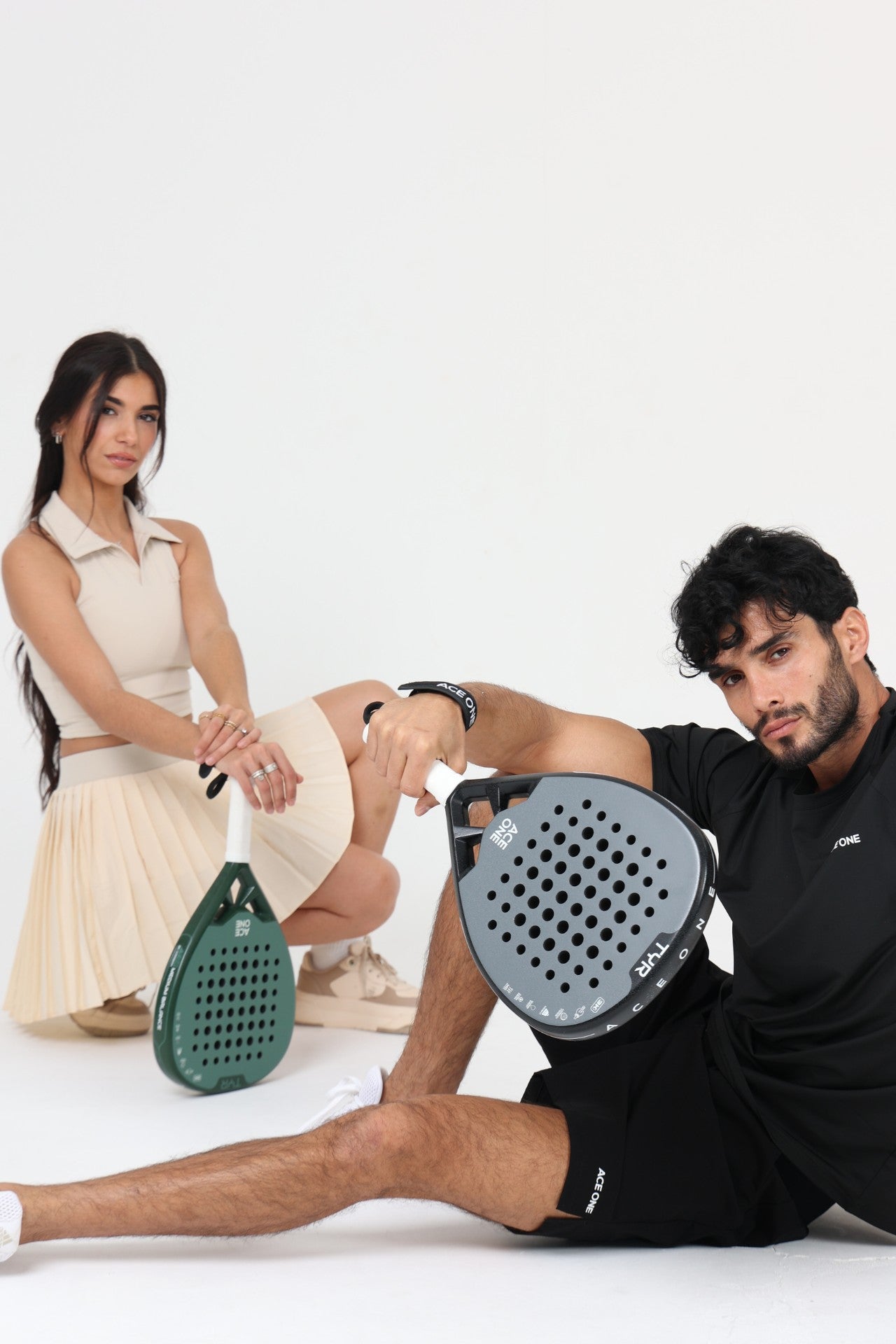
Your racket choice matters more at this volume. A stiff 12K frame transmits more vibration up your forearm; over 3 sessions a week, that compounds. The TŸR collection with its 3K carbon and Soft EVA core absorbs more impact and is the safer bet for amateurs sustaining a real weekly volume. Save the Cøre 12K for the players whose technique already produces the power they need without bracing.
Your kit needs to survive the wash cycle too. Three sessions a week is three rinses, three dries, three packs. Light, breathable activewear that does not pill after ten washes is a quiet multiplier of consistency. Shop our men's and women's activewear for kit built for repeat sessions, not one-photo wear.
Frequently asked questions
Is two padel sessions a week enough to improve?
Yes, but only if both sessions are structured (one technique drill, one match play) and spaced no more than four days apart. Two unstructured matches a week is recreation, not training.
Can I play padel five or six times a week?
You can, but only if you build in a deload week every 4-6 weeks (50% reduction in padel hours and strength volume) and never skip the rest day. Above three sessions, recovery becomes the limiting factor, not effort.
Should I do strength training or play more padel?
Strength training is what allows you to keep playing padel. Replacing one of your two weekly strength sessions with a third padel match is the single fastest path to tennis elbow. Keep the strength.
What if I cannot do daily mobility?
Compress it into 10 minutes after every padel session: hip openers, thoracic rotations, calf and ankle circles, shoulder pass-throughs. The minimum non-negotiable dose is roughly 30 minutes of mobility per week, distributed across at least three days.
The Ace One Padel Verdict
A padel weekly training plan is not a pro spreadsheet. It is a rhythm: three on-court hours, two short strength sessions, daily 10-minute mobility, and one rest day held with the same discipline as the matches. The plan is not what makes you better. The repetition of the plan is what makes you better.
Train often enough to remember last week. Rest enough to absorb this week. Drill enough to deserve the match.
If you are stuck at two unstructured sessions a week and wondering why you have plateaued, the answer is not a new racket. It is a calendar. Get the kit that survives the calendar, change the overgrip the calendar demands, and pick the racket your forearm can sustain. Then book Tuesday, Thursday, and Saturday. The improvement is on the other side of the rhythm.
Share:
Padel Third Ball Positioning: Where the Point Is Actually Won (2026 Guide)
How to Choose a Padel Racket in 2026: The Master Decision Flow Guide