
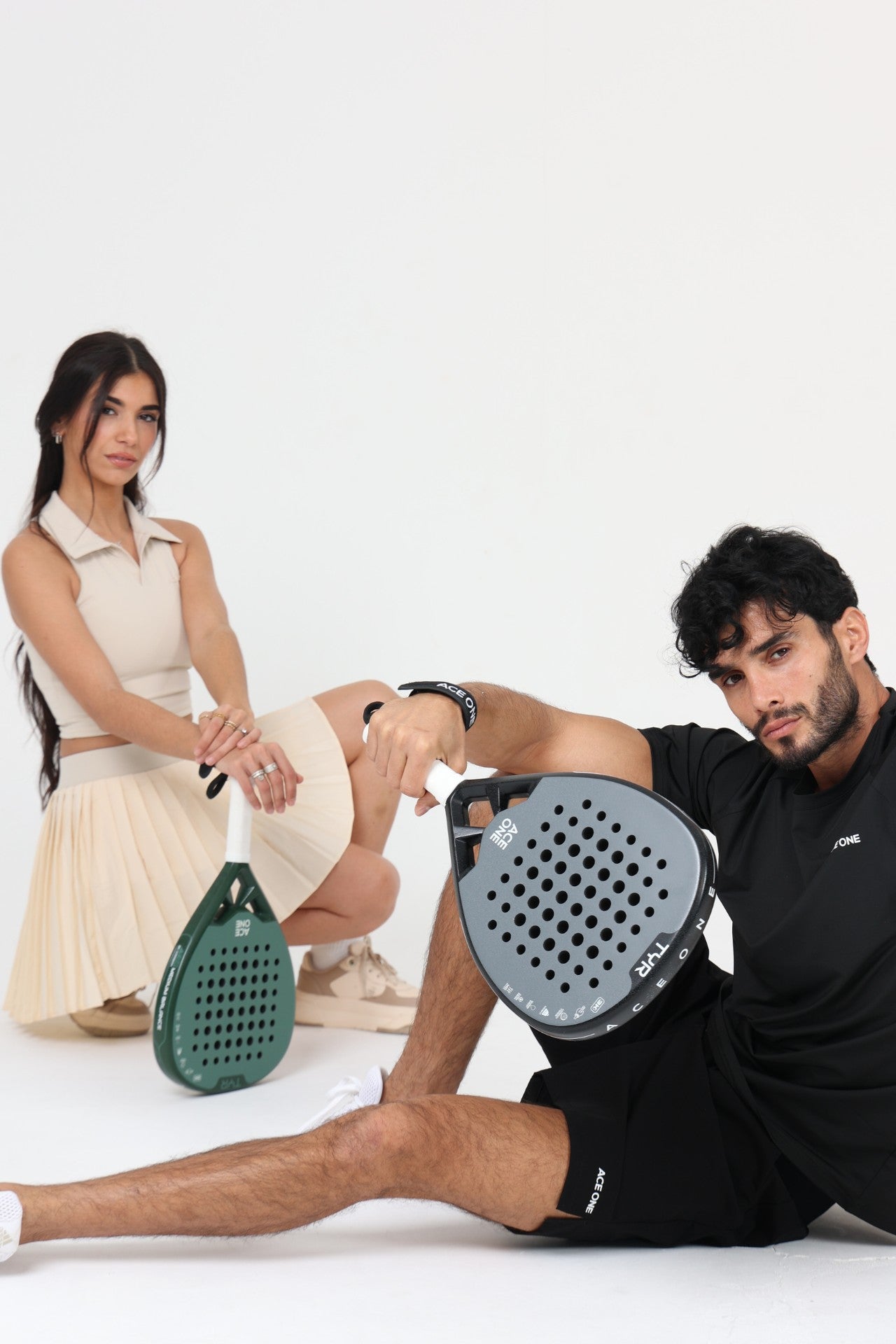
Walk into any padel shop and the rackets are sorted by price. That is the wrong sort. The number that should decide your purchase is not the sticker, it is the fibre: carbon or fiberglass. It changes how the racket feels on day one, how it treats your arm, and how long it stays good.
Most guides frame this as power versus comfort. That framing is tidy and slightly wrong. The real trade-off is retention versus instant ease: fiberglass hands a beginner easy, forgiving pop straight out of the bag and then quietly fades, while carbon asks a little more of your swing and holds its performance for years. Here is how to choose the carbon vs fiberglass padel racket question honestly, without paying for a spec you will never feel.
TL;DR
- Fiberglass: soft, forgiving, easy power, cheaper, kinder on the arm, but loses its pop in roughly 1 to 2 years of regular play.
- Carbon: stiffer, more precise, more durable performance, but it rewards clean contact and transmits more vibration.
- The twist: the fiberglass racket does not die because glass is weak. It dies because the softer face fatigues its trampoline faster.
- Hybrid: carbon frame plus fiberglass face is the honest middle, and the smart first upgrade for most improvers.
- Best of both: a soft-tuned carbon layup gives glass-like comfort with carbon lifespan, which is exactly how the TŸR is built.
The real question is not power versus comfort
Carbon and fiberglass are both fibres woven into a cloth, soaked in resin, and cured into the racket face. They do the same job. They just do it with very different stiffness.
That single difference cascades into everything you feel. A stiff face barely flexes on contact, so energy returns fast and precise. A softer face bends a fraction more and springs it back as a gentle assist. One rewards a swing that already makes its own speed. The other lends speed to a swing that does not yet. So the real question is not "power or comfort", because you can get comfort from carbon and power from fiberglass. It is what you want the racket to do while your technique is still arriving, and how long you want it to keep doing it.
What the two fibres actually do
The gap between the two materials is not marketing. It is mechanical. Carbon fibre is several times stiffer than glass fibre, and that stiffness is the source of every difference you feel on court.
Read left to right, here is what that stiffness gap turns into on court:
- Power source. Carbon returns your own racket-head speed cleanly. Fiberglass adds a small trampoline that flatters a slower, still-developing swing.
- Control. Carbon is more predictable at pace, so precise placements and hard flat finishes are easier to repeat. Fiberglass is looser and more damped, which some players read as vague.
- Arm comfort. Fiberglass swallows more of the impact shock. Carbon passes more of it through to the handle, which matters over long sessions.
- Sweet spot. A softer face tends to forgive off-centre hits more generously. A stiff carbon face makes a mishit obvious.
Peer-reviewed work backs the idea that these differences are real and hard to shop for. A robotic study that measured the sweet spot and handle vibration across padel rackets found that manufacturers simply do not publish this behaviour, leaving buyers to judge by feel alone (Sensors, 2023). You cannot read damping off a box. You can only read the fibre, and reason from there.

The durability twist most guides get backwards
Everyone repeats the same line: carbon lasts, fiberglass does not. It is true in practice and misleading in reason.
Here is the catch. As a raw fibre, glass actually tolerates repeated flexing well. It bends and returns without complaint. So why do fiberglass rackets tend to feel dead after 1 to 2 years of regular play while carbon holds on longer?
Because in a padel racket, the thing that dies is not the frame, it is the pop. The softer glass face flexes more on every single impact, and that constant working gradually fatigues its trampoline until the spring goes flat. The racket does not crack. It just stops giving back. Carbon flexes less per hit, so it keeps its response far longer, though its stiffness makes it a little more prone to a sudden crack from a sharp frame impact or a hit off the glass.
Note what this is not about: weight. Measured across 137 real padel rackets, mass clustered between 316 and 387 grams regardless of build, averaging 363 grams (Sensors, 2022). The carbon-versus-fiberglass difference you feel is stiffness and damping, not scale weight. If you want the full weight story, we broke it down in our padel racket weight guide.
Carbon vs fiberglass vs hybrid: the honest table
Most rackets are not purely one material. Many mix a carbon frame with a fiberglass face, or layer both. Here is how the three builds actually compare.
| What matters | Fiberglass | Carbon | Hybrid |
|---|---|---|---|
| Feel on contact | Soft, springy | Firm, direct | Balanced |
| Where power comes from | Trampoline assist | Your own swing speed | A bit of both |
| Control at pace | Looser | Precise, repeatable | Good |
| Arm comfort / vibration | Most forgiving | Transmits more shock | Forgiving |
| Off-centre forgiveness | Largest | Least | Large |
| Performance lifespan | ~1 to 2 years | Longer, holds its pop | Between the two |
| Price | Lowest | Highest | Middle |
| Best for | Absolute beginners, casual, tight budget | Regular, technically sound players | Improvers, most weekly players |
For whom each material is worth it (and for whom it is not)
The wrong move is to buy the material that suits the player you imagine you are. Buy for the player you are this season.
Fiberglass is worth it if
You are brand new, you play once a week or less, your budget is tight, or your arm is sensitive and wants maximum give. Fiberglass lets a raw swing produce a satisfying ball and protects a developing elbow. It is not worth it if you play two or three times a week, because you will feel it go soft inside a season.
Carbon is worth it if
You play regularly, your contact is reasonably clean, and you want a racket whose performance you can trust match after match for years. Full carbon is not worth it if you are still learning to find the middle of the face every time, because a stiff frame punishes mishits and can nag a sensitive arm. If your elbow is the concern, read our piece on padel and tennis elbow before you commit to a very stiff build.
Hybrid is worth it if
You are past your first months, you play weekly, and you want carbon's lifespan without carbon's harshness. For most improving amateurs, a hybrid or a comfort-tuned carbon is the smartest single racket to own.

One more layer most buyers forget: the face is only half of feel. The core does the other half. A soft EVA core absorbs shock and lengthens dwell no matter what the face is made of, which is why the core you choose matters as much as the fibre. And whichever material you land on, expect the racket to earn or lose its keep over time, as we covered in how long a padel racket lasts.
The MATERIAL-MISREADING trap
Three quick errors sink most first purchases:
- Buying carbon to look serious. A stiff full-carbon frame in a beginner's hand costs comfort and forgiveness, and buys precision you cannot yet use.
- Buying fiberglass to save money forever. If you play weekly, the soft face will fade in a season and you will pay twice.
- Thinking "carbon" is one thing. Carbon comes in weaves that behave very differently, which is the next choice after this one. We mapped it in 3K vs 12K carbon.
The Ace One Padel Verdict
At Ace One Padel, we have built our range entirely in carbon, and this is exactly why. The reason players reach for fiberglass is comfort, damping and a forgiving face. But you do not have to accept a fading racket to get those things. A soft-tuned carbon layup over a Soft EVA core, which is precisely how the TŸR is built, gives you glass-like comfort and anti-vibration feel with carbon's lifespan and control ceiling. When you are ready to make your own power, the full-carbon Cøre 12K is waiting.
So do not shop the fibre by price. Shop it by how long you want the racket to stay as good as the day you bought it. Fiberglass is a great first handshake with the sport. Carbon is the one that grows with you.
Buy the racket that keeps its pop. Buy the comfort you do not have to replace. Buy carbon that forgives. Explore the full Ace One Padel rackets collection and pick the fibre that fits the player you are becoming.
Frequently asked questions
Is carbon or fiberglass better for a beginner?
For an absolute beginner on a tight budget, fiberglass or a hybrid is the friendlier start: softer, more forgiving, kinder on the arm. If you already know you will play weekly, a comfort-tuned carbon lasts longer and saves you a second purchase.
Do fiberglass padel rackets really wear out faster?
Yes, in terms of performance. A fiberglass face flexes more on every hit, so its trampoline fatigues and the pop goes flat in roughly 1 to 2 years of regular play. It rarely cracks, it just stops giving back. Carbon holds its response longer.
Does carbon give more power than fiberglass?
Carbon returns your own swing speed more efficiently, so it produces more power when you supply the racket-head speed. Fiberglass adds a trampoline assist that helps a slower swing, so a beginner can feel more instant pop from glass.
What is a hybrid padel racket?
A hybrid mixes materials, typically a carbon frame with a fiberglass face, or carbon and glass layered together. It aims for carbon's durability and control with fiberglass's comfort and forgiveness. For most improving players it is the sensible middle.
Share:
Padel Serve Strategy: Where to Serve and Why Your Advantage Expires (2026 Guide)
How to Win the Net in Padel: Why the Pair at the Net Wins 4 Out of 5 Points (2026)