
You just served. The return comes back deep, fast, and a little flat. You take three steps off the baseline. The ball lands at your feet, half a meter inside the service line. You are not at the net yet. You are not behind the line either. You are nowhere. Whatever you do next is the shot that decides this point.
The pros call it the third ball. It is statistically the most-decided shot in padel, and the one most amateurs treat as a footnote. Get it right and you take the net. Get it wrong and you spend the next forty seconds defending lobs off your own back glass. This guide breaks down what the third ball asks of your feet, your racket, and your decision tree.
TL;DR
- The third ball wins or loses the point: serve, return, and first volley together decide roughly 70% of padel points. The third ball is your first volley as the serving team.
- Position before contact: the 3-meter zone in front of the net is where you finish. Anything between the service line and that zone is no man's land, the worst place on the court.
- Split-step is the decision moment: when your opponent's racket meets the ball, you stop. Then you hit. Running through a low volley is the single biggest amateur giveaway.
- Three patterns cover 90% of cases: hit at the body of the closer opponent, low cross-court reset to buy a step forward, or a defensive lob if the return is too good and you are caught short.
- The racket asks for two things: a stable, rigid frame for the finishing volley near the net, and a forgiving frame for the half-volley reset out of the transition zone.
What the third ball actually is
The third ball is the third shot of any rally in padel. Serve. Return. Third ball. By definition it is your first contact as the serving team after the return comes back. By geometry it is almost always a volley or a half-volley, taken somewhere between your baseline and the net while you are still moving forward.
Padel coaching data converges on a statistic most amateurs never internalize: the serve, return, and first volley together decide roughly 70% of points at every level of the game. The third ball is the choke point where the serving team's structural disadvantage (server pinned at the baseline while one opponent is already at the net) gets either dissolved or paid for.
Finish the third ball clean and arrive at the net alongside your partner: you have erased the receiving team's positional edge in one shot. Mishit it and you spend the rest of the point reacting to lobs and back-wall passes you no longer have time to read.

Court geometry: the 3-meter rule and the no-man's-land trap
Every padel court has three depth zones, and only two of them are positions you want to occupy. The third one absorbs most third-ball errors.
The back zone runs from the back glass to the service line. It is defensive territory: the ball can bounce, the wall buys you time, your racket has room. You play out of this zone when you cannot get to the net safely.
The net zone runs from the net forward 2 to 3 meters. This is offensive territory: volleys land before the bounce, angles of attack are short, and the opponent has roughly 0.6 seconds to react.
Between them sits the transition zone, also called no man's land. It stretches from the service line to about 3 meters from the net. You are too far back to volley with authority and too far forward to use the wall or let the ball bounce. The first padel rule that survives every level of play: do not stand still in the transition zone. Move through it, never park in it.
The third ball lives at the boundary between the transition zone and the net zone. Every decision you make in that 1.5 seconds is a decision about whether you cross the line or get caught short of it.
The split-step: when to keep running, when to stop and hit
If court geometry is the macro decision, the split-step is the micro decision. Every coaching source on the planet agrees here, which is rare. At the moment your opponent's racket meets the ball, you stop. Both feet, slightly wider than your shoulders, knees soft, racket in front of your chest. You jump, you land, and only then do you move toward the ball.
The split-step is not a stylistic flourish. It is the moment your reaction window resets. If you are still mid-stride when the return is hit, you cannot change direction in time, you cannot lower your center of gravity for a low ball, and your racket is wherever your arm happens to be (often too low). Most amateurs run through the third ball trying to "save time." They lose half a second of reaction window for a quarter-second of foot speed. Net loss.
The cleanest pro habit to copy: sprint forward after the serve, and stop the moment the returner's racket starts moving forward. Even if you are still in the transition zone, you stop. Then you hit. Then you finish moving forward.
Three third-ball patterns the pros use
Roughly 90% of pro third balls fall into one of three patterns, each tied to a specific return quality. The first decision is which pattern the return is asking for. The second decision is to commit to it without negotiating with yourself.
| Return quality | Third-ball pattern | Target zone | Outcome |
|---|---|---|---|
| Soft / floating return at chest height | Body volley at the closer opponent | Hip / racket-shoulder of the net player | Forces a cramped reply, you arrive at the net |
| Low and cross-court at your feet | Low cross-court reset (block volley) | At the feet of the cross-court opponent | Buys one or two steps forward, neutralizes the rally |
| Heavy, deep, your knees buckle | Defensive lob with high topspin | Deep into the back third on the partner's diagonal | You retreat to the back zone, both teams reset |
The body volley is the highest-EV pattern when the return is anything but perfect. Padel space at the body is the smallest target the receiver can defend. The low cross-court reset is the patience pattern: instead of trying to win the point on the third ball, you hit a soft, low ball that drops at the cross-court returner's shoes, and use the half-second they spend lifting it to walk yourself into the net zone. The defensive lob is the survival pattern. If the return is too good and you would have to scoop a half-volley out of your own ankles in mid-stride, do not try to be brave. Lob it deep, retreat to the back zone, and play the next rally from a position you can actually defend.
The wrong-position trap: why your "I almost got there" volley keeps dying
The single most expensive amateur habit on the third ball is hitting it from the transition zone while still moving. The geometry punishes this three ways at once.
First, the ball is below your knees because you have not had time to lower your stance. Second, your racket is wherever your forward stride leaves it (usually low and slightly behind your hand), so you cannot square the face. Third, even if you make clean contact, the ball travels back to opponents already at the net with full reaction time. They volley back at your feet, you are still moving, and the same problem repeats one shot later until they put you away.
The fix is awareness, not technique. The fix is to stop, even if it costs you 30 cm of net advance. A clean half-volley from a stopped split-step beats an ugly chase volley from mid-stride at every level of the game. Stop, hit the reset, then advance. The net is not a finish line, it is a destination you reach in stages.

What it asks of your racket
The third ball is the only shot in padel that genuinely splits into two physical asks, depending on where you take it. From the net zone, it is a finishing volley. From the transition zone, it is a half-volley reset. The two situations want different things from your frame.
From inside 3 meters, you want a rigid, stable face that returns the ball cleanly the moment carbon meets surface. Power is welcome because the angle is already short. A 12K-carbon weave with a firmer core, like our Cøre 12K Carbon, gives you a finishing surface that does not flex and does not bleed energy on the body shot. Pick this when you intend to end the rally on the third ball.
From the transition zone, the ask flips. You are taking a low ball you barely got your feet to. You want dwell time, forgiveness on off-center contact, and a face that does not vibrate when the ball arrives below your strike zone. A 3K-carbon weave with Soft EVA, like our TŸR line, holds the ball longer and lets the half-volley land soft. Pick this when the third ball is a survival shot, not a finishing one.
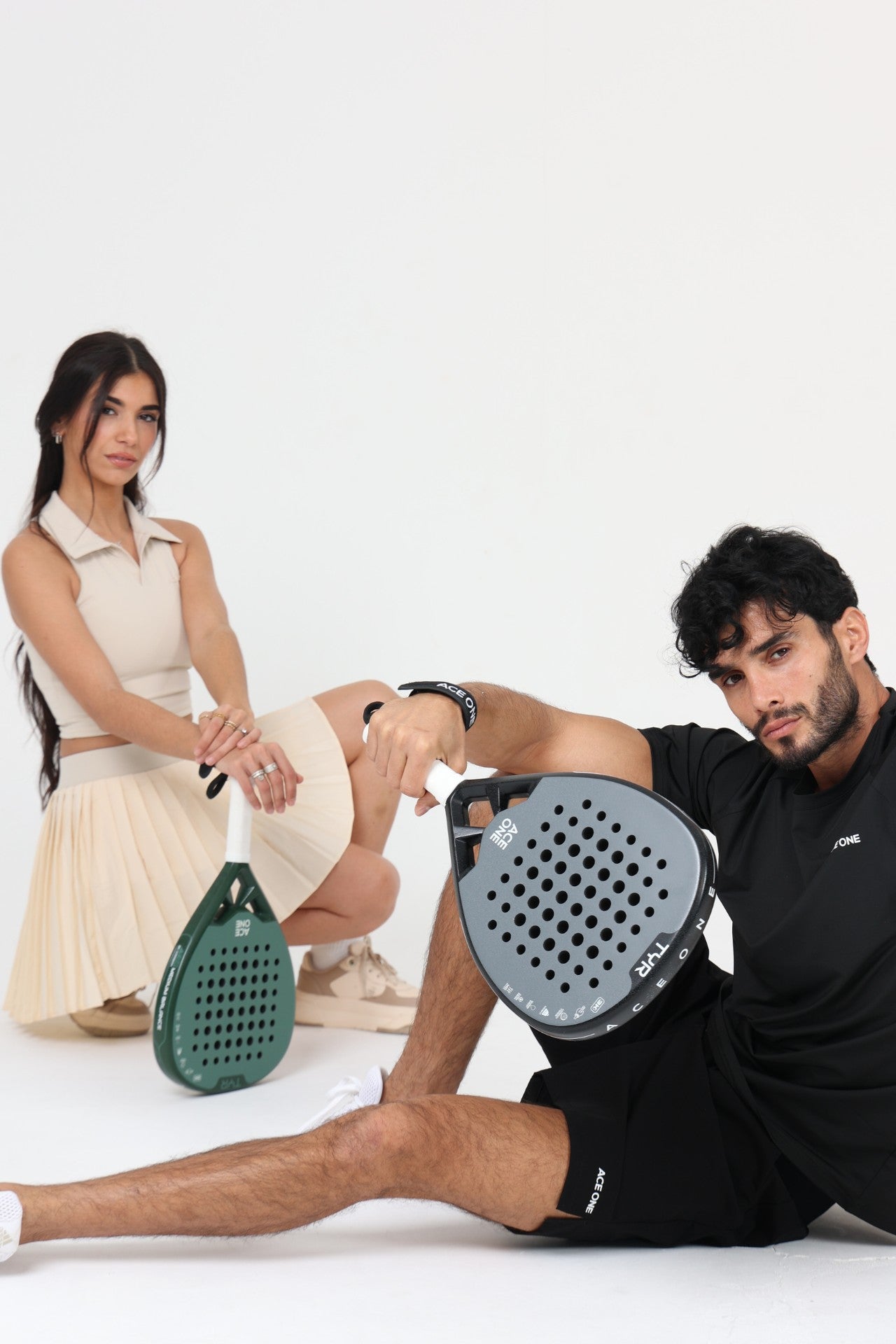
If you do not yet know which third ball you hit more often, that is your honest answer: TŸR. Most amateur points end with a transition-zone half-volley, not a net-zone finisher. Pick the racket that forgives the shot you actually take, not the one you wish you took. We covered the deeper trade-off in our 3K vs 12K carbon weave guide and how it interacts with weight in our weight and balance guide.
FAQ on third-ball execution
How fast should I move forward after my serve? As fast as you can while staying balanced. Two or three explosive steps to break the line, then a smooth jog into your split-step. Aim to be at the service line by the time the returner's racket is moving forward. You do not need to reach the net before the third ball, but you do need to reach a stopped position before contact.
What if the return goes to my partner instead of to me? Then your partner hits the third ball and you move with them. Same geometry applies. The non-hitting partner closes diagonally to take the cross-court angle away. The split-step still happens at the moment of opponent contact, as the volleyer's safety net.
Should I aim down the line or cross-court on the third-ball volley? Cross-court is statistically safer because the diagonal is the longest line on the court and the net is lowest at the center. Down-the-line works as a surprise weapon when the receiver leans cross-court early, but it is harder to keep low over the higher side of the net, and a poorly executed one feeds the closer opponent a shoulder-high ball.
Is the third ball the same shot as the bandeja? No. The bandeja is a defensive overhead from the back zone after a lob. The third ball is a transitional first volley from the front of the court while moving forward. Different geometry, different timing, different target. We broke down the bandeja in our bandeja technique guide and the back-glass defence in our back-glass guide.
The Ace One Padel Verdict
The third ball is not a shot. It is a position-decision. Your feet decide before your racket does, and your eyes decide before your feet. The pros do not hit better volleys than amateurs by a huge margin. They arrive at better positions, on time, and the cleaner volley follows for free.
If you fix one thing this week, fix the split-step. Stop the moment the returner's racket starts forward. The rest of your padel will reorganize itself around that single habit. The FIP coaching curriculum treats the split-step as a foundation block for a reason.
Stop before you hit. Hit before you decide. Decide before the ball does. Three steps, three shots, the third one is the one that matters.
Ready to upgrade the racket that does the work for you? The Cøre 12K Carbon finishes net-zone third balls. The TŸR line rescues transition-zone resets. Both are designed in France, assembled in Spain, and built for the third ball you actually hit on Saturday morning.
Share:
Premier Padel Asuncion P2 2026: 150-Point Race and a Returning Stupa-Lebron
Padel Weekly Training Plan: The 5-Day Rhythm That Actually Improves Amateurs (2026 Guide)