
You have played tennis for ten years. You walk onto a padel court for the first time, confident your forehand will do the talking. Forty minutes later you have lost to two players who cannot hit half as hard as you, and you are quietly furious. What just happened?
Padel looks like tennis shrunk and wrapped in glass, so most newcomers assume it plays like tennis too. It does not. The court is smaller, the racket is solid, the serve goes under your waist, and the back wall turns your biggest weapon into your opponent's easiest reply. This is the full padel vs tennis breakdown: what actually changes, why your tennis instincts backfire, and how to make the switch without losing every match for a month.
TL;DR
- Smaller, enclosed court: padel is 20 x 10 m versus a 23.77 x 10.97 m tennis doubles court, and the glass walls are in play.
- Different tools: a solid perforated racket up to 45.5 cm (no strings) versus a strung racket up to 73.66 cm, plus a slightly softer, lower-bouncing ball.
- Underarm serve: you bounce the ball and strike it at or below waist height, diagonally. No overhead bombs.
- Same scoring: 15-30-40-game, six games per set, win by two. Only the deuce format differs in 2026.
- The walls flip the game: raw power that wins in tennis often loses in padel, because hard shots rebound straight back. Control beats power.
Padel vs tennis at a glance
Both are racket sports played over a net on a rectangular court, and the scoreline reads the same. After that, almost every variable changes, which is why the two sports are run by separate bodies and the LTA's own padel vs tennis explainer treats them as cousins, not twins. Here is the side by side.
| Element | Padel | Tennis |
|---|---|---|
| Court size | 20 x 10 m (FIP) | 23.77 x 10.97 m doubles (ITF) |
| Enclosure | Glass and mesh walls, in play | Open, ball must stay inside the lines |
| Racket | Solid, perforated, up to 45.5 cm, no strings | Strung frame, up to 73.66 cm |
| Ball | Slightly smaller, about 10-11 PSI, lower bounce | Larger, about 14 PSI, higher bounce |
| Net height | 88 cm centre, 92 cm sides | 91.4 cm centre |
| Serve | Underarm, bounce first, at or below waist | Overhead, no bounce |
| Format | Doubles only | Singles or doubles |
| Scoring | 15-30-40, six games by two (deuce format varies in 2026) | 15-30-40, six games by two, advantage |
The court and the walls are the real difference
The dimensions matter, but the walls matter more. A tennis court, at the ITF standard of 23.77 by 10.97 metres, is open: if the ball leaves the lines, the point is over. A padel court, fixed by the International Padel Federation at 20 by 10 metres, is a glass and mesh box, and the back and side walls are part of the rally. After the ball bounces once on your floor, you can let it hit your own back glass and play it on the rebound.
This single rule rewrites the sport. In tennis, a deep, heavy ball pushes you back and often wins the point outright. In padel, that same heavy ball bounces off your back wall and comes back to you at a comfortable height, so you defend it calmly and reset the rally. Power does not end points the way it does on an open court. Patience, angles and placement do.
The smaller floor also means you and your partner cover roughly 77% of a tennis doubles court between two people, so positioning and communication carry more weight than footspeed. If you are coming from tennis, this is the hardest habit to unlearn: the instinct to hit through your opponent rather than around them.
Racket, ball and serve: three new tools
A tennis racket is a strung frame up to 73.66 cm long, built to generate and absorb pace through the string bed. A padel racket is a solid, perforated bat no longer than 45.5 cm, with no strings at all. It is shorter, thicker and far less powerful by design, because power is not the point. The padel ball is a close cousin of the tennis ball but slightly smaller and pressurised to roughly 10-11 PSI rather than 14, so it sits up a little less and lets you control the longer exchanges.

The serve is where tennis players give themselves away. There is no overhead serve in padel. You stand behind the service line, bounce the ball once, and strike it underarm at or below waist height, sending it diagonally into the opposite service box. The serve is a way to start the point fairly, not a weapon to end it. If you have spent years grooving a 180 km/h first serve, letting it go is a genuine mental adjustment, and a necessary one. Our full guide to the padel serve rules walks through the legal motion step by step.
Scoring is almost identical (with one 2026 twist)
Good news for tennis converts: you already know how to keep score. Padel uses the same 15-30-40-game count, the same six games to win a set by two, and the same tie-break logic. The only meaningful difference sits at deuce. As of the 2026 FIP update, a padel match can be played with classic Advantage, with the new Star Point, or with the Golden Point sudden-death format, depending on the competition. The Premier Padel circuit has kept traditional Advantage. We break down exactly how each option works in our padel scoring rules guide.
So the scoreboard is familiar, but the rhythm that gets you there is not. Tennis points are often won in three or four shots. Padel points routinely run to ten, fifteen or twenty, because the walls keep the ball alive. You are not chasing a quick winner, you are constructing a position.
The power trap: why tennis instincts backfire
Here is the single most expensive mistake a tennis player makes on a padel court, and it has a name: the power trap. The belief is simple and wrong. "I hit hard, so I will dominate." On an enclosed court, the harder you hit a flat ball, the faster it returns off the back glass to a well-positioned opponent. Pace becomes a gift to the other team.
The fix is not to abandon everything you know. It is to repoint it. Tennis gives you clean contact, good footwork and shot tolerance, all of which transfer beautifully. What does not transfer is the assumption that the rally ends when you hit your best shot. In padel, your best shot is usually the one that puts your opponents in an awkward position, not the one that travels fastest.
If you are making the switch, here is the short version of how to stop losing to placement players.
- Shorten your swing. Trade the full tennis backswing for a compact, blocked contact. The court is too small for a big take-back.
- Learn to use the back wall. Let the ball pass you, read the rebound, and play it on the way back. This is the skill that separates beginners from improvers.
- Win the net, do not bomb from the back. The team controlling the net wins most padel points. Build toward it with the lob and the volley, not with flat drives.
- Pick a forgiving, control-first racket. A soft, high-tolerance frame helps you place the ball instead of fighting it while your touch develops.
That last point is where gear actually helps. A stiff, powerful 12K carbon frame suits an attacking competitor who already generates control. A new switcher is far better served by a soft, forgiving 3K carbon racket with a long dwell time, which is precisely the brief our how to choose a padel racket guide lays out in full.
The Ace One Padel Verdict
Padel is not tennis with walls. It is a placement game wearing a racket sport's clothes. The court is smaller, the racket is softer, the serve is gentler, and the glass behind you forgives the opponent's power and punishes your own. That is not a downgrade from tennis, it is a different problem to solve, and it is why a 65-year-old with great hands can beat a 25-year-old with a huge forehand.
For tennis players, the message is short: keep your footwork, lose your ego, and respect the wall. For total beginners, padel is the easier and friendlier door into racket sport, because the rallies last longer, the serve is simple, and the court rewards thinking over thumping.
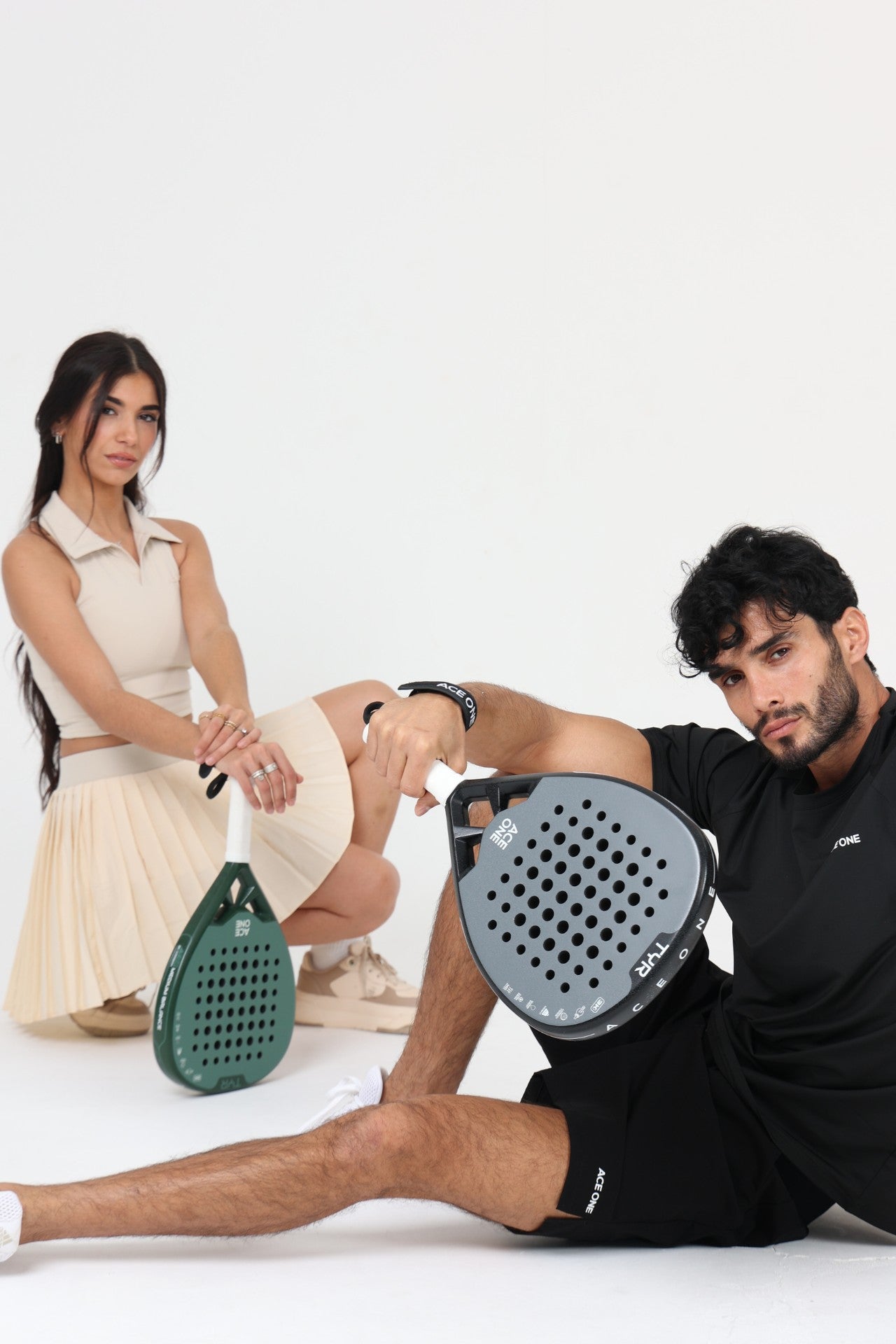
At Ace One Padel, we have built the TŸR for exactly this player: 3K carbon and a Soft EVA core that absorbs vibration, lengthens contact and forgives the mishits you will make while you learn the walls. It is the control-first racket that lets placement, not power, do the work. Browse the full Ace One Padel racket range to find the colourway that fits your game.
Power wins tennis points. Position wins padel points. Once that clicks, you will stop being furious at the player who hits half as hard, and start becoming them.
Share:
Padel Shoes Decoded: How to Match Your Sole to the Court and When to Replace It (2026 Guide)