
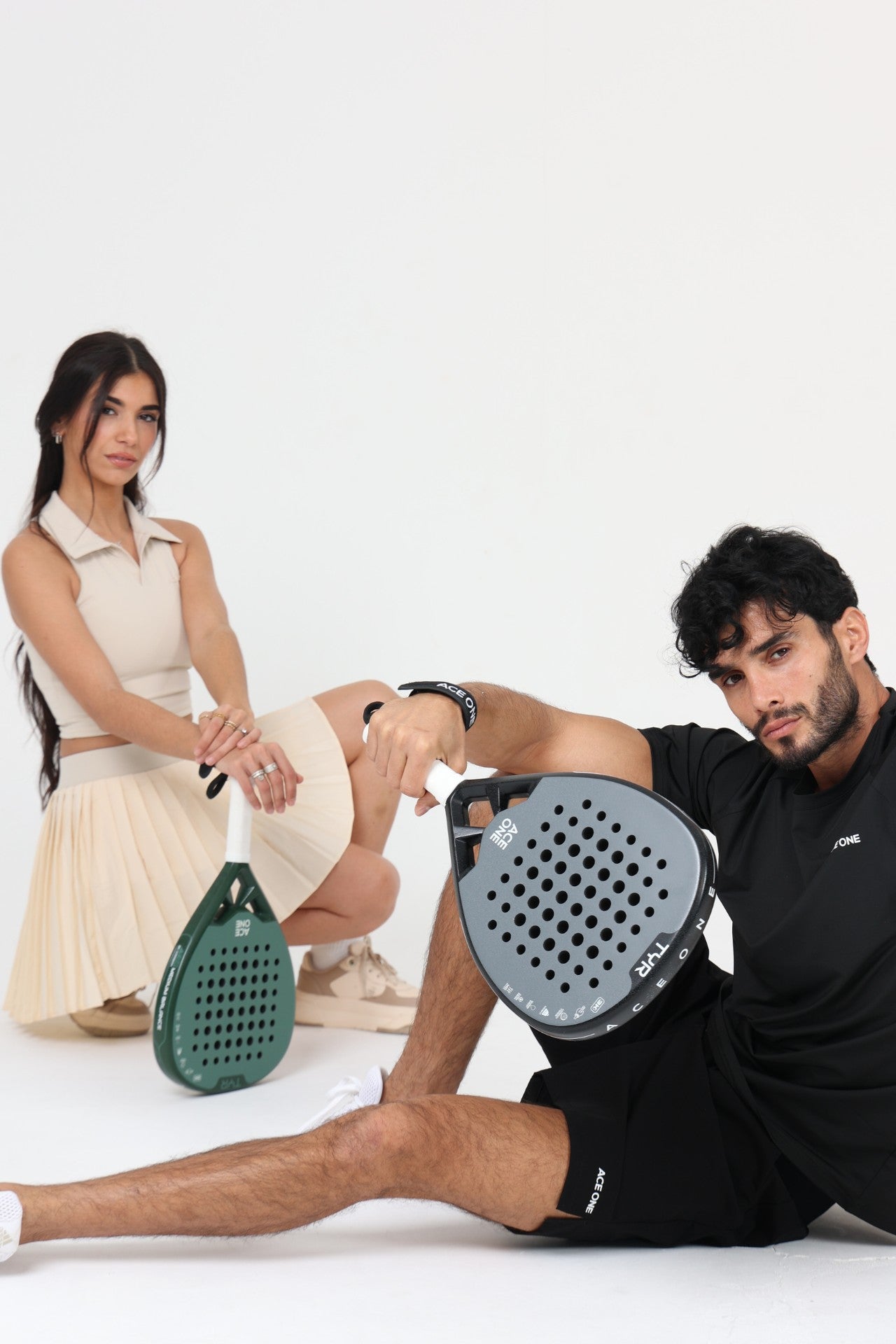
Two padel rackets sit on the wall. Same brand tier, same weave, both stamped 365 g. You pick up the first and it swings like a scalpel. You pick up the second and it feels like a hammer. Same weight, completely different sport. The thing that changed is not how heavy the racket is. It is where that weight lives, and that single number is called balance.
Most buyers obsess over grams and ignore balance, which is backwards. Balance decides whether a racket plays for power or control, and it is quietly the most decisive property on the wall. This guide breaks down head-heavy, even and head-light balance, shows you the real measured range from a 137-racket study, and gives you a simple way to pick the balance that fits your game.
TL;DR
- Balance is where the weight lives: the distance in millimetres from the butt to the racket's balance point, not how heavy it is.
- Head-heavy = power, head-light = control: high balance loads the top for smashes, low balance keeps the racket fast and forgiving at the net.
- Real range is tight: a study of 137 rackets measured balance points from 246 mm to 283 mm, averaging about 266 mm. A few millimetres change everything.
- Balance is not weight or swingweight: three different specs people confuse. The one that decides feel, the moment of inertia, is the one most makers never print.
- Most amateurs over-buy power: chasing head-heavy for "more pop" is the classic trap that costs you the net game and strains your arm.
What padel racket balance actually means
Balance is brutally simple to picture. Rest a racket flat across one finger and slide it until it sits level. The point where it balances is the balance point, and the spec is just the distance from the butt of the handle to that point, measured in millimetres.
The closer that point sits to the head, the higher the number and the more head-heavy the racket. The closer it sits to your hand, the lower the number and the more head-light it feels. That is the whole concept. What surprises most players is how small the window is.
A peer-reviewed study from the Universitat Politècnica de València measured 137 padel rackets and found balance points ranging from 246 mm to 283 mm, with an average of roughly 266 mm (Blanes et al., 2022, Sensors). That is a spread of under four centimetres across the entire market. Shift the balance point by ten millimetres and a racket that swung like a wand starts to swing like a club. Balance is a precision spec hiding inside a small range.
The three balance profiles, and who they suit
Balance sorts rackets into three families. None of them is "better". Each one trades the same currency: power for the head, or control and speed for the hand.
| Balance | Typical range | What it gives you | The cost | Usual shape |
|---|---|---|---|---|
| Head-light | Low, near the hand | Fast hands at the net, big central sweet spot, forgiving, easy on the arm | You supply the power yourself | Round |
| Even | Middle, around the average | All-court compromise, manageable in defence, useful pop | Master of none by design | Teardrop |
| Head-heavy | High, near the top | Free power on smashes and volleys, a high sweet spot that punishes the ball | Slow to position, smaller sweet spot, more wrist and elbow load | Diamond |
The shape column is not a coincidence. A diamond pushes material toward the top of the face, so the balance point climbs and the sweet spot sits high. A round frame keeps mass low and central, so the racket stays head-light and forgiving. If you want the full story on moulds, our padel racket shape guide breaks down round, teardrop and diamond in detail. Balance is the number behind the silhouette.
This is also where the Ace One Padel range lines up cleanly. The Cøre 12K Carbon sits on the firmer, power end of the spectrum: a stiffer 12K layup that rewards a player who already swings fast and wants the racket to add weight behind the smash. The TŸR, with its softer 3K weave and longer dwell, leans toward the control side that pairs naturally with a lower, more forgiving balance.

Balance is not weight, and it is not swingweight
Here is where most buyers get lost, because three different specs all sound the same and get used interchangeably. They are not the same thing.
- Weight is how heavy the racket is, full stop. Measured in grams. See our padel racket weight guide.
- Balance is where that weight lives, measured in millimetres from the butt.
- Swingweight is how heavy the racket feels when you actually swing it. Physicists call it the moment of inertia. See our guide to swingweight.
Two rackets can share the same weight and the same balance and still feel different to swing, because swingweight depends on how the mass is spread, not just where its centre sits. That is the property the human arm reads as "heavy" or "fast". And here is the uncomfortable part: the same study that measured those 137 rackets points out that hardly any manufacturer specifies the moment of inertia, even though it is the property players care about most. The single most decisive spec is the one that almost never makes it onto the box.
So balance is your best public proxy. It is printed far more often than swingweight, and it correlates strongly with how a racket will play. Read balance first, then confirm the feel with your own arm before you buy.
The head-heavy trap
The most common mistake on the wall is simple to describe: an improving amateur reaches for the most head-heavy racket they can find because head-heavy means power, and power sounds like progress. Then three things happen.
First, the net game suffers. A head-heavy racket is slower to bring up and reset, so in fast hands exchanges you arrive late and get jammed. Second, the sweet spot moved up and shrank, so your off-centre hits, which is most of them under pressure, lose more energy. Third, the extra leverage at the top loads the wrist and elbow on every swing, which is how a fun hobby turns into a nagging tendon problem.
Head-heavy is not a flaw. It is a tool for a player who already has fast hands, clean contact and a smash they want to weaponise. For everyone still building those, a lower balance buys more good shots per match than a head-heavy frame ever will. This is the same honest message behind the 3K versus 12K decision: more demanding gear only pays off once your technique can cash the cheque.

How to choose your balance
Match the balance to your honest game, not the game you want on your best day.
- Beginner or returning player: go head-light or even. You want forgiveness, fast hands and a racket that protects your elbow while you build technique.
- Improving amateur, control-first: even balance. It defends well, keeps the net game sharp and still offers usable power.
- Strong intermediate with a real smash: a higher, head-heavy balance starts to pay off, especially if you finish points from the back glass.
- Sensitive elbow or shoulder, any level: bias lower. Less leverage at the top means less load on the joint.
For whom head-heavy is worth it: advanced players with clean contact, fast hands and an aggressive finishing game who want the racket to add free weight to the smash.
For whom it is not: beginners, control players, anyone with arm niggles, and the large group of amateurs who play more net exchanges than highlight-reel smashes. For them, lower balance is not a compromise. It is the upgrade.
Whatever you land on, start your shortlist from a range built for progression rather than ego. Our padel rackets collection is balanced toward control and comfort for exactly this reason.
The Ace One Padel Verdict
At Ace One Padel, we have weighed and swung enough rackets to be blunt: the grams on the box are the least interesting number, and balance is the most. Weight tells you what the racket is. Balance tells you what it does.
Buy the balance your game can carry today, not the one your ego wants. Head-heavy is borrowed power that charges interest in missed volleys and tired tendons. Head-light is patient power you build yourself, and it ages with you. Read the millimetres. Trust your arm. Skip the grams.
Frequently asked questions
What is a good balance for a padel racket?
There is no universal number, but most amateurs are best served by a head-light or even balance, roughly in the lower half of the 246 mm to 283 mm range that real rackets occupy. It keeps the racket fast at the net, forgiving on mishits and easier on the arm. Reserve head-heavy for advanced players with a genuine attacking game.
Is head-heavy or head-light better for beginners?
Head-light, almost always. Beginners benefit from a bigger sweet spot, quicker hands and lower joint load, all of which a lower balance provides. Head-heavy rewards power you cannot yet generate cleanly and punishes the off-centre contact that beginners make most often.
Does balance matter more than weight?
For how a racket plays, usually yes. Two rackets at the same weight can feel like different sports depending on where that weight sits. Weight sets the broad effort level, but balance, and the swingweight it hints at, decides whether the racket plays for power or control.
How do I find my racket's balance point at home?
Rest the racket across one finger and slide it until it sits perfectly level. Mark that spot, then measure the distance from the butt of the handle to the mark in millimetres. That number is your balance point. Compare it to the 246 mm to 283 mm market range to see where your racket sits.
Sources and further reading: Blanes, Correcher, Beltrán and Mellado, "Identifying the Inertial Properties of a Padel Racket," Sensors, 2022 (peer-reviewed, 137 rackets); and the physics of moment of inertia.
Share:
Rough vs Smooth Padel Rackets: Does Surface Roughness Really Add Spin? (2026)
The Padel Chiquita: How the Slowest Shot in the Game Wins You the Net (2026 Guide)