
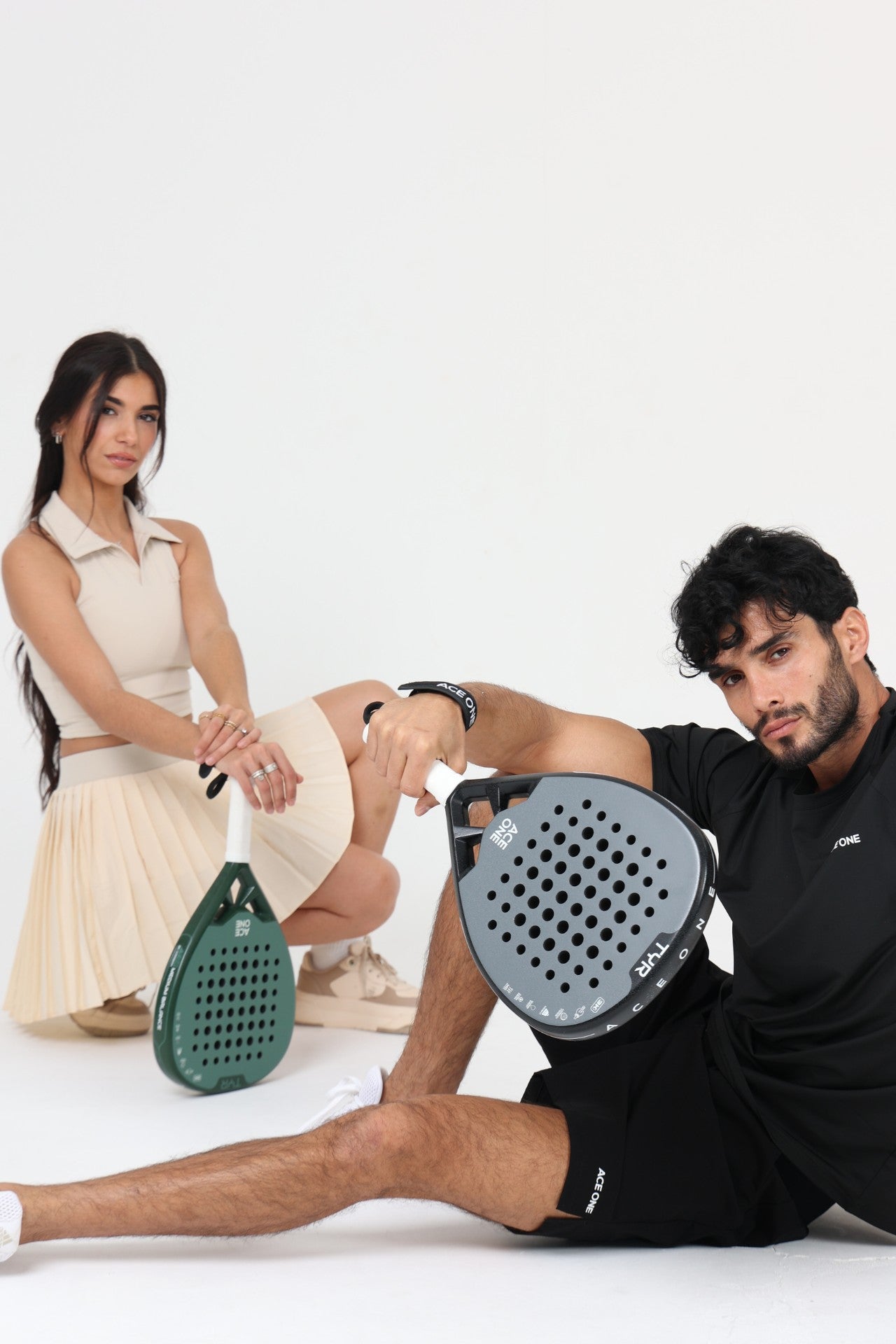
You park at the club at 7:50 a.m. The court reads 11°C. Your tank top is in the bag, so is the jacket. Forty minutes later the sun crosses the canopy and the court reads 23°C. Your sleeves are too warm. You sit down between games to peel the layer off, the wristband velcro catches on the cuff, and the rhythm you had at 8:00 is gone for two games.
That is a layering failure, not a wardrobe failure. The women's padel outfit is not one piece. It is a three-layer system that scales from a 10°C warm-up to a 25°C closing set, without sitting down to undress, without the skort riding up, and without the technical tank that wicked sweat at 8:00 turning into a wet sponge by 9:30.
At Ace One Padel, we have spent two seasons stress-testing the activewear our female members actually wear. This guide names the three layers, the fabric maths behind each, the on-court swap order that does not break your serve clock, and the layering trap that costs intermediates two games every spring morning.
TL;DR
- Three layers, not three outfits: base tank (skin), insulating mid-layer (warm-up), shell or quarter-zip (pre-match). One bottom, the skort, stays on all session.
- Fabric maths: polyester 80-90% + elastane 10-20% on the base, polyester+spandex with four-way stretch on the bottom. Cotton on the base is the single biggest comfort mistake.
- The swap window: peel the mid-layer at +14°C above your starting temp, not at the first bead of sweat. Mid-game changeover (90 seconds) is your gate, not the warm-up.
- Skort beats shorts and skirts: built-in compression short stays in place on lunges, the outer skirt vents heat, the waistband sits under the navel and does not roll on the bandeja split.
- Three traps to avoid: cotton base, no mid-layer for cold mornings, and a high-neck top in summer indoor halls. Each one costs two games before you notice.
Why padel apparel is layered differently from tennis
Tennis is a baseline sport: forward and back, long sweat bursts, open court. Padel is a cage sport with overhead motion every second point. You lunge into the back glass, you split-step at the net, you reach above the shoulder for a bandeja, all inside a 20m by 10m enclosed space that traps body heat faster than an open court.
The brief that follows, confirmed across multiple independent women's padel apparel guides: a polyester-dominant blend with 10-20% elastane for four-way stretch, with the elastane percentage hitting the upper band when overhead motion dominates. Cotton, even pre-shrunk, becomes saturated in 12-18 minutes of cage humidity and stops wicking. The second-set drop in comfort is almost always a base-layer fabric problem, not a fatigue problem.

The three-layer kit, named
Forget "summer outfit" and "winter outfit". Padel sessions cross both inside the same 90 minutes. The frame that works is three layers, each with one job, each with a moment in the session where it earns its place.
Layer 1: the base tank or short-sleeve performance top
This is the layer that stays on for every minute of every game. It does the wicking. A racerback or wide-strap cut is the default because it frees the shoulder for the volley and the bandeja, and it removes the strap-shift problem you get with thin spaghetti straps when the racket arm extends overhead.
Pick it for fit first, fabric second, color third. A black tank stays visually consistent across the three colors of skort you might rotate; a beige tank pairs back to a wider range of mid-layers. Pick once and let it anchor the rotation.
Layer 2: the mid-layer (lightweight long-sleeve, half-zip or stretch hoodie)
This is the warm-up layer. It goes on in the parking lot, it stays on through the first three minutes of knock-up, and it comes off at the first changeover when core temperature has crossed the threshold. The defining feature is the zip: a quarter-zip vents the top of the chest without removing the layer; a half-zip peels to the waist between games without touching the skort waistband; a stretch hoodie works if the hood is light enough that it does not flap on the bandeja split.
Layer 3: the outer shell or windbreaker
The optional layer, for outdoor courts under 14°C, removed before the first ball. Its only job is to keep wind off the shoulders while you are static (between games, during opponent serve setups). Never wear the outer shell during a point. The trapped heat builds in 90 seconds of cage humidity and you finish the game sweat-saturated.
The bottom: why skort beats every alternative
The skort, an athletic skirt with a built-in compression short underneath, is the foundation of the women's padel kit for three reasons. The compression short stays in place on the lunge to the back glass: a loose short rides up, a skirt without a short flips on the split-step, leggings restrict the lateral hip rotation needed for bandeja recovery. The skort solves all three because the inner short sits flat under the skirt.
The outer skirt vents heat. The space between skirt and short is a low-volume airflow channel, dropping thigh-front temperature by 1.5 to 2°C versus a skin-on legging. The waistband sits below the navel and does not roll on the bandeja split-step.

The 5-row layering table by court condition
Read this table once before the season, then once every Friday for the Saturday morning weather. Each row is a layering recipe calibrated to a real condition you will face on a European padel court between October and June.
| Condition | Base (Layer 1) | Mid (Layer 2) | Outer (Layer 3) | Bottom |
|---|---|---|---|---|
| Indoor heated (18-22°C) | Performance tank, racerback | None | None | Skort |
| Indoor unheated (15-18°C) | Performance tank or short-sleeve | Quarter-zip for warm-up only | None | Skort |
| Outdoor mild (15-22°C) | Performance tank or high-neck tank | Light long-sleeve, peel by game 2 | None | Skort |
| Outdoor cool (8-14°C) | High-neck tank or short-sleeve | Half-zip or stretch hoodie | Lightweight windbreaker, off before serve | Skort over thin tights optional |
| Outdoor hot (over 25°C) | Lightweight tank, racerback, mesh panel | None | None (sun cap optional) | Skort (lightest color) |
The fabric brief: what actually wicks, what only claims to
Four numbers separate a real performance fabric from a marketing tank. All four are on the inside label.
- Polyester 80-90%. The synthetic backbone that wicks. Below 70% and the wicking drops; above 95% and the stretch is gone.
- Elastane 10-20%. The stretch component. 10% is the floor for four-way stretch on the racerback cut; 20% is the ceiling for compression-fit tops worn under a mid-layer.
- Mesh panels in the underarm, back and side. Visible on the garment, not always on the label. Adds 30 to 40% extra ventilation in high-sweat zones without weight.
- Cotton percentage. Cap at 5%. Anything more and the second-set comfort drops measurably.
One exception: a high-cotton (40-60%) blend works for outdoor sessions over 28°C in dry-heat regions (Andalusia, southern Italy) because cotton holds water and acts as an evaporative cooler. It does not work in cage humidity at 15-20°C, which is most of European padel from October to April. Default to the polyester-dominant brief.
The wrong-layer trap: three mistakes that cost two games
Layering is not a recipe of products. It is a sequence of decisions, each with a fail state. Three traps account for 80% of the on-court comfort complaints we hear during cold-morning to warm-afternoon sessions.
Trap 1: cotton on the base layer
Cotton feels soft in the parking lot. Cotton becomes a wet sponge by game 6. Every coaching source we triangulated agrees: cotton on the skin layer is the single biggest comfort mistake in women's padel apparel. The fix is a polyester-dominant tank with 10-20% elastane, full stop.
Trap 2: no mid-layer for the cold morning warm-up
The temptation on a 12°C morning is to start in the tank only because you know you will sweat in 20 minutes. The cost is a stiff cold shoulder on the first three bandejas. The shoulder needs 8-12 minutes at body temperature to extend properly; without the mid-layer, the warm-up phase is wasted compensating for cold tissue. Wear it for three minutes of knock-up, peel it at the first changeover. The principle is the same as the Padel School warm-up routine teaches its members: cold tissue extends slowly, and the mid-layer's job is to buy the eight minutes the rotator cuff needs.
Trap 3: a high-neck top in a summer indoor hall
The high-neck tank is a cool-season piece. In a heated indoor hall in July, the neck closure traps heat that wants to leave through the upper chest, and you finish the first set 0.5 to 1°C warmer than a teammate in a low-cut racerback. The high-neck has a place (cool mornings, outdoor courts under 18°C), not a 22°C indoor August session.

The 90-second swap protocol
The reason layered systems fail is not the layers, it is the swap. Swapping mid-game costs focus for three points, costs your partner a beat of rhythm, and costs your serve clock if it happens at deuce. The protocol that works is built around the 90-second changeover at odd games.
At game 1-0, sit down, sip water, feel your core. A single bead of sweat on the sternum or lower back means the mid-layer comes off at the next break, not now. At game 2-1, peel the mid-layer: quarter-zip down first, sleeves off second, fold on the bench. 35-45 seconds for a quarter-zip, 60 seconds for a stretch hoodie, both inside the 90-second window. At game 4-3, re-evaluate. If the core is still cool, re-zip for the changeover only and peel before the first point. If warm, do nothing.
The cost of getting this wrong is two games. The cost of getting it right is one fluent session where you never sit down feeling either cold or sweat-saturated.
The kit-bridge: how layering maps to the Ace One catalog
The three-layer brief is product-agnostic, but for the women playing in our racket setups the mapping is direct. Each role and condition pairs to a specific piece in the Women's activewear collection.
- Indoor heated default: the Active Tank Top Black as Layer 1 + the Pleated Skort Black as bottom. One color story, fits every condition above 15°C.
- Outdoor cool morning: the High-Neck Tank Beige + personal mid-layer + the Skort Beige.
- Summer dry-heat sessions: the Tank Top Beige (light color reflects heat) + the Skort Blue.
- Tournament weekends: pair the activewear with your frame. A right-side constructor playing patient bandejas pairs to a TŸR 3K racket (longer dwell complements the conserved-energy brief); a left-side finisher pairs to the Cøre 12K (rigid head converts the freed shoulder of a racerback into clean overhead power).
Building a complete kit from scratch: the Pack Performance bundle handles the equipment (racket, three overgrips, bag); activewear is bought separately because color and fit are personal.
Frequently asked questions about women's padel layering
What fabric is best for a women's padel top?
Polyester 80-90% blended with elastane 10-20%. The polyester wicks sweat, the elastane provides four-way stretch for overhead motion, and mesh panels in the underarm and back add 30-40% extra ventilation. Cotton on the base layer saturates in 12-18 minutes of cage humidity and stops wicking.
Should I wear a sports bra under a padel tank?
Yes. A medium-impact sports bra is the right level for padel: upper-body motion is more lateral than vertical, but overhead motion still creates impact loading. Same fabric brief as the tank (polyester-dominant, 10-20% elastane). A high-impact running bra is over-spec and can restrict the chest expansion needed on the bandeja recovery breath.
Skort or leggings for padel?
Skort by default. Leggings work for outdoor cool sessions under 14°C as a single layer or under a skort for added warmth, but the skort vents heat better and the built-in compression short stays in place on the lunge to the back glass.
Can I wear a tennis outfit for padel?
Almost. Tennis tops and skorts share the fabric brief, but padel-specific tops cut the underarm slightly deeper to free the shoulder for the bandeja and víbora overhead motion. A tennis kit will work for occasional padel; for three or more sessions a week, a padel-specific tank is worth the swap.
How often should I replace my women's padel tank?
A polyester-dominant tank washed correctly (cold cycle, no fabric softener, air dry) lasts 200-300 wears before wicking drops measurably. Roughly 18-24 months for two to three sessions a week. The first sign is a tank that feels damp on the lower back after 20 minutes where it used to feel dry.
The Ace One Padel verdict
The women's padel outfit is not one piece. It is three layers on top, one piece on the bottom, and a swap protocol that runs at the changeover. The base tank is the only piece you cannot change mid-session, so pick it for fabric first. The skort handles cage lunges and waistband roll without compromise, so pick it over shorts and leggings. The mid-layer is the warm-up layer and comes off at the second changeover, never during a point.
The outfit that wins is not the one that looks the most coordinated on court. It is the one that lets you forget what you are wearing by game three.
Pack for the cold morning. Pack for the warm afternoon. Pack for the swap that takes ninety seconds.
Share:
How to Install a Padel Frame Protector: The 7-Step Heat Method (and Three Mistakes That Strip It in Two Weeks) (2026 Guide)
BNL Italy Major 2026: How Foro Italico Decides the Race to Barcelona Before It Even Reaches Madrid