
You are 2-4 down, glued to the back glass, opponents camped at the net. A high ball floats toward you and something says go big, hit through them, end this. So you flatten a drive into the smallest gap on the court, it clips the tape, and the point is theirs.
Here is the uncomfortable truth about how to defend in padel: from the back of the court, trying to win is how you lose. Defense is not a heroic get or a screaming counter. It is a job with one deliverable, and the professional data is blunt about what that deliverable is.
TL;DR
- Defense has one goal: not to win the point, but to win back the net. Points are decided up front, not from the fence.
- The lob is the escape hatch: in pro finals it was 85.4% of all defensive shots and flipped the pair back into attack 70.4% of the time.
- Deep beats hard: a lob that lands in the last metre buys you time and pushes opponents off the net. A short lob invites a smash.
- Use the glass, do not fight it: let the ball rebound, take it low and late, and answer with height.
- Move as a pair: survive, neutralise, then advance together the moment your lob goes deep.
Defense in padel is not what you think it is
Most players picture defense as spectacular: the diving retrieve, the ball scraped off the back wall and threaded past two opponents. That highlight reel is a trap. It teaches you to value the wrong outcome.
Look at what actually separates winners from losers at the top level. A study of 532 World Padel Tour matches (1,070 sets from 2016 to 2019) found that the pairs who won were distinguished by their smash winners, volley winners, groundstroke winners and break points, and by making fewer errors (Sánchez-Alcaraz et al., published in the International Journal of Environmental Research and Public Health). Almost every one of those decisive shots is played from the net or on the way to it. None of them are hit from the back fence.
The lesson writes itself. The net is where points are won, so the back of the court is not where you try to win them. When you are pinned deep, your objective is not to end the rally. It is to survive it and buy your way forward. Once you accept that, the panic drains out of back-court play, and you start solving a much simpler question: what one shot gets me and my partner back to the net?
The one shot that gets you out: the lob
The answer, measured on the best players in the world, is the lob. Researchers analysed 1,324 defensive actions across 14 women's World Padel Tour finals and the pattern was overwhelming (Escudero-Tena et al., IJERPH, 2020):
- The lob was 85.4% of every shot hit from the defensive position. Not a tool among many. The tool.
- 79.5% of those lobs were valid, meaning they stayed in play and kept the rally alive.
- 70.4% of the time, the lob let the defending pair recover the offensive position and move up to the net.
Every other defensive shot did the opposite. In the statistics, non-lob replies from the back were strongly associated with staying stuck in defense. The lob was the only stroke that reliably reversed the situation. Roughly seven deep lobs out of ten handed the initiative back to the pair who, a second earlier, were on the ropes.
This is measured on women's professional finals, where rallies are long and the tactical patterns are cleanest. Men's play leans a little more on volleys, but the core principle holds across the game: when you are stuck deep, the deep lob is what gets you unstuck. Everything else is a coin flip you usually lose.
How to hit the escape lob
A defensive lob is a precision shot disguised as a soft one. Height without depth is a gift-wrapped smash. Depth without height gets picked off as a volley. You need both, under pressure, off an awkward bounce. Here is the checklist that makes it repeatable:
- Aim for the last metre. Your target is the back glass, not the service line. A lob that forces opponents to turn and chase toward their own back wall cannot be smashed cleanly.
- Height buys time. The higher the arc, the longer you and your partner have to climb back up the court. Think of altitude as seconds on the clock.
- Open the face, brush up. Contact under the ball with a relaxed grip and lift. You are carrying the ball upward, not hitting through it.
- Favour the backhand corner. Most players smash weaker from their backhand side. A cross-court lob to that corner buys the most margin.
- Reset your feet first. A lob hit off-balance floats short. Split, let the ball drop into your strike zone, then lift.
The frame in your hand matters more here than anywhere else on the court. A defensive lob is a touch shot: you are absorbing incoming pace and re-releasing it as controlled height. A softer, more flexible racket gives you a longer dwell time on the strings and a larger forgiving zone when you are stretched and late, which on defense is most of the time.

Read the back glass, do not fight it
Amateurs treat the wall as an enemy. Good defenders treat it as a second chance. When a ball flies past you toward the back glass, resist the urge to take it out of the air in a panic. Let it come off the wall, and it becomes slower, lower and far more predictable.
The rhythm is simple: turn your shoulders as the ball passes, track it onto the glass, wait, and take it late and low as it rebounds into your strike zone. Trusting the rebound buys the extra half-second that turns a scramble into a clean escape. If glass play is new to you, our padel back-glass technique guide breaks the footwork down step by step.
The three-step escape: survive, neutralise, advance
Getting back to the net is a sequence, not a single swing. Rush it and you get passed on the way up. Run it in order and you arrive together, balanced, and ready to volley.
- Survive. Get the ball back safely, ideally with a deep lob. Do not gamble. A ball in play keeps the point alive and keeps the pressure on them to execute.
- Neutralise. A good deep lob forces your opponents off the net or drags out a weak reply. Watch for the tell: they back up, they let a ball bounce, they hit up instead of down. That is your green light.
- Advance. Move forward together, as a wall of two, the instant your lob goes deep. One player up and one player back is the most exploited weakness in amateur padel. Climb as a pair or do not climb at all.
Position is a team decision. If you drift up while your partner stays pinned, the diagonal gap between you becomes a highway. For the full picture of where each player should stand as you transition, see our guide to padel net-zone positioning, and once you have reclaimed the net, how to win the net in padel takes over.
When not to lob (the honest exceptions)
The lob is the default, not the only answer. Blindly lobbing every ball turns you into a metronome the other pair will eventually solve. Three moments call for something else:
- A slow, low ball you can meet moving forward. If a soft ball lets you step in, a controlled counter-volley or a chiquita at the opponents' feet is stronger than retreating for a lob. Taking it early steals their time.
- An opponent visibly out of position. If one of them is scrambling or has drifted wide, a firm drive into the vacated space can end it. This is the exception the data allows, not the habit it warns against.
- A short, sitting ball above net height. That is not a defensive situation anymore. Step up and attack it.
Read the difference and you graduate from "always lob" to "lob until they give me something better." The mechanics of the lob itself and the smash you are trying to avoid feeding are both worth studying alongside this framework.
Good lob versus bad lob, at a glance
| Factor | Escape lob (do this) | Trap lob (avoid) |
|---|---|---|
| Depth | Lands in the last metre, near the back glass | Drops around the service line, smash height |
| Height | High enough to buy time to advance | Flat and fast, easy to volley away |
| Target | The backhand corner | Straight down the middle to the forehand |
| Intent | Reset the point, climb as a pair | Win it outright from the fence |
| Body | Balanced, feet set, ball in strike zone | Stretched, off-balance, rushed |
Gear for defense: control first, then the finish
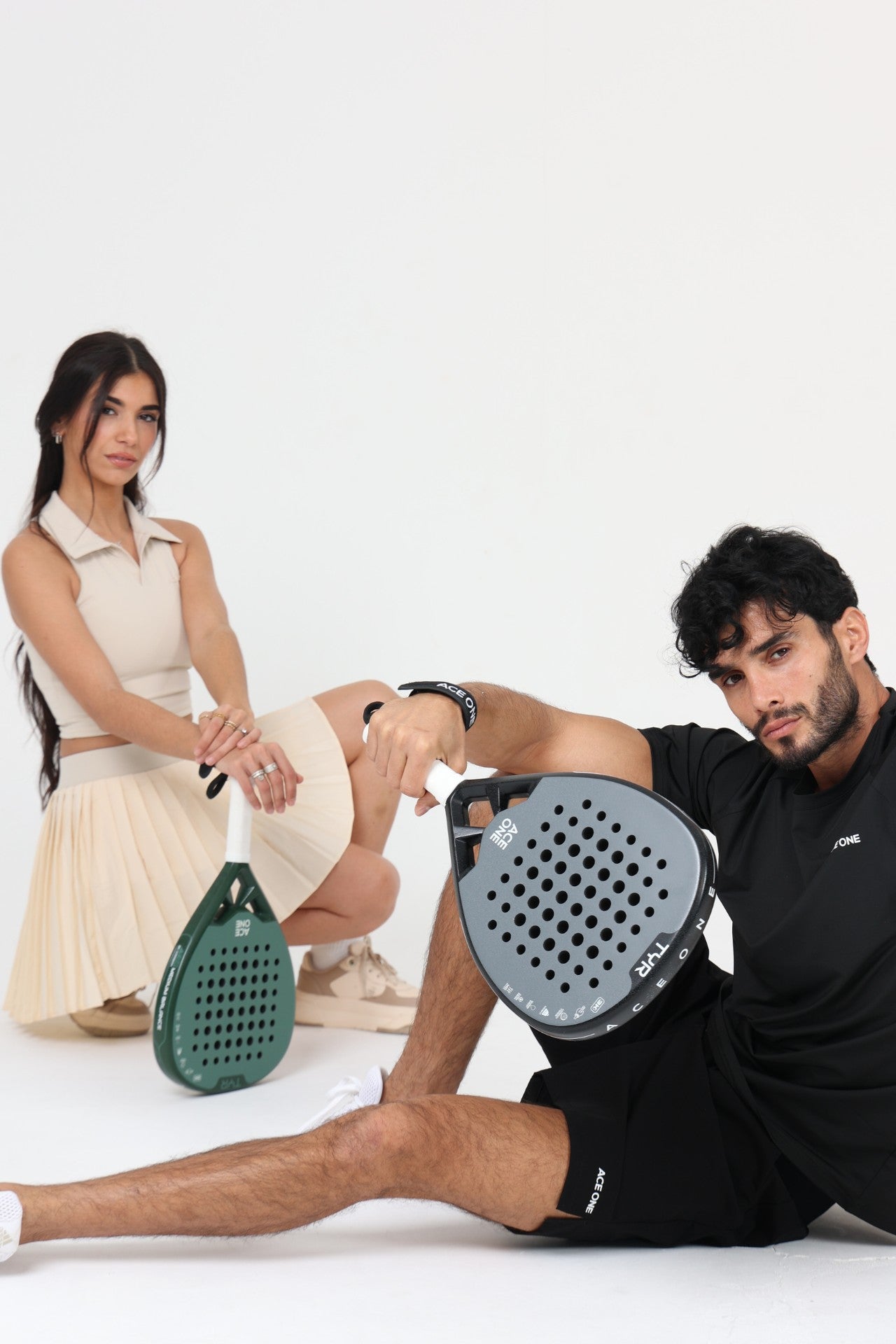
Defense is a touch game, so the racket you defend with should reward feel, not raw power. A frame built around a softer core and a flexible lay-up gives you a longer contact time and a more forgiving sweet zone, exactly what you want when you are lifting a lob off a low, late ball near the glass. That is the case for the TŸR (3K carbon and Soft EVA): comfort, control and tolerance on the shots you hit under pressure.

The honest caveat: none of this means a control racket is "better." The lob gets you back to the net, but the point is still won up front with a volley or a smash, and there a stiffer, more explosive frame like the Cøre 12K carbon pays off. Most players defend far more than they finish, so if you are picking one frame, favour the one that makes your escape lob reliable. Choose for the shots you actually hit most.
The Ace One Padel Verdict
Defending in padel is not a fight you win with your arm. It is a job you finish with your patience. The professional record is clear: from the back, the lob is not one option among many, it is the option, chosen 85% of the time and buying back the net 7 times in 10. Everything glamorous about defense, the diving get and the impossible pass, is what happens when the boring deep lob was not there.
So the next time you are pinned and the ball floats up, silence the voice that says end it. Lift a deep lob to the backhand corner, watch them back up, and walk forward with your partner. Do that on repeat and you turn defense into the thing that wins you the net, and the net into the thing that wins you the match.
At Ace One Padel, we have broken down the shots that get you out of trouble and the frames that make them repeatable. When you are ready to defend like the point depends on it, because it does, start with the racket that rewards touch: explore the Ace One Padel racket range.
Share:
Common Padel Mistakes: The 6 That Quietly Cost Beginners Every Match (2026 Guide)
Padel Court Lines Explained: When Is the Ball Actually In or Out? (2026 Guide)